🍷 Which Glass Will Be Filled Last? Can You Solve This Tricky Puzzle?
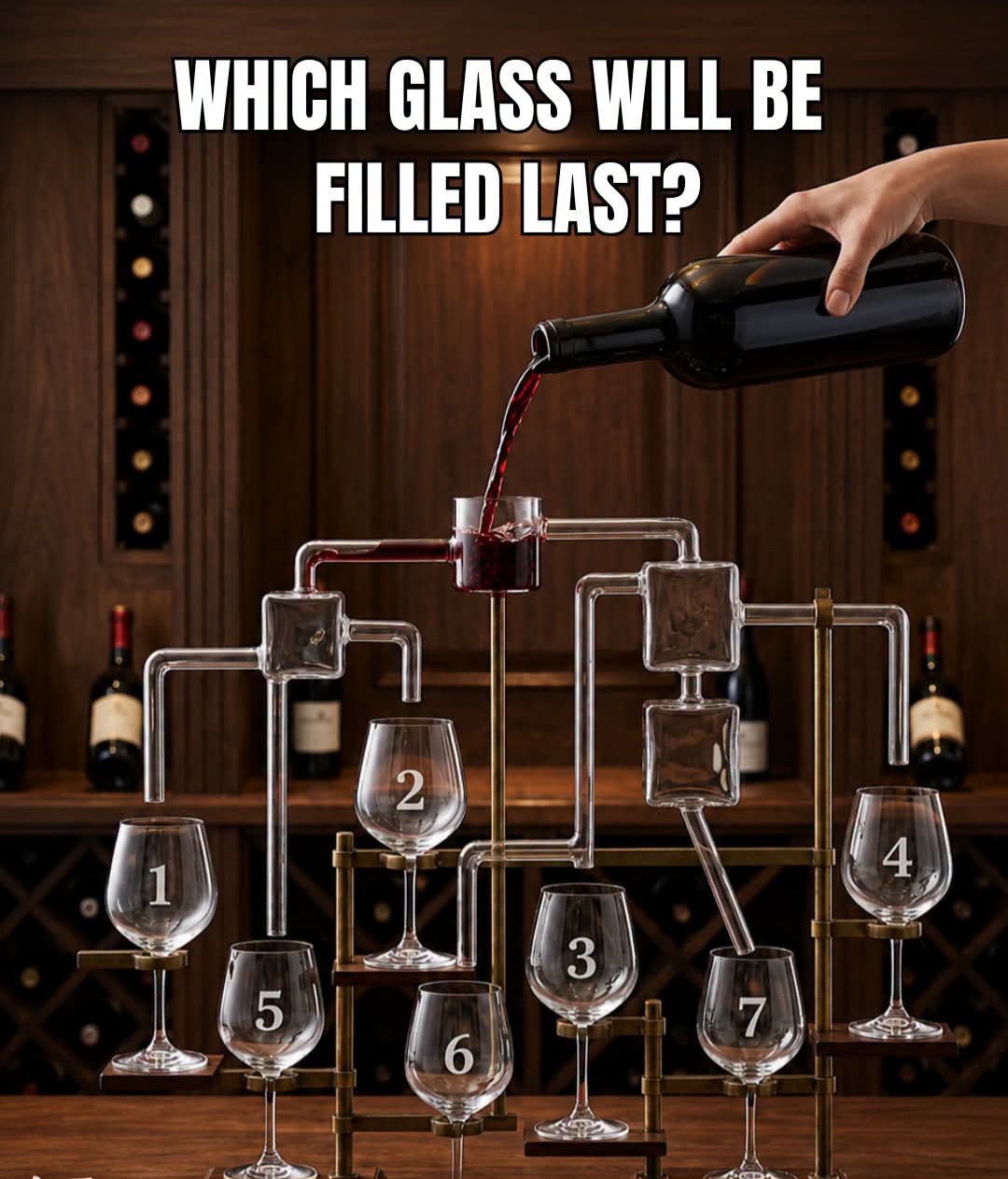
At first glance, this looks like a simple pouring puzzle. A bottle of wine is being poured into a network of pipes connected to seven numbered glasses.
But don’t let the complicated-looking pipes fool you.
The real challenge is to follow the path of the liquid carefully and notice which pipes are actually open and which ones are blocked.
👀 Look Closely Before You Answer!
You have seven glasses:
1 — 2 — 3 — 4 — 5 — 6 — 7
The wine enters at the top and begins traveling through the connected tubes. Your job is to determine which glass will be filled last.
And here’s the trick:
Some of the pipes aren’t actually open!
That means you can’t simply assume that the wine will travel through every tube it appears to touch. Similar versions of this puzzle rely on blocked pipe ends and closed connections to make the obvious answer incorrect. (GPuzzles)
🧩 Let’s Follow the Wine
The first thing to do is resist the temptation to look only at the numbers.
Instead, trace each pipe from beginning to end.
🍷 Glass 1
It appears that the liquid could travel toward the left side and eventually reach Glass 1.
However, the connecting route is blocked.
So Glass 1 isn’t going to be the simple first destination many people expect.
🍷 Glass 2
Glass 2 also looks like it has a route leading toward it, but its connection is blocked as well.
That means the wine can’t simply continue into Glass 2.
🍷 Glasses 4 and 7
These are another distraction.
The pipes leading toward them appear connected at first glance, but closer inspection reveals blocked sections.
This is the entire point of the puzzle: a pipe that looks connected isn’t necessarily a working path.
🏆 The Key Is Glass #3
After eliminating the blocked routes, the liquid’s usable path leads toward Glass #3.
This is why 3 is the intended answer in versions of this seven-glass puzzle. Published solutions to the same pipe-layout puzzle identify Glass 3 as the answer because the routes toward the neighboring glasses are blocked. (GPuzzles)
So if the question is asking which glass ultimately fills first in this puzzle:
🥇 THE ANSWER IS GLASS #3!
🤯 Why Is This Puzzle So Easy to Get Wrong?
Because your brain naturally follows the visible shape of the pipes rather than checking whether each connection is actually open.
You see:
Bottle → pipe → glass
and your brain immediately assumes the liquid will follow that route.
But the puzzle requires you to stop and ask:
“Is that pipe actually open?”
That’s the little detail that changes everything.
🧠 A Good Trick for Solving Pipe Puzzles
Whenever you see one of these puzzles, don’t start by looking at the numbers.
Instead:
1. Start at the liquid source
Follow the liquid from the bottle.
2. Trace one pipe at a time
Don’t jump from one pipe to another just because they appear close together.
3. Look for blocked ends
A tiny wall or closed section can completely change the answer.
4. Ignore appearances
The most obvious glass isn’t necessarily the correct one.
5. Eliminate impossible routes
Once you find a blocked pipe, cross that route out mentally.
6. Follow the remaining open path
Eventually, the answer becomes much easier to see.
🍷 What About the “Last” Glass?
There’s an important wording detail in this particular picture.
The image asks:
“Which glass will be filled last?”
That is slightly different from the more common version asking which glass will be filled first.
The exact outcome of “last” depends on assumptions about the amount of wine, flow rate, pipe dimensions, overflow, and whether the system is intended to continue until every reachable glass is full. In real fluid systems, those details matter.
So for a website puzzle, it’s best to frame the answer around the intended visual logic rather than presenting it as a real-world fluid-dynamics experiment.
The commonly circulated seven-glass version identifies Glass 3 as the key answer because the other routes contain blocked connections. (GPuzzles)
😂 Did You Get It Right?
This is one of those puzzles where you can stare at the picture for 30 seconds and still miss the tiny detail that makes the whole thing work.
At first you might think:
“Obviously #1!”
Then you trace the pipe.
Nope.
Maybe #2?
Blocked.
Maybe #4?
Look again.
Another blocked connection!
And eventually you realize the puzzle has been testing your observation, not your ability to calculate how fast wine flows.
🏆 FINAL ANSWER
🍷 GLASS #3
The trick is the blocked pipe connections. Several apparent routes are closed, preventing the wine from reaching the glasses you might initially expect. That leaves Glass #3 as the intended solution to the classic seven-glass version of the puzzle. (GPuzzles)
🗳️ NOW IT’S YOUR TURN!
Before looking at the answer, which glass did you choose?
1️⃣ 2️⃣ 3️⃣ 4️⃣ 5️⃣ 6️⃣ 7️⃣
🍷 Did you spot the blocked pipes immediately, or did this puzzle fool you?
Comment your answer before checking someone else’s! 👀🍷
