🥔🔥 What’s Your Roastie Level? A Through E
There are few things more comforting than a tray of golden roast potatoes coming out of the oven.
But here’s the real question: how crispy do you like your roasties?
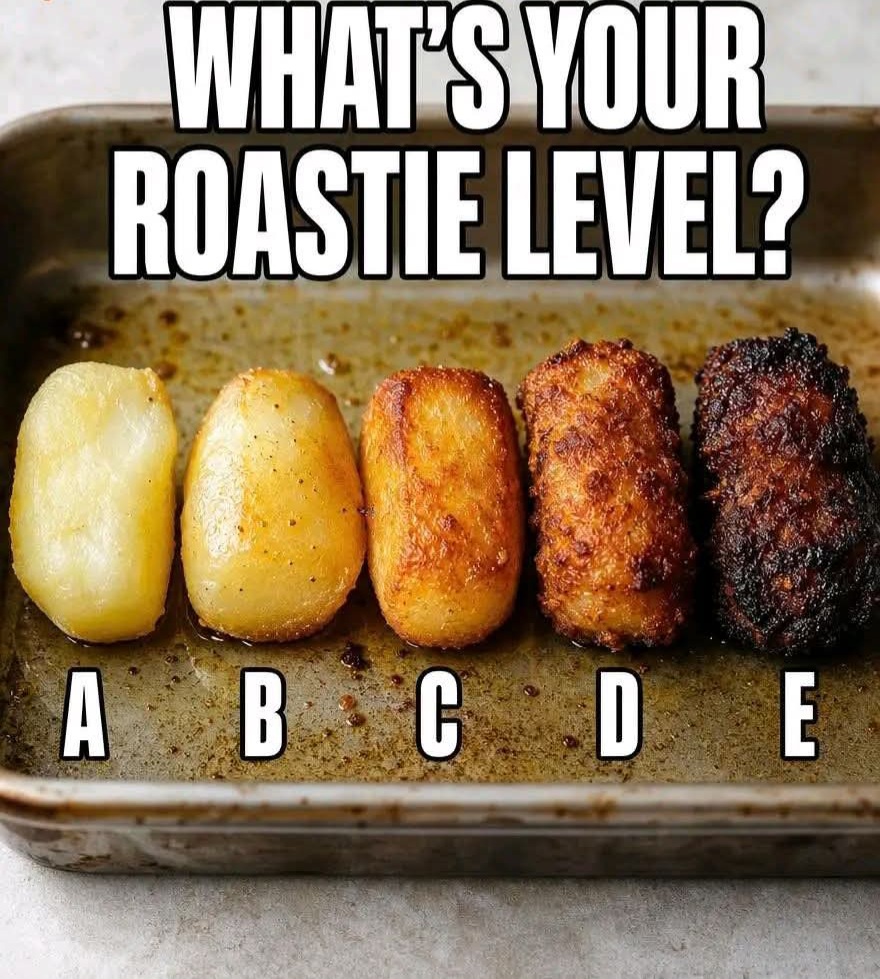
The picture gives us five levels, from A—soft, pale and barely browned—to E, with a deeply browned, almost charred exterior.
And somewhere in between is the roast potato that makes someone say, “Yep. That’s exactly how I like them.” 😍
🥔 A — Soft & Simple
A is for anyone who prefers a soft, tender roast potato with very little browning.
The outside is lightly cooked, while the inside is soft and fluffy.
There is nothing wrong with preferring your potatoes this way. Some people simply aren’t looking for a crunchy crust. They want something tender that practically falls apart with a fork.
A fans: You like your roasties gentle, soft and comforting.
🥔 B — Lightly Golden
B is where the roasting really starts to show.
The potato has developed a light golden surface, but it’s still relatively soft rather than seriously crunchy.
This is a great middle ground if you want some roasted flavor without turning the outside into a hard shell.
B fans: You want a little color and texture, but you still want plenty of softness.
🥔 C — The Classic Roastie
Now we’re getting serious.
C has a beautiful golden-brown exterior while the inside remains soft and fluffy.
For many people, this is the classic roast potato sweet spot.
You get that satisfying little crunch when your fork breaks through the outside, followed by a tender, fluffy center.
This is the level where roast potatoes start becoming difficult to resist.
C fans: You believe a roast potato should be crispy outside and fluffy inside—but not overly dark.
🥔 D — Extra Crispy
D is for the people who want CRUNCH.
The outside is noticeably darker and more textured, with plenty of roasted flavor.
This kind of potato develops an especially satisfying crust when the potatoes are prepared properly and roasted with enough space around them.
And let’s be honest: those crispy edges are often the first pieces to disappear from the serving dish.
D fans: You don’t just want roast potatoes. You want crispy roast potatoes.
🥔 E — Maximum Roast
And then there’s E.
This is the extreme roastie level.
Deeply browned, intensely crisp and bordering on charred, E is definitely not for everyone.
Some people would immediately reach for the darkest, crunchiest piece on the tray.
Others would look at E and say, “That’s burned!” 😂
That’s what makes this question so fun—there isn’t one universal answer.
E fans: You want your roast potatoes dark, intensely roasted and seriously crunchy.
🔥 How Do You Get Crispy Roast Potatoes?
If you’re aiming for C, D or even E, a few techniques can make a huge difference.
1. Choose the right potato
Potatoes with a good balance of starch and moisture can produce a wonderfully fluffy interior and crisp exterior.
Russet-type potatoes are especially useful for fluffy roast potatoes, while Yukon Gold-style potatoes can give you a naturally creamy center.
2. Don’t skip parboiling
Partially cooking the potatoes before roasting can help create the contrast we’re looking for: fluffy inside, crispy outside.
Boil the potatoes until the outside is beginning to soften while the center still has some firmness.
3. Give them a rough surface
Here’s one of the best tricks.
After draining the potatoes, give them a gentle shake in the pot or colander.
The roughened edges create more surface area, which can turn into those wonderful crispy bits in the oven.
4. Use enough fat
Olive oil, vegetable oil, beef drippings, duck fat or another suitable cooking fat can all produce delicious results.
The choice of fat changes the flavor, but the bigger goal is getting the potato surfaces lightly coated.
5. Don’t overcrowd the pan
This is important.
If the potatoes are packed tightly together, they can trap moisture and steam instead of roasting properly.
Give each potato some breathing room.
A little space around them helps promote browning.
6. Turn them during roasting
Turning the potatoes partway through cooking helps expose multiple surfaces to the hot pan and oven.
That’s how you end up with more evenly browned potatoes rather than one crispy side and three pale sides.
🧂 Seasoning Makes a Difference
Salt is essential, but roast potatoes don’t have to stop there.
Try adding:
- Black pepper
- Garlic powder
- Fresh rosemary
- Thyme
- Smoked paprika
- Onion powder
- Dried herbs
- A little grated Parmesan after roasting
For a classic Sunday dinner, simple salt, pepper and rosemary can be all you need.
🥔 The Great Roastie Debate
The funniest thing about roast potatoes is that everyone seems to have a different definition of perfection.
One person sees A and thinks:
“Perfectly soft.”
Someone else sees C and thinks:
“Now that’s a roast potato.”
And another person looks at E and says:
“Give me all the crispy ones.” 😂
There isn’t really a wrong answer.
Food preferences are personal, and that’s exactly why these little picture polls are so much fun.
👀 So, What’s Your Roastie Level?
A — Soft and pale
B — Lightly golden
C — Crispy outside, fluffy inside
D — Extra crispy and deeply browned
E — Dark, crunchy and almost charred
Personally, I’d say C or D is the perfect balance: enough browning to give you that irresistible crunch while keeping the middle beautifully fluffy.
But if you’re an E person, I respect it. 😂🔥
🥔 Be honest…
What’s your roastie level: A, B, C, D or E?
And the more important question:
Do you fight your family for the crispiest potatoes on the tray? 😍🥔🔥
