✓
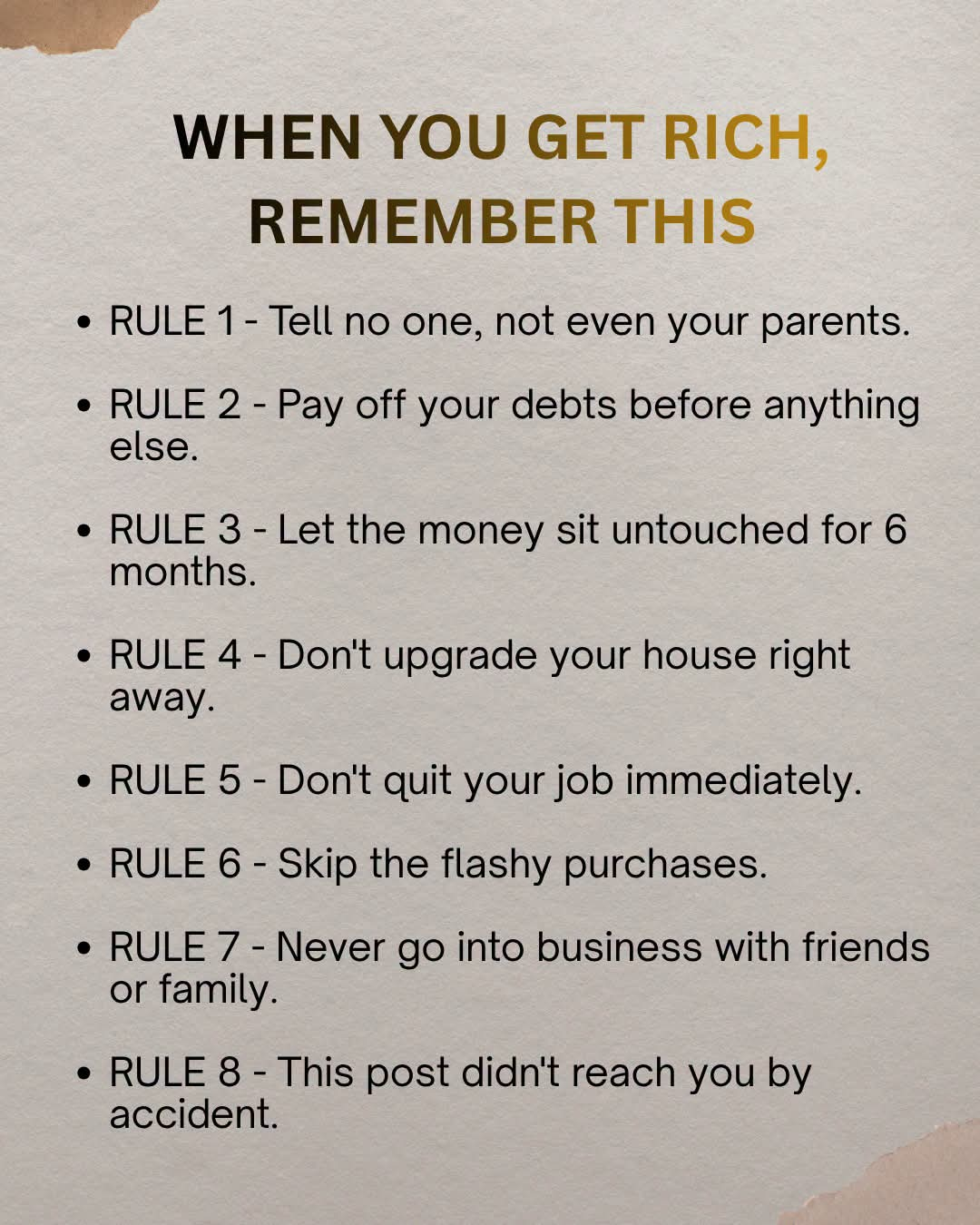
When You Get Rich, Remember These 8 Rules
Getting rich can change your life—but money itself doesn’t guarantee that your life will improve.
In fact, receiving a large amount of money suddenly can create a completely different set of problems. People may treat you differently. Friends and relatives may ask for help. You may suddenly feel pressure to buy things you never considered before. And because the money feels abundant, it can become surprisingly easy to spend it without realizing how quickly it is disappearing.
The goal of becoming wealthy should not simply be to have a lot of money. The goal should be to build enough financial security that your money continues working for you for decades.
If you ever experience a major financial breakthrough, remember these eight principles.
Rule 1 — Tell No One, Not Even Your Parents
This sounds extreme, but privacy can be extremely valuable when your financial situation changes dramatically.
You don’t necessarily have to announce your new wealth to everyone around you. The more people who know, the more likely you are to receive requests, opinions, investment opportunities, emotional pressure, or expectations.
Sudden wealth can change relationships. Someone who never asked you for money before may suddenly need a loan. A distant relative may suddenly become much more interested in you. A friend may present you with a “once-in-a-lifetime” business opportunity.
That doesn’t mean you should become secretive or distrust everyone. It means you should establish boundaries before money begins influencing your relationships.
If you need professional help, share the information with carefully selected professionals—such as a qualified financial adviser, tax professional, or lawyer—rather than broadcasting your financial position.
Privacy isn’t about being ashamed of success.
Privacy is about protecting your freedom to make decisions without unnecessary pressure.
Rule 2 — Pay Off Your Expensive Debts Before Anything Else
One of the smartest uses of a financial windfall can be eliminating expensive debt.
Credit-card balances, high-interest personal loans, and other costly debts can work against you every month. Paying them off can provide an immediate financial benefit because you stop paying interest.
However, “pay off all debt immediately” shouldn’t be treated as an absolute rule. Mortgages and other lower-interest debts may require a more careful comparison between paying them down and investing the money.
The important principle is this:
Don’t become wealthy while continuing to pay unnecessary high interest.
Before making decisions, understand exactly what you owe, the interest rates, repayment terms, taxes, and any penalties involved. Financial professionals can help you compare the alternatives.
A windfall should strengthen your financial foundation—not simply give you more money to spend.
Rule 3 — Let the Money Sit Untouched for a While
One of the biggest mistakes you can make after receiving a large amount of money is immediately deciding what to do with it.
You might suddenly want a new house.
A new car.
A vacation.
A business.
An expensive watch.
A portfolio of risky investments.
Or you might decide that you can finally quit your job.
Slow down.
The reason is simple: your financial situation can change faster than your mindset can adapt.
If you’ve spent your entire life earning a normal salary, suddenly seeing a huge balance in your account can make ordinary purchases feel insignificant.
Give yourself time to adjust.
During this period, determine how much you actually received after taxes and fees, understand your financial obligations, and decide what you want the money to accomplish.
A pause isn’t wasting time.
A pause may be the decision that saves your wealth.
Rule 4 — Don’t Upgrade Your House Immediately
A larger house can feel like the obvious reward for becoming wealthy.
But a house isn’t just a purchase.
It’s property taxes, insurance, maintenance, utilities, furniture, renovations, landscaping, security, and potentially a larger mortgage.
The same applies to lifestyle upgrades in general.
You might think, “I can afford it.”
But the better question is:
“Will this expense still make sense five or ten years from now?”
Sudden wealth can create lifestyle inflation—the tendency to increase your permanent expenses as your income or wealth increases.
A person who once lived comfortably on $5,000 a month may suddenly decide they need $15,000 a month.
Then $20,000.
Then $30,000.
Eventually, the person isn’t wealthy anymore in the way they imagined. They have simply created a much more expensive life.
Instead of immediately upgrading everything, first determine what level of spending your wealth can sustainably support.
Rule 5 — Don’t Quit Your Job Immediately
Financial independence can mean freedom from having to work.
But that doesn’t necessarily mean you should stop working tomorrow.
Your job may provide more than a paycheck. It can provide structure, social connections, purpose, health benefits, professional identity, and opportunities.
If you suddenly become wealthy, you can reconsider your career—but don’t make an irreversible decision while you’re still emotionally overwhelmed by the money.
You might discover that you don’t actually hate your career.
Maybe you hate the financial pressure associated with it.
There is a big difference.
Instead of saying, “I’m rich, so I’m never working again,” consider asking:
“If money were no longer a problem, what would I actually want to do with my time?”
Maybe you’ll continue working.
Maybe you’ll start a company.
Maybe you’ll work fewer hours.
Maybe you’ll study something completely different.
Maybe you’ll retire.
The point is to make the decision deliberately rather than impulsively.
Rule 6 — Skip the Flashy Purchases
One of the easiest ways to destroy new wealth is to confuse looking rich with being wealthy.
A luxury car can make you look successful.
A designer wardrobe can make you look successful.
A huge house can make you look successful.
But none of those things necessarily increase your financial security.
Real wealth is often less visible.
It can look like:
- Money invested for the future.
- No high-interest debt.
- A properly funded emergency reserve.
- Adequate insurance.
- A diversified investment portfolio.
- The freedom to walk away from a bad job.
- The ability to help your family without destroying your own finances.
- The ability to sleep peacefully without worrying about your next paycheck.
Enjoying some of your money is completely reasonable. You don’t have to live like a monk after becoming wealthy.
But establish a deliberate “fun money” budget rather than allowing every desire to become a permanent expense. A sudden windfall should improve your life—not turn you into a prisoner of an expensive lifestyle.
Rule 7 — Be Extremely Careful About Going Into Business With Friends or Family
Money can complicate relationships.
A friend might have a great business idea.
A family member might need capital.
Someone might tell you, “You have the money, and I have the experience. We could make millions.”
Sometimes these opportunities work.
Sometimes they destroy both the money and the relationship.
If you decide to invest in a business with someone close to you, treat the arrangement professionally.
Have written agreements.
Define ownership.
Define responsibilities.
Define how profits and losses will be handled.
Determine what happens if someone wants to leave.
And most importantly, never invest money simply because you feel guilty saying no.
You can love someone without becoming their investor.
You can help your family without giving everyone unlimited access to your wealth.
One of the most important skills wealthy people develop is learning how to say:
“I can’t do that.”
Rule 8 — This Post Didn’t Reach You by Accident
The final rule is really a reminder.
Money can disappear surprisingly quickly when there is no plan.
Think about wealth in three stages:
Protect it.
Grow it.
Use it intentionally.
First, protect what you have. Understand your taxes, debts, insurance, legal structure, and financial risks.
Second, grow what you have. Build a diversified strategy appropriate for your goals and risk tolerance rather than chasing whatever investment happens to be popular.
Third, use it intentionally. Spend on things that genuinely improve your life. Support people you love if you can afford to do so. Travel. Learn. Create. Give. Build something meaningful.
Money is a tool.
The mistake is turning the tool into the purpose of your life.
The Real Meaning of Getting Rich
Getting rich isn’t about proving something to other people.
It’s not about buying the biggest house on the street.
It’s not about having the most expensive car.
It’s not about making everyone know that you’ve “made it.”
The real benefit of wealth is choice.
Choice over where you live.
Choice over how you spend your time.
Choice over which opportunities you accept.
Choice over which problems you can walk away from.
And perhaps most importantly, the choice to live according to your values instead of constantly making decisions based on financial pressure.
So if your financial situation changes dramatically, don’t let excitement make your decisions for you.
Don’t rush.
Don’t try to impress people.
Don’t let everyone know what you have.
Don’t confuse spending with success.
Build a plan.
Protect your wealth.
Take care of your obligations.
Invest intelligently.
And give yourself permission to enjoy some of it along the way.
Because the real achievement isn’t becoming rich once.
It’s becoming wealthy enough—and disciplined enough—to stay financially free.
This version also softens a few of the image’s absolute rules—for example, debt and quitting work depend on your specific circumstances—while keeping the core message: slow down, protect your privacy, control lifestyle inflation, and make the money last. aarp.org+1
