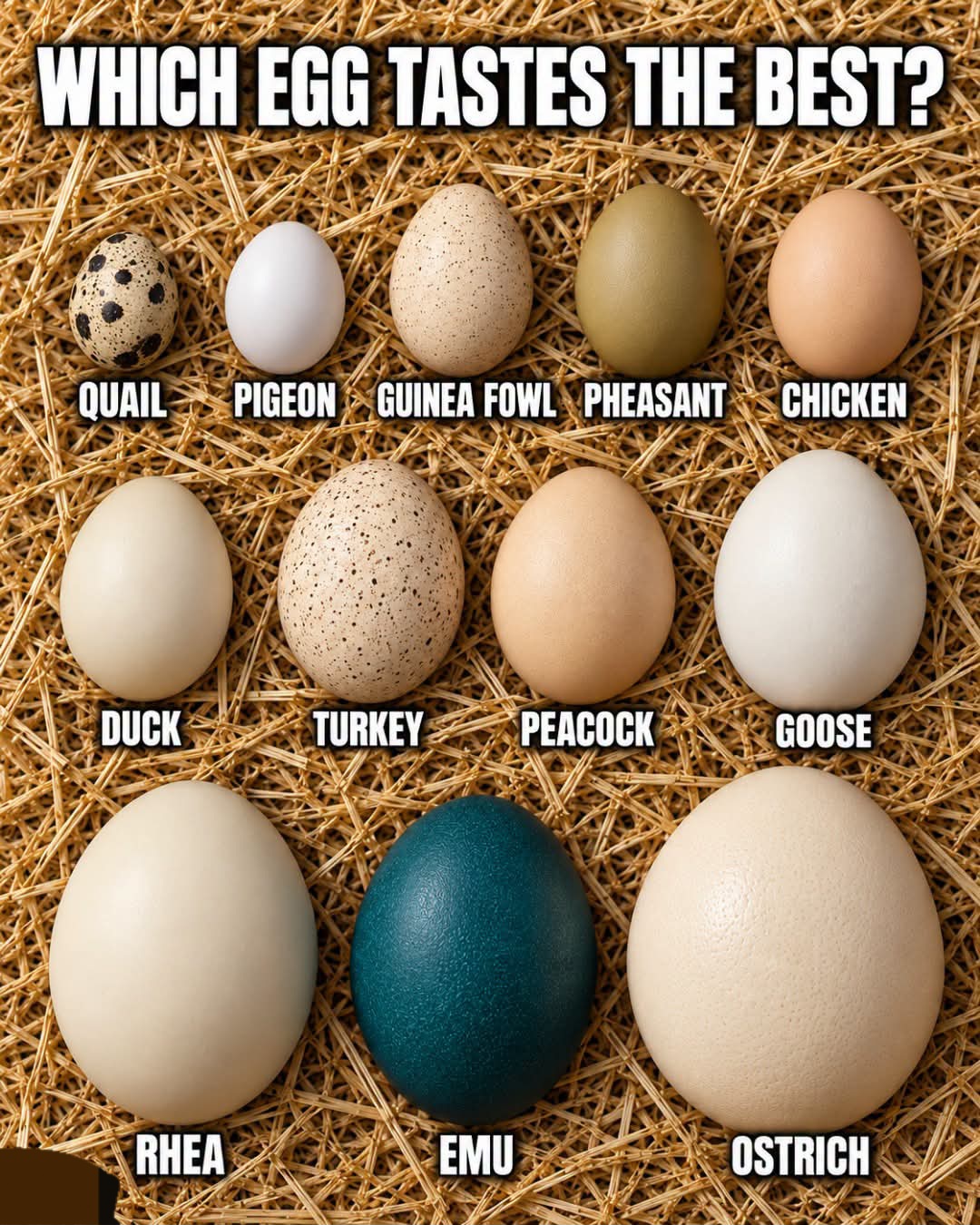
🥚 ? A Delicious Guide to 12 Different Bird Eggs
Walk through a farm, a specialty food market, or even a country kitchen, and you may discover that not every egg comes from a chicken! 🥚👀
The image above features eggs from quail, pigeon, guinea fowl, pheasant, chicken, duck, turkey, peacock, rhea, emu, and ostrich—and each one can differ in size, texture, yolk-to-white ratio, and flavor.
So the big question is:
Which egg tastes the best?
The answer isn’t quite as simple as picking the biggest or most unusual egg. Taste is subjective, and preparation makes a huge difference. However, some of these eggs are particularly prized for their rich yolks, distinctive flavors, or interesting textures.
Research comparing eggs from several bird species has found meaningful differences in egg size, yolk proportion, albumen characteristics, and sensory qualities. (ScienceDirect)
Let’s crack them open! 🍳
🐔 1. Chicken Egg — The Classic Favorite
It’s hard to beat the everyday chicken egg.
Chicken eggs are versatile, relatively inexpensive, and familiar to almost everyone. They work beautifully scrambled, fried, poached, boiled, baked, or turned into everything from cakes to custards.
Their flavor is mild enough to pair with almost anything.
Best for: Everyday cooking, breakfast, baking, omelets, and deviled eggs.
For many people, the humble chicken egg remains the standard against which all other eggs are compared.
🦆 2. Duck Egg — Rich and Creamy
Duck eggs are famous for their large yolks and rich texture.
Compared with chicken eggs, duck eggs generally contain more fat and protein and have a thicker shell. Their richer yolk makes them especially appealing for baking and dishes where you want extra richness. (ScienceDirect)
If you love a creamy, luxurious yolk, a duck egg may be your winner.
Best for: Baking, fried eggs, custards, and rich breakfasts.
🐦 3. Quail Egg — Tiny but Delicious
Quail eggs may be small, but they have plenty of fans.
Their beautifully speckled shells make them especially attractive on appetizer plates, salads, and party foods. They’re roughly a fraction of the size of a chicken egg, so several are usually needed for a full serving. (ScienceDirect)
They are often appreciated for their delicate flavor and tender texture.
Best for: Appetizers, salads, garnishes, and bite-sized boiled eggs.
And let’s be honest—the little spotted shells are adorable! ❤️
🐓 4. Guinea Fowl Egg — A Hidden Gem
Guinea fowl eggs are smaller than chicken eggs and have relatively thick shells.
They are particularly prized in some parts of the world as a delicacy. Their yolks are relatively large compared with the amount of white, giving them a rich character. (ScienceDirect)
Sensory research has also found guinea fowl eggs to have favorable tenderness characteristics, particularly when boiled. (ResearchGate)
Best for: Boiling, scrambling, omelets, and baking.
If you’ve never tried one, this might be the surprise favorite on the list.
🦃 5. Turkey Egg — Bigger and Creamy
Turkey eggs are considerably larger than typical chicken eggs, but they’re surprisingly familiar in flavor.
They have a substantial yolk and white and can be used much like chicken eggs. The main problem is availability: turkeys don’t produce eggs at the volume of commercial laying hens, so turkey eggs are relatively uncommon and are often reserved for breeding. (ScienceDirect)
Interestingly, sensory studies have found turkey eggs to be well-liked in cooked preparations. (ResearchGate)
Best for: Scrambled eggs, omelets, baking, and hearty breakfasts.
🪿 6. Goose Egg — Big, Rich and Impressive
A goose egg is considerably larger than a chicken egg and has a hard shell.
The flavor is broadly similar to chicken egg, although goose eggs can have a richer or more pronounced character. Some culinary sources describe them as having an oily quality, which is one reason they’re often used in baking rather than simply served on their own. (ScienceDirect)
Best for: Baking, cakes, pastries, and large breakfast dishes.
One goose egg can make quite an impression at the breakfast table!
🦚 7. Peacock Egg — Beautiful but Rare
Peacock eggs are certainly one of the most unusual choices on this list.
Unlike chicken or duck eggs, they’re not something most people will encounter in an ordinary grocery store. Their availability is extremely limited, and they are primarily associated with ornamental birds rather than commercial egg production.
If you ever encounter one legally and from an appropriate food source, it would certainly make for a memorable culinary experiment.
Best for: Curiosity and culinary novelty rather than everyday cooking.
🟢 8. Emu Egg — The Dramatic One
An emu egg is impossible to miss.
Its naturally dark green-to-blue shell makes it one of the most striking eggs in the world. One emu egg can be equivalent to roughly a dozen chicken eggs, although exact comparisons vary with egg size. (ScienceDirect)
Emu eggs are edible, but they’re a niche food and aren’t commonly sold for everyday consumption.
Their flavor and texture can also be quite distinctive. Sensory studies have generally found emu eggs less favored than many conventional poultry eggs, particularly in some cooked preparations. (ResearchGate)
Best for: Specialty cooking and novelty meals.
🪶 9. Ostrich Egg — The Giant
Now we’re talking BIG breakfast.
An ostrich egg can weigh around 1.5–2 kilograms, making one egg roughly equivalent to many chicken eggs. (ScienceDirect)
Despite its enormous size, its flavor is often described as relatively delicate rather than overwhelmingly strong.
The challenge isn’t eating it—it’s cooking it!
Because the shell is extremely thick, opening one isn’t like cracking a chicken egg against the side of a bowl. Special techniques or tools may be needed.
Best for: Giant omelets, scrambled eggs, special events, and culinary adventures.
Imagine making one enormous breakfast omelet for the whole family!
🐦 10. Rhea Egg — The South American Giant
Rhea eggs are another fascinating giant egg.
They’re much larger than chicken eggs and can be used in ways similar to other large bird eggs. Culinary references describe them as suitable for scrambling, soft-boiling, and baking. (ScienceDirect)
They’re uncommon compared with chicken or duck eggs, making them much more of a specialty ingredient.
Best for: Baking, pancakes, scrambling, and adventurous cooking.
🐤 11. Pheasant Egg — Small and Flavorful
Pheasant eggs are smaller than chicken eggs and can have olive, greenish, or brownish shells.
They are known for having a relatively strong flavor compared with ordinary chicken eggs. (ScienceDirect)
Because they’re smaller and less readily available, they’re often considered a specialty ingredient.
Best for: Boiling, specialty breakfasts, and gourmet dishes.
🕊️ 12. Pigeon Egg — Tiny and Unusual
Pigeon eggs are small and aren’t a common commercial food.
Interestingly, research comparing several poultry species found pigeon egg albumen to have distinctive physical properties compared with the other eggs studied. (ScienceDirect)
As with other uncommon bird eggs, sourcing matters. An egg from a wild bird shouldn’t automatically be treated as a food item.
Best for: Specialty culinary use where legally and safely sourced.
🥚 Does a Bigger Egg Mean Better Taste?
Not at all!
This is one of the most interesting things about comparing eggs.
A huge ostrich egg isn’t automatically going to taste better than a quail egg.
In fact, sensory research has found that people can have quite different preferences depending on whether eggs are boiled, scrambled, or prepared another way. In one study, chicken, turkey, duck, guinea fowl, and quail eggs were broadly similar in taste ratings among sighted participants, while ostrich and emu eggs stood out more strongly from the other eggs. (ResearchGate)
So size, appearance, and flavor are three different things.
🍳 Which Egg Is Best for Cooking?
It depends on what you’re making!
🥚 For everyday breakfast:
Chicken egg
🧈 For a richer yolk:
Duck egg
🌟 For appetizers:
Quail egg
🍰 For baking:
Duck, goose, or guinea fowl egg
🥚 For a specialty treat:
Guinea fowl egg
😲 For the ultimate conversation starter:
Ostrich or emu egg
🍳 For feeding a crowd:
Ostrich egg or rhea egg
⚠️ A Quick Food-Safety Reminder
Not every egg you see in nature or from an ornamental bird should automatically be eaten.
For unusual eggs, it’s important to know what species they came from, where the egg came from, and whether it was produced and handled for human consumption.
As with other eggs, proper storage and thorough cooking are important food-safety considerations. Wild or illegally collected eggs should never be assumed to be safe to eat.
🏆 So Which Egg Tastes the Best?
If you’re looking for a rich, creamy egg, duck eggs are an excellent contender.
If you want something small, delicate, and beautiful, quail eggs are hard to beat.
If you’re looking for something special and less common, guinea fowl eggs are worth talking about.
And if your goal is simply to make everyone at the breakfast table say “WOW!”, an ostrich or emu egg wins the presentation contest! 😂
But ultimately, the best egg is the one you enjoy eating most.
👀 Now It’s Your Turn!
Forget what everyone else says—which one would YOU try?
🥚 A. Quail
🥚 B. Duck
🥚 C. Guinea fowl
🥚 D. Turkey
🥚 E. Goose
🥚 F. Pheasant
🥚 G. Emu
🥚 H. Ostrich
🥚 I. Rhea
🥚 J. Chicken — I’m sticking with the classic!
And be honest… have you ever actually tasted anything other than a chicken egg? 👀👇
Note: The image is a fun comparison, but egg appearance and exact size can vary considerably by species, breed, and individual bird. (ScienceDirect)
