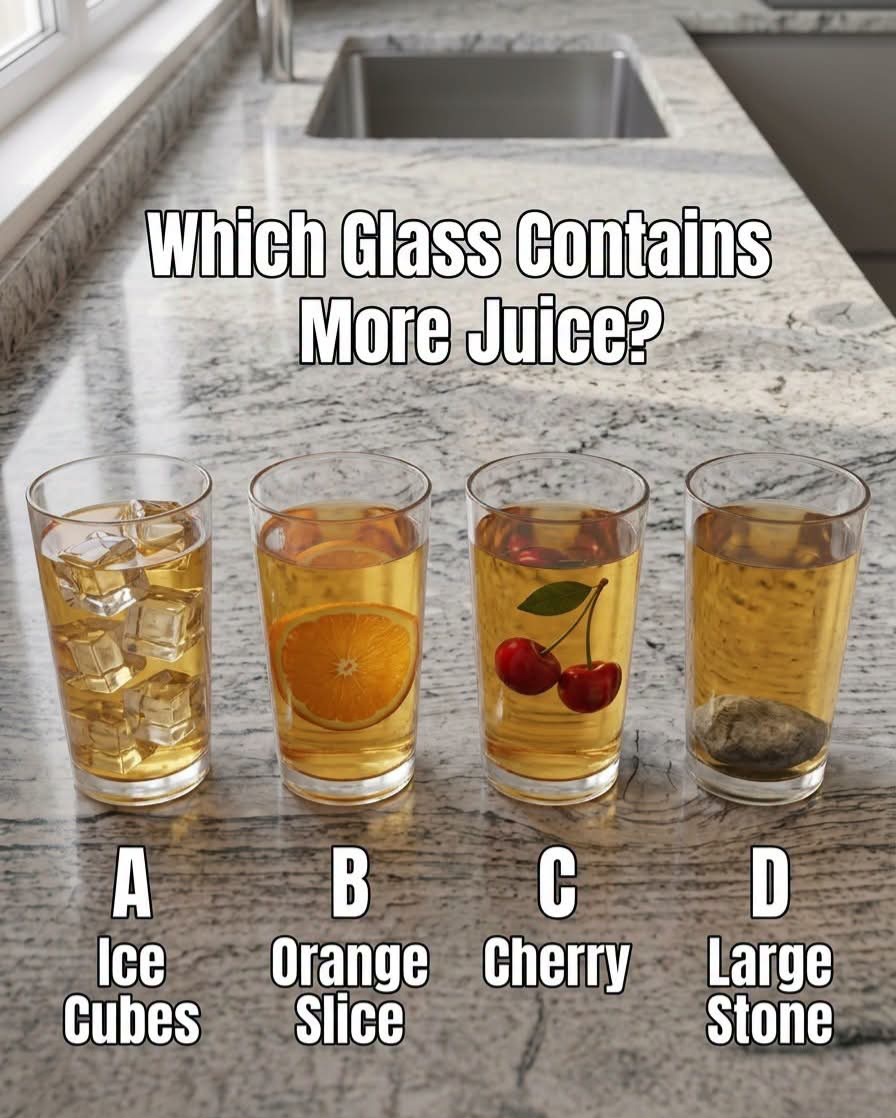
🥤 Which Glass Contains More Juice? Think Carefully Before You Answer!
At first glance, this looks like a simple picture puzzle. Four identical-looking glasses contain the same golden-colored drink, but each glass has something different inside:
- A — Ice cubes
- B — An orange slice
- C — Cherries
- D — A large stone
So, which glass actually contains the most juice?
Take a moment before scrolling to the answer. 👀
🤔 My Guess: A — The Glass With Ice Cubes
The answer is A, assuming the glasses started with the same amount of liquid and the objects shown are sitting in the glasses as pictured.
But the reason is more interesting than simply looking at the liquid level.
The trick is displacement.
Whenever you put an object into a glass of liquid, the object takes up space that could otherwise be occupied by liquid. This is called displacement.
Archimedes’ principle tells us that a submerged object displaces a volume of liquid equal to the volume of the portion of the object that is submerged. A floating object is different: it settles at a depth where the weight of the displaced liquid balances the object’s weight. (OpenStax)
And that’s where this puzzle gets sneaky.
🧊 Glass A: Ice Cubes
The ice cubes are floating.
Because ice is less dense than liquid water, it doesn’t become completely submerged. Only part of each cube is below the surface.
That means the ice cubes don’t displace their entire apparent volume.
In fact, a floating object displaces enough liquid to equal its own weight. (OpenStax)
So although the ice cubes look like they’re taking up quite a bit of space, much of that space is above the liquid.
That leaves more actual liquid in the glass than you might initially expect.
🍊 Glass B: Orange Slice
The orange slice is another object that displaces liquid.
Depending on how it is positioned and whether it floats, only the submerged portion contributes to displacement. But it still takes up some of the glass’s volume.
The orange slice also makes the puzzle visually deceptive because the fruit is large and appears to occupy a considerable amount of space.
🍒 Glass C: Cherries
The cherries also occupy space inside the glass.
Because they are immersed in the liquid, the portions beneath the surface displace liquid. The exact amount depends on their density, size and position.
Several cherries together can therefore displace a noticeable amount of liquid.
🪨 Glass D: The Large Stone
This is the one that may fool people.
The stone is sitting completely underwater.
A fully submerged solid object displaces liquid according to its entire submerged volume. (OpenStax)
So even though the stone might look smaller than the collection of ice cubes, orange or cherries, its entire volume below the surface is occupying space that otherwise could have contained liquid.
That’s why simply looking at the visible size of the objects isn’t enough.
🧠 The Important Difference: Floating vs. Sinking
Here’s the key to solving the puzzle:
Floating object: only the submerged portion displaces liquid.
Completely submerged object: the entire volume of the object displaces liquid.
For a floating object, the amount submerged is related to the object’s density compared with the liquid. The lower its density, the smaller the fraction that needs to be underwater. (Open Books)
That’s why ice is such an important clue in this puzzle.
🥤 So Which Glass Has the Most Juice?
🏆 A — The Ice Cube Glass
The floating ice cubes don’t occupy as much submerged volume as their visible size might suggest.
The stone in D, on the other hand, is completely submerged and therefore displaces its full volume.
So if the glasses began with equal amounts of liquid and the objects are positioned exactly as shown, A is the best answer.
⚠️ But There’s a Catch!
This type of viral puzzle isn’t a precise laboratory experiment.
The image doesn’t give us:
- The exact amount of liquid initially placed in each glass
- The exact volume of each object
- The density of the drink
- The density and weight of the orange and cherries
- The amount of each object submerged
- Whether the glasses actually contain identical starting volumes
So we can’t calculate an exact answer from the photograph alone.
The intended answer comes from the physics principle of displacement, not from measuring the pixels in the picture.
👀 Why This Puzzle Is So Tricky
Most people instinctively look at the visible liquid level.
But the better question is:
How much of the glass’s space is actually occupied by liquid?
That’s a completely different question.
An object can make the liquid level rise without adding any liquid at all.
This is the same basic idea behind measuring the volume of an irregular object by placing it in water: the rise in water level reveals the volume displaced by the submerged portion. (UCSB Physics)
🧪 Try This at Home
You can recreate a simple version of this puzzle.
Take four identical glasses and add the same amount of water to each.
Then try:
Glass A: Add floating ice.
Glass B: Add a slice of fruit.
Glass C: Add several small fruits.
Glass D: Add a completely submerged stone.
Now compare the amount of liquid remaining in each glass.
You’ll quickly see why what appears to take up the most space isn’t necessarily what removes the most liquid from the glass.
🎯 Final Answer
Which glass contains the most juice?
🥇 A — The glass with the ice cubes! 🧊
The secret is displacement and buoyancy.
Don’t just look at how big the objects appear. Ask how much of each object is actually under the surface and displacing the liquid.
That’s what makes this seemingly simple picture puzzle much harder than it looks!
Did you guess A, B, C, or D? 👀👇
