Which Watermelon Would You Choose? Only One Has the Best Signs of Ripeness!
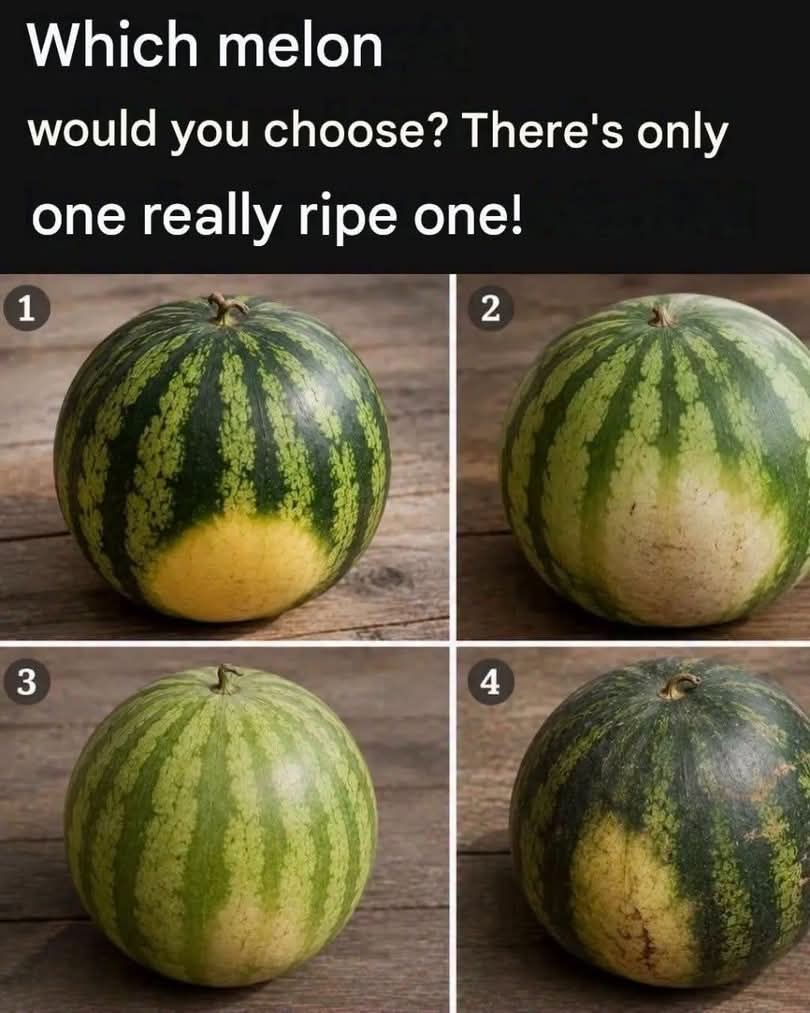
🍉 Look closely! Which watermelon would you take home?
At first glance, all four watermelons might look delicious, but their skin holds clues about how they grew and whether they may be ripe and sweet inside.
The four melons in this picture have different-looking field spots, the pale patches that develop where a watermelon rests on the ground. Experienced shoppers often examine these spots, along with the stem, shape, and weight, to help choose a good watermelon.
But which one would you pick: 1, 2, 3, or 4?
Let’s look at what these visual clues can tell us!
What to Look for When Choosing a Watermelon
1. Look for a Creamy Yellow Field Spot
The field spot is the area where the watermelon rested on the ground while growing.
A creamy yellow or golden-yellow field spot is generally a good sign that the watermelon had time to mature on the vine. A very pale white spot may indicate that it was harvested before reaching full maturity.
However, the field spot alone cannot guarantee sweetness or ripeness.
2. Check the Stem
When a watermelon is harvested, its stem may remain attached.
A dry, brown, curly stem can sometimes suggest that the fruit matured before harvesting. However, stem appearance varies with the watermelon variety and harvesting conditions, so it should not be the only factor you consider.
Many watermelons are sold with the stem cut off, which makes this clue less useful.
3. Choose a Firm, Symmetrical Shape
Look for a watermelon that is reasonably uniform in shape, whether round or oval.
An unusually misshapen fruit may have developed under less-than-ideal growing conditions, although appearance does not necessarily mean the watermelon will taste bad.
Avoid melons with deep cuts, soft spots, leaking areas, or significant damage.
4. Compare the Weight
Pick up two watermelons that are similar in size.
The heavier one is often a better choice because it may contain more water and have a juicy texture.
This is a helpful comparison, but it cannot tell you exactly how sweet the fruit will be.
5. Examine the Skin
A watermelon should generally feel firm, without large soft areas or obvious damage.
The color and pattern depend on the variety. Some ripe watermelons have dark green skin, while others are lighter green or have more pronounced stripes.
A shiny or dull appearance by itself is not a reliable way to determine ripeness.
So, Which Watermelon Is the Best Choice?
Looking at the four melons in the picture, Watermelon No. 1 has a prominent golden-yellow field spot, which is a favorable sign. No. 2 has a much paler spot, while Nos. 3 and 4 have different-looking pale patches.
If I had to choose based on the visible field spots alone, I would lean toward No. 1.
However, a picture cannot prove that any of these watermelons is the ripest or sweetest. We cannot compare their weight, firmness, sound, or actual flesh, and field-spot color varies naturally.
The best choice would be the watermelon that combines a mature-looking field spot with a firm exterior, an appropriate weight for its size, and no signs of damage.
The Bottom Line
Choosing a sweet watermelon takes more than looking at one patch of color. The field spot can provide a useful clue, but no single visual feature guarantees a perfectly ripe melon.
Next time you’re at the grocery store or farmers’ market, compare the field spots, pick up the melons, and check for firmness and damage before making your choice.
Now it’s your turn! 🍉
Which watermelon would you choose?
1️⃣ No. 1 — Golden yellow spot
2️⃣ No. 2 — Pale cream spot
3️⃣ No. 3 — Light-colored spot
4️⃣ No. 4 — Yellowish spot
Leave your answer in the comments, and tell us what you look for when choosing a watermelon!
Remember: These are general shopping tips, not a guarantee of ripeness. The only way to know the fruit’s actual flavor and texture for certain is to cut it open and taste it.
