🧼 So How Should You Actually Wash Strawberries?
The safest everyday approach is surprisingly simple.
Step 1: Wash your hands
Before handling fresh produce, wash your hands thoroughly with soap and water.
The FDA recommends washing hands for at least 20 seconds before and after preparing fresh produce.
Step 2: Inspect the strawberries
Look through the container.
Remove strawberries that are:
- heavily moldy;
- leaking;
- badly damaged;
- rotten;
- unusually soft;
- or showing obvious insect infestation.
The FDA recommends cutting away damaged or bruised areas and throwing away produce that appears rotten.
Step 3: Rinse under running water
Place the strawberries under cool, clean running water.
Gently rub the surfaces with your fingers.
This helps remove dirt, debris and some microorganisms from the surface.
The FDA specifically recommends washing fresh produce thoroughly under running water before eating it.
Step 4: Don’t use soap
This is a common mistake.
You should not wash strawberries with dishwashing liquid, hand soap or household detergent.
Produce is porous, and the FDA warns that soap and household detergents can be absorbed by fruits and vegetables and may make you sick.
🧂 Is There Any Benefit to Salt Water?
Salt water may help physically dislodge some insects or debris, which is why people sometimes find things floating in the bowl afterward.
But that doesn’t make it superior to the basic food-safety recommendation of rinsing produce under running water.
In fact, FDA food-safety guidance cautions against soaking or submerging certain produce during cleaning because water can potentially enter through cracks, bruises or damaged areas and facilitate movement of microorganisms.
For strawberries, which are delicate and easily damaged, a gentle running-water rinse is a more straightforward approach.
🪰 What Are the “White Worms” in Viral Videos?
When genuine larvae are present, they can be extremely small.
Spotted-wing drosophila larvae are described as white or cream-colored and can feed inside ripe strawberries.
These larvae are not the same thing as intestinal worms or parasites that infect humans.
They are insect larvae.
That’s an important distinction.
Calling them simply “worms” may make the situation sound much more dangerous than it actually is.
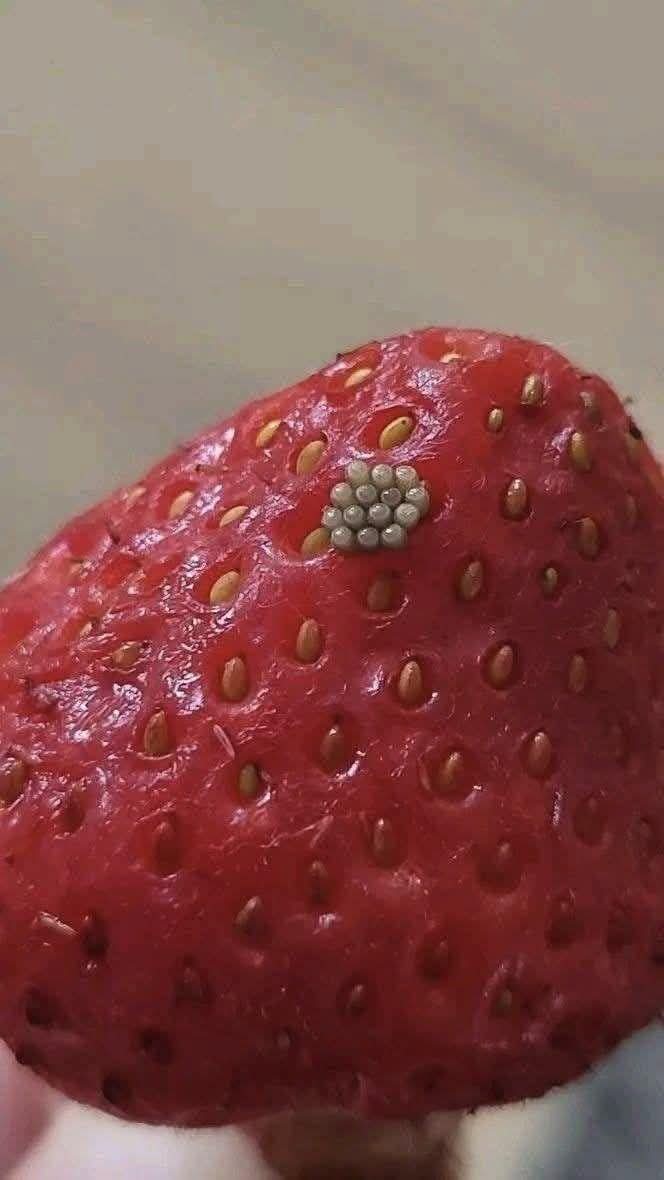
🥚 What About the Cluster in Your Image?
This is where the image is particularly interesting.
The objects are:
- round;
- tightly grouped;
- arranged in a regular pattern;
- attached to the surface of the strawberry.
That pattern is consistent with an insect egg mass.
UC Agriculture and Natural Resources has specifically documented stink bug egg masses on strawberries and notes that such eggs can occasionally be found on the fruit.
Therefore, it would be misleading to caption this particular image simply:
“Worms are hiding inside your strawberries.”
A more accurate description would be:
“This strawberry appears to have an insect egg cluster attached to its surface.”
The exact insect species cannot be confirmed from this photograph alone.
😨 Does Finding Insect Eggs Mean the Strawberry Is Poisonous?
Not necessarily.
Finding an insect egg mass is obviously unpleasant, but the presence of insect eggs does not automatically mean that the fruit is poisonous or contaminated with a human pathogen.
The immediate practical response is:
- Don’t eat that particular strawberry without examining it carefully.
- Discard it if you’re uncomfortable with the infestation.
- Inspect the remaining berries.
- Throw away berries that are rotten, moldy or badly damaged.
- Rinse sound berries thoroughly under running water.
Remember that food safety involves more than insects. Fresh produce can acquire bacteria and viruses through soil, water, handling and other points in the supply chain.
🍓 What If You Find a Larva Inside a Strawberry?
This is slightly different.
If you cut open a strawberry and discover a small white larva inside, the simplest choice is:
Discard that strawberry.
There is little benefit in trying to rescue a fruit that is visibly infested.
Then inspect the rest of the container.
If many berries are:
- soft;
- leaking;
- collapsing;
- visibly infested;
- or showing signs of spoilage,
discard the affected fruit rather than trying to save everything.
Spotted-wing drosophila infestation can cause fruit to soften and collapse, and damaged tissue can also become vulnerable to secondary fungal and bacterial growth.
🦠 What About Bacteria and Viruses?
This is where the conversation should move beyond the “worms” that attract attention online.
The bigger food-safety concern with raw fruit isn’t necessarily an insect larva.
It can be microbial contamination.
Fresh produce can become contaminated during:
- cultivation;
- irrigation;
- harvesting;
- transportation;
- processing;
- retail handling;
- or preparation at home.
The FDA notes that fresh produce has been implicated in outbreaks of foodborne illness and recommends careful washing and handling.
Berries have also been associated with outbreaks involving pathogens such as norovirus and hepatitis A.
That is why proper produce handling matters even when you don’t see anything unusual.
👶 Who Should Be Especially Careful?
Everyone should practice good food hygiene, but some people are more vulnerable to serious foodborne illness.
This includes:
- young children;
- older adults;
- pregnant people;
- and people with weakened immune systems.
The FDA identifies these groups as being at higher risk for severe foodborne illness.
For these individuals, it is especially sensible to discard visibly spoiled or heavily damaged strawberries rather than trying to salvage them.
❌ Common Strawberry-Washing Mistakes
Mistake #1: Using dish soap
Don’t.
The FDA specifically advises against washing produce with soap or detergent.
Mistake #2: Assuming salt water kills everything
It doesn’t.
A salt-water soak is not a guarantee against pathogenic microorganisms.
Mistake #3: Soaking fruit for a long time
Prolonged soaking isn’t necessary and may damage delicate strawberries.
Mistake #4: Washing strawberries days before eating
Once strawberries are washed, they can become more prone to deterioration if they remain wet.
If possible, wash them relatively close to when you intend to eat them and dry them well.
Mistake #5: Ignoring mold
Don’t simply cut a little mold from a soft strawberry and assume the rest is fine.
For visibly moldy, very soft berries, discarding them is the safer choice.
🧊 How Should Strawberries Be Stored?
Keep fresh strawberries refrigerated.
The FDA recommends keeping perishable produce refrigerated at or below 40°F (about 4°C).
Before storing:
- remove obviously damaged berries;
- avoid crushing them;
- keep them relatively dry;
- use a clean container;
- and avoid packing them so tightly that air cannot circulate.
Moisture is one of the enemies of fresh strawberries because it encourages deterioration and mold.
🔍 Can You Tell If a Strawberry Contains Larvae?
Unfortunately, not always.
A strawberry can look perfectly normal from the outside and still contain tiny insect larvae.
However, signs that deserve closer attention include:
- unusually soft areas;
- tiny punctures;
- collapsed tissue;
- leaking juice;
- discoloration;
- premature deterioration.
Washington State University notes that spotted-wing drosophila egg-laying can leave small scars or indented soft areas on fruit, while larvae feeding inside can cause the fruit to soften and collapse.
Still, appearance alone cannot prove that a strawberry contains larvae.
🧪 Does Salt Water “Pull Out” Worms?
This claim needs a little skepticism.
If a video shows larvae appearing after strawberries have been soaked, the observation may be genuine.
But the conclusion:
“Salt water proves that all strawberries are full of worms”
is not justified.
The strawberries may have been unusually infested.
The organisms may have been on the surface rather than inside.
The salt solution may have encouraged movement.
Or the video may simply show an unusual example that isn’t representative of normal strawberries.
A viral video is not a controlled scientific experiment.
🍓 Should You Stop Eating Strawberries?
Absolutely not.
The existence of insect pests in agriculture doesn’t mean strawberries are inherently unsafe.
Strawberries remain a nutritious fruit containing vitamin C, fiber and various plant compounds.
The practical approach is not fear.
It’s inspection + proper washing + appropriate storage + common sense.
If a strawberry looks healthy, smells normal and has no visible spoilage, rinse it thoroughly under running water before eating.
If it looks rotten, moldy or heavily infested:
Throw it away.
That’s a much more useful rule than assuming every strawberry contains worms.
🧠 The Most Important Difference: Eggs vs. Larvae
Let’s summarize the image and the viral videos clearly.
| What you see | What it may be | What to do |
|---|---|---|
| Round objects in a neat cluster | Insect eggs | Discard the affected berry if desired; inspect the rest |
| Tiny white/cream moving larvae | Insect larvae | Discard the affected fruit |
| Soft, collapsing strawberry | Possible insect damage/spoilage | Discard |
| Green/blue/gray fuzzy growth | Mold | Discard |
| Healthy strawberry with no visible damage | No obvious infestation | Rinse under running water |
| Dirt/debris on surface | Soil/plant material | Rinse thoroughly |
The photograph you’ve provided falls most closely into the first category: a possible insect egg mass rather than obvious worms.
🧂 Should You Try the Viral Salt-Water Experiment?
If your goal is simply to prepare strawberries safely for eating, you don’t need to perform the experiment.
The FDA’s basic recommendation is much simpler:
Wash your hands.
Rinse the strawberries under clean running water.
Gently rub the fruit.
Remove damaged or rotten berries.
Dry them.
Refrigerate them appropriately.
And don’t use soap or detergent.
If you’re doing the salt-water experiment purely out of curiosity, remember that whatever you see floating in the bowl isn’t automatically a dangerous parasite.
It may be:
- an insect;
- an insect larva;
- an insect egg;
- plant debris;
- dirt;
- or another harmless bit of material.
🍓 A Simple Strawberry-Safety Routine
Here’s an easy routine you can remember:
BUY → INSPECT → REFRIGERATE → RINSE → DRY → EAT
BUY
Choose strawberries that are firm and free from obvious mold.
INSPECT
Remove heavily damaged or rotten berries.
REFRIGERATE
Keep them cold.
RINSE
Wash under clean running water before eating.
DRY
Gently pat dry.
EAT
Enjoy them fresh.
It’s simple, practical and supported by food-safety guidance.
Final Verdict: Are Strawberries With “Worms” Safe to Eat?
The answer depends on what you actually found.
If you discover an obvious insect larva or egg cluster on a strawberry, the safest and simplest choice is to discard that strawberry rather than trying to clean it and eat it.
For the rest of the batch, inspect them carefully. Discard berries that are rotten, moldy, severely damaged or visibly infested.
Healthy-looking strawberries should be thoroughly rinsed under clean running water before eating. Washing can reduce surface contamination, but it does not sterilize the fruit.
And most importantly, the image you’ve shared should not automatically be described as “white worms.” The neat cluster of round pale spheres is much more consistent with an insect egg mass, and UC Agriculture has documented stink bug egg clusters on strawberries.
So the viral message can be turned into something much more accurate:
“Before eating strawberries, inspect and rinse them carefully. You may occasionally encounter insects or their eggs—but that doesn’t mean every strawberry is full of worms.”
The good news is that you don’t need a complicated cleaning ritual. Proper inspection, refrigeration and washing under running water are the important habits.
