🥔 ? The Old-Fashioned Kitchen Tool Many People Still Remember
Take one look at this unusual kitchen gadget and you might wonder what on earth it was supposed to do.
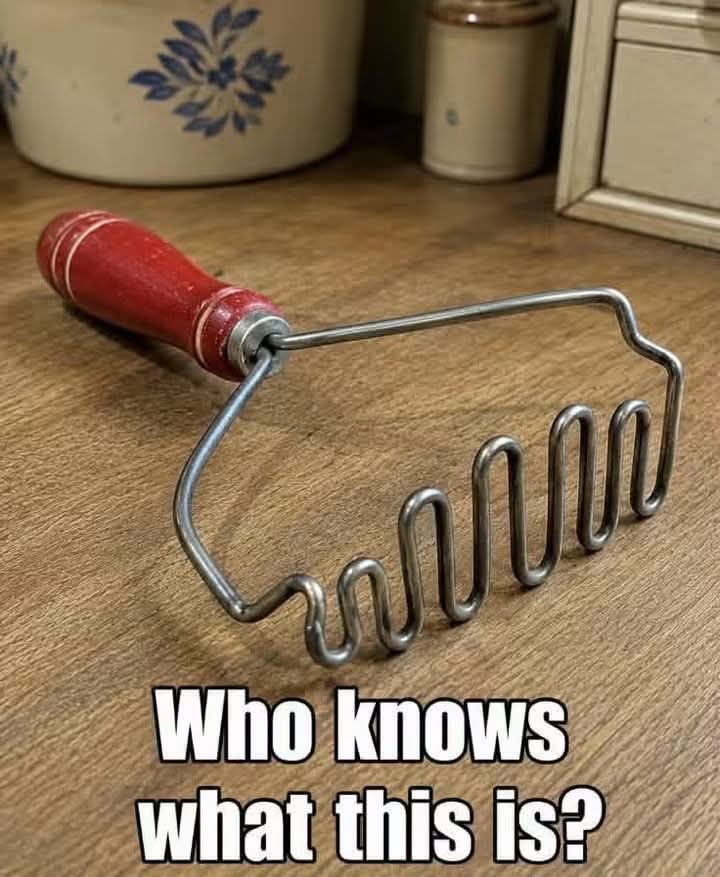
It has a wooden handle, a metal frame, and a wonderfully wavy wire head.
Today, someone seeing it for the first time might guess it was a strange whisk, a primitive beater, or perhaps some kind of garden tool.
But if you grew up with an older kitchen—or remember watching your grandmother cook—you may recognize it immediately.
It’s a vintage wire potato masher! 🥔❤️
And this simple little utensil is a wonderful reminder that some of the best kitchen tools were never complicated to begin with.


🥔 What Is This Thing?
The utensil in the photo is a wire potato masher, sometimes simply called a masher.
Its job is exactly what its name suggests:
Mash potatoes!
The thick metal wire is bent into a series of loops or waves. When you press it down into cooked potatoes, the soft potatoes are broken apart and pushed around the wire.
Unlike an electric mixer or food processor, it doesn’t pulverize the potatoes.
Instead, it gives you that classic homemade mashed-potato texture.
The basic wire masher design has been around for well over a century. Historical records from the National Park Service note that wire potato mashers appeared in the 1850s, with early examples using a hardwood handle and a square or round wire head. (npshistory.com)
👵 A Kitchen Tool From Another Era
Before modern electric appliances became common, cooks relied on simple tools that could perform one job extremely well.
Potatoes could be mashed with wooden utensils, spoons and other basic implements, but the wire masher offered something particularly useful: leverage and surface area.
The cook simply pressed the masher down repeatedly until the potatoes reached the desired consistency.
No electricity.
No buttons.
No motor.
No complicated parts.
Just a potato, a pot, butter, milk and a strong arm. 😂
❤️ Why Grandma’s Mashed Potatoes Tasted So Good
There’s something special about mashed potatoes made by hand.
The potatoes aren’t necessarily perfectly smooth—and that’s part of the charm.
Those tiny lumps and soft pieces give homemade mashed potatoes their character.
A traditional masher also makes it easy to stop when the potatoes have reached the texture you want.
That’s important because potatoes can become gluey when they’re overworked. A masher allows you to break them down without repeatedly processing them with a powerful appliance.
Potato mashers are also useful for more than potatoes. They’re commonly used for foods such as cooked vegetables, beans, peas and other soft foods. (Wikipédia)
🥔 How to Make Old-Fashioned Mashed Potatoes With One
If you still have one of these old-fashioned mashers—or find one at a thrift store—put it to work!
Ingredients
- 2 pounds potatoes
- 4 tablespoons butter
- ½–¾ cup warm milk
- 1 teaspoon salt, plus more to taste
- ¼ teaspoon black pepper
- 2 tablespoons sour cream, optional
Optional additions
- Roasted garlic
- Chives
- Green onions
- Shredded cheese
- Cream cheese
- Gravy
- Fresh parsley
👩🍳 Step-by-Step Instructions
1. Peel the potatoes
Peel the potatoes if desired and cut them into roughly equal-sized pieces.
You can leave the skins on for a more rustic mashed potato.
2. Boil
Place the potatoes in a large pot and cover them with cold water.
Add a generous pinch of salt.
Bring to a boil, then reduce the heat and cook until the potatoes are completely tender when pierced with a fork.
3. Drain well
Drain the potatoes thoroughly.
Let them sit for a minute or two so excess moisture can evaporate.
This helps prevent watery mashed potatoes.
4. Add butter
Return the potatoes to the warm pot.
Add the butter and allow it to melt into the potatoes.
5. Start mashing
Now bring out that old-fashioned masher!
Press down firmly and lift.
Repeat.
Keep working until the potatoes reach the texture you like.
6. Add warm milk
Pour in a little warm milk at a time, gently mashing between additions.
Don’t add all the milk at once.
You can always add more—but it’s difficult to rescue potatoes that have become too thin.
7. Season
Add salt and black pepper to taste.
For extra creamy potatoes, stir in sour cream.
8. Serve immediately
Pile those beautiful mashed potatoes into a serving bowl.
Add a little pat of butter right on top.
Now that’s comfort food. 🥔🧈
🧈 The Secret to Really Good Mashed Potatoes
One of the simplest tricks is to make sure your dairy ingredients aren’t ice cold.
Warm milk blends into the hot potatoes more easily and helps keep everything hot.
And don’t be afraid of butter.
This is mashed potatoes we’re talking about. 😂
For especially rich mashed potatoes, you can replace some of the milk with heavy cream.
🥔 Don’t Only Use It for Potatoes!
That vintage masher has more uses than you might think.
🫘 Beans
Use it to mash cooked beans for refried beans or rustic bean dips.
🥑 Avocado
A masher can create chunky homemade guacamole.
🍎 Apples
Soft cooked apples can be mashed into applesauce.
🎃 Pumpkin & Squash
Use it to break down cooked pumpkin, butternut squash or other soft vegetables.
🥚 Egg Salad
A masher can help break boiled eggs into pieces for egg salad.
🫘 Peas
Mash cooked peas into a rustic side dish.
The Smithsonian and other historical kitchen references document mashers as tools for crushing a range of soft foods, not just potatoes. (Wikipédia)
🏡 Why These Old Tools Are So Special
Modern kitchens are filled with appliances designed to do everything faster.
Food processors chop.
Blenders puree.
Stand mixers beat.
Electric hand mixers whip.
But there is something satisfying about reaching into a kitchen drawer and pulling out a tool that requires nothing but your own hands.
The design is simple enough that you can look at it and immediately understand how it works.
That’s one reason vintage kitchen tools remain so charming.
They’re practical, durable and often built around a single purpose.
The Smithsonian’s Cooper Hewitt collection, for example, includes a circa-1935 wire potato masher with a painted wooden handle and bent steel wire head—proof that this basic style was firmly established decades ago. (Smithsonian)
🧼 How to Care for an Old Potato Masher
If you own a vintage masher and want to actually use it, inspect it carefully first.
Look for:
- Rust
- Flaking paint
- Loose wires
- Cracked wooden handles
- Corrosion around the handle
- Areas that are difficult to clean
If the metal is rusty or the handle has deteriorated, it’s better to use the piece as kitchen décor rather than for food preparation.
For a sound vintage utensil, wash it thoroughly and dry it completely after use.
And if it’s an antique or sentimental family piece, you may want to preserve it rather than put it through years of additional wear.
🥔 Vintage vs. Modern Mashers
The basic principle hasn’t changed much.
Modern mashers can have:
- Perforated plates
- Zigzag wires
- Stainless-steel heads
- Ergonomic handles
- Silicone-coated components
The Smithsonian even has examples of modern wire mashers featuring stainless-steel zigzag heads. (Musée national d’histoire américaine)
But the job remains exactly the same:
Press, mash, repeat.
Sometimes the simplest ideas really do stand the test of time.
😂 The Kitchen Tool Test
Show this utensil to someone who grew up in the 1940s, 1950s, 1960s or 1970s and there’s a good chance they’ll recognize it immediately.
Show it to a child today and you might get:
“What is THAT?”
And that’s what makes these old kitchen tools so much fun.
They aren’t just objects.
They remind us of kitchens where meals were made from scratch, recipes were often passed down by word of mouth, and nobody needed an app to tell them how to mash a potato.
❤️ A Little Piece of Kitchen History
That funny-looking metal gadget in the photograph may not look particularly impressive.
But generations of cooks used tools just like it to make mashed potatoes, beans, vegetables and countless family meals.
It represents something we don’t always appreciate anymore:
A well-designed tool doesn’t need to be complicated.
Give someone potatoes, a pot, butter, milk and an old-fashioned masher, and they can turn a humble vegetable into one of the world’s greatest comfort foods.
And maybe that’s why so many of us still smile when we see one.
It reminds us of home.
🥔 So… Did You Know What It Was?
YES! 🙋♀️
NOPE! 🤔
I STILL HAVE ONE! ❤️
MY GRANDMA HAD ONE! 👵
If you recognized this old-fashioned kitchen tool immediately, you definitely get a few nostalgia points!
Did your family have one of these wire potato mashers—and do you still use it today? 🥔❤️
