👀🍝
When “Traditional Italian Food” Goes Very, Very Wrong
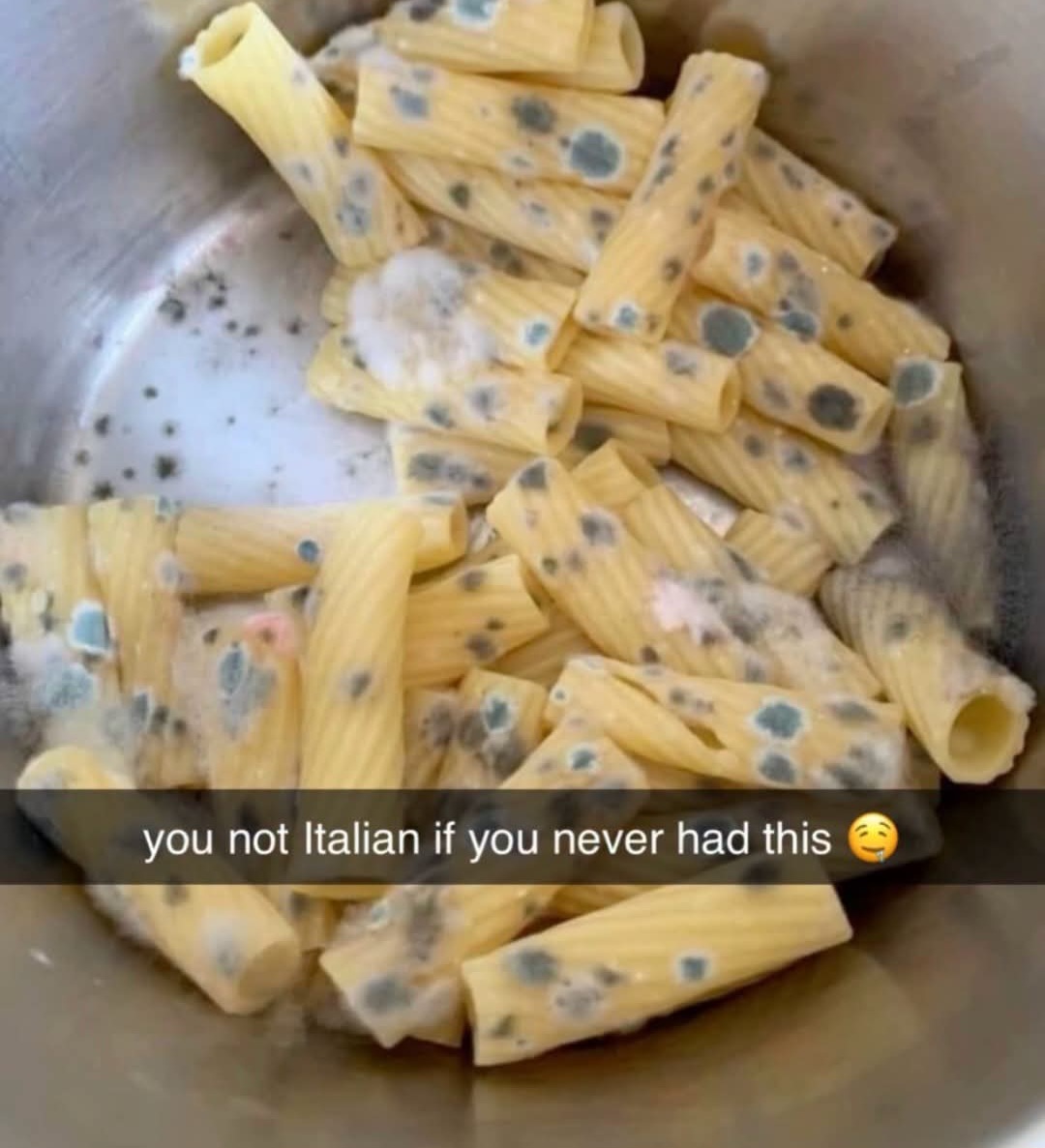
At first glance, this picture might make you do a double take. A bowl of rigatoni is covered in strange blue, green, gray, and white spots, while the caption jokingly suggests:
“You not Italian if you never had this.” 😅
But before anyone starts arguing about family recipes, there’s an important detail: those spots look like mold, not an Italian delicacy.
So, Italians… can you vouch for this one? 🇮🇹🍝
What Are Those Blue Spots?
The discoloration on the pasta is consistent with visible mold growth. Mold can appear in different colors, including green, blue, gray, white, or black, depending on the type and conditions.
And while certain molds are deliberately used to make foods such as Gorgonzola and other blue cheeses, that does not mean mold growing accidentally on leftover pasta is safe to eat. (FSIS)
In other words, this isn’t “extra seasoning.”
It’s spoilage. 😅
No, This Isn’t a Secret Italian Pasta Tradition
Italian cuisine has thousands of traditional dishes, regional specialties, unusual ingredients, fermented foods, aged cheeses, and recipes that have been passed down for generations.
But moldy cooked rigatoni isn’t one of them.
The joke works because many families have experienced the classic refrigerator surprise: you put leftovers away, forget about them, and discover them days—or weeks—later.
You open the container…
You see something growing…
And suddenly you’re questioning every decision that led to that moment. 😂
Why Does Pasta Mold So Easily?
Cooked pasta contains plenty of moisture, which creates favorable conditions for mold growth when it is stored too long or improperly.
That’s why cooked pasta shouldn’t simply be left sitting on the counter indefinitely. Leftovers should be refrigerated promptly and stored properly.
According to the USDA, cooked grain and pasta with visible mold should be discarded, because mold can penetrate below the surface and moldy foods may also contain bacteria that aren’t visible. (FSIS)
“Can I Just Scrape the Mold Off?”
This is where you definitely don’t want to follow the old-fashioned approach of simply removing the suspicious-looking part.
With some firm, low-moisture foods, such as certain hard vegetables or hard cheeses, a small area of mold can sometimes be cut away according to food-safety guidance.
Cooked pasta is different.
Because it is moist and porous, visible mold on one piece can mean contamination extends beyond what you can see. The USDA specifically lists cooked pasta among foods that should be discarded when moldy. (FSIS)
So don’t pick out the blue pieces and eat the rest.
The whole batch belongs in the trash.
And Don’t Give It the “Smell Test”
You might be tempted to open the container and take a sniff to see whether it’s really bad.
Don’t.
USDA guidance specifically recommends not sniffing moldy food, because disturbing mold can send spores into the air. (FSIS)
If you see obvious mold, that’s enough information.
How Long Does Cooked Pasta Last?
A good rule for refrigerated leftovers is to use cooked pasta within about 3–4 days when stored properly in the refrigerator. USDA guidance gives 3–4 days for cooked rice and pasta. (FSIS)
If you aren’t going to eat it within that window, freezing portions can be a much better option.
And remember: refrigeration slows microbial growth, but it doesn’t make food immortal. Some molds can grow even at refrigerator temperatures. (FSIS)
What About the “Italian” Part?
That’s what makes the meme funny.
Italy has an extraordinary food culture built around pasta, but Italian cooking isn’t about eating food after it has visibly spoiled. Traditional Italian cuisine includes everything from simple tomato pasta and carbonara to regional specialties featuring aged cheeses, cured meats, seafood, vegetables, legumes, and fermented or preserved foods.
Mold intentionally introduced as part of making a specific food is one thing. Random mold growing on leftover pasta is another.
So if someone serves you this and says, “It’s a traditional family recipe,” you might want to ask a few questions first. 😂
The Refrigerator Lesson We Can All Relate To
We’ve probably all had that moment when something gets pushed to the back of the refrigerator and forgotten.
A few days become a week.
The container gets pushed farther back.
Eventually, you discover it again.
And suddenly your leftover pasta has developed its own ecosystem.
The safest response isn’t to investigate how advanced the colony has become.
Throw it away.
The FDA also advises that mold is a sign of spoilage and says the safest practice is to discard moldy food. (U.S. Food and Drug Administration)
Final Verdict 🇮🇹🍝
Can Italians vouch for this?
Probably not as a traditional Italian dish! 😂
The picture is much better understood as a joke about forgotten leftovers than an authentic Italian recipe.
If your rigatoni looks like the pasta in this picture—with obvious blue, green, gray, or fuzzy growth—don’t eat it, don’t scrape it off, and don’t try to rescue the rest.
Toss it, clean the container, and make a fresh plate of pasta.
Because there’s nothing more Italian than enjoying good pasta…
but there is absolutely no reason to eat pasta that has started growing a new life form. 😅🍝🇮🇹
