🥩 “!” 👀🐄 The Steak Doneness Debate Everyone Has an Opinion About
There are few food topics that can start an argument faster than how a steak should be cooked.
Some people want a steak with a deeply browned crust and a warm, rosy center. Others want their beef cooked until there isn’t a hint of pink. And then there are the people who look at an extremely rare steak and say:
“That’s not rare… that’s still mooing!” 😂🥩
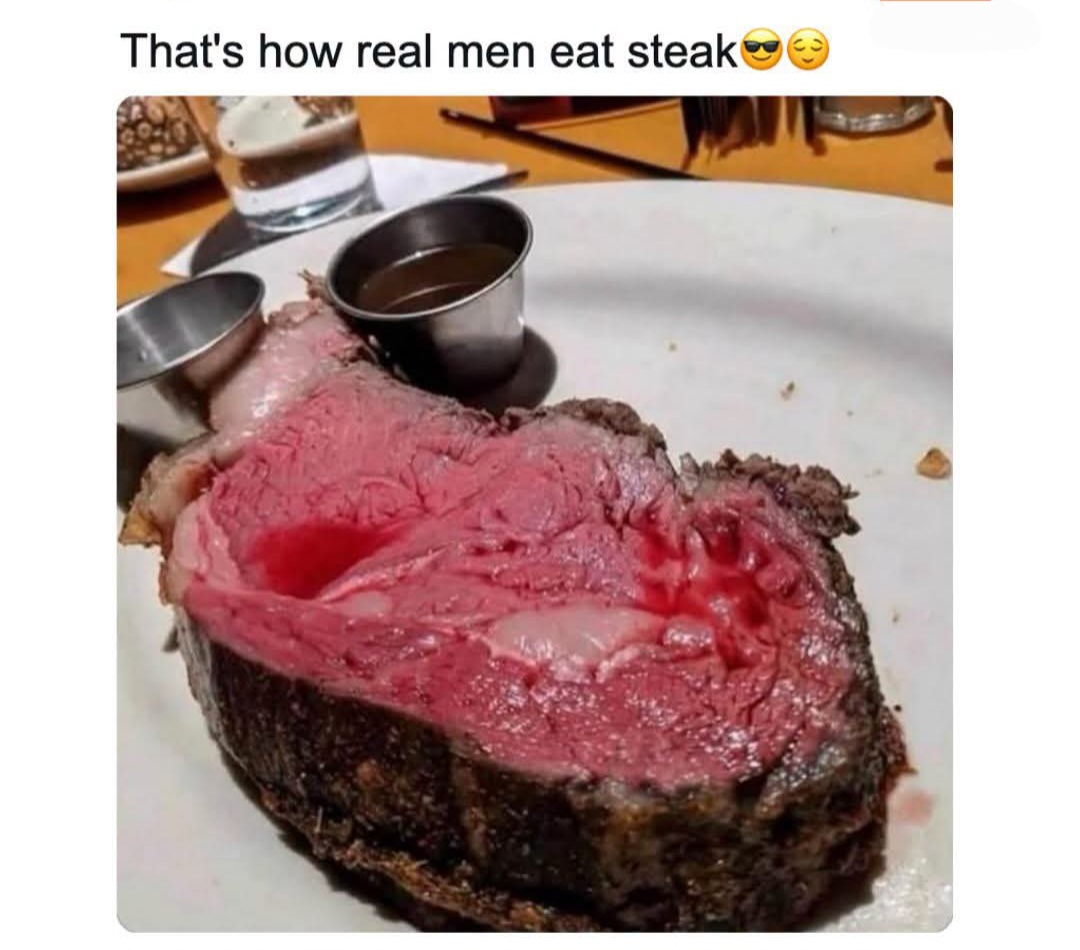
The steak in this photo definitely falls into the category that gets people talking.
But what exactly is the difference between rare, medium-rare, medium, medium-well and well-done? And how can you cook a steak so the outside is beautifully seared while the inside reaches the doneness you actually want?
Let’s settle the steak debate once and for all.
🥩 First: Is That Steak “Alive”?
No. A very red steak isn’t alive.
The red or pink liquid you see on a cooked steak also isn’t simply blood. Most of the blood has been removed during processing. The red color is largely associated with myoglobin, a protein in muscle tissue that gives beef its characteristic color.
So when someone sees a very red steak and says, “It’s still bleeding,” that’s not technically what’s happening.
However, very red doesn’t automatically mean safely cooked.
That’s an important distinction.
🔥 The Five Common Levels of Steak Doneness
Restaurants and home cooks commonly use terms such as rare, medium-rare, medium, medium-well and well-done.
The appearance and texture change considerably as the internal temperature increases.
🥩 Rare
A rare steak is typically:
- Deep red in the center
- Warm inside
- Very juicy
- Soft and tender
- Seared on the outside
This is the level that produces the biggest reaction from people who prefer their steak well done.
🥩 Medium-Rare
For many steak lovers, medium-rare is the sweet spot.
The center is:
- Warm
- Rosy pink to red
- Juicy
- Tender
- Surrounded by a flavorful browned crust
It’s especially popular for naturally tender cuts such as ribeye, strip steak and tenderloin.
🥩 Medium
A medium steak has a noticeably pink center but is more cooked than medium-rare.
You’ll generally get:
- A warm pink center
- A firmer texture
- Less visible redness
- Plenty of moisture when cooked properly
This is a great compromise when two people at the table prefer different levels of doneness.
🥩 Medium-Well
Medium-well has only a small amount of pink remaining in the center.
The steak is:
- Firmer
- More thoroughly cooked
- Less juicy than medium or medium-rare
Because there’s less moisture remaining, choosing a naturally tender and well-marbled cut can help prevent the steak from becoming dry.
🥩 Well-Done
A well-done steak is cooked throughout with little or no visible pink center.
For people who prefer their meat fully cooked, that’s a perfectly valid personal preference.
The challenge is keeping the steak from becoming dry or tough.
A thicker steak, good seasoning and careful temperature control can help.
🌡️ But Here’s the Important Part: Color Isn’t a Safety Test
This is where steak memes can be misleading.
You cannot reliably determine whether beef is safely cooked just by looking at the center.
The USDA recommends cooking whole cuts of beef, including steaks and roasts, to a minimum internal temperature of 145°F (62.8°C) and allowing them to rest for at least three minutes. (FSIS)
That means a steak can still appear somewhat pink after reaching a safe temperature.
Likewise, a steak can look browned on the outside without you knowing its internal temperature.
The safest way to check?
Use a food thermometer.
Insert it into the thickest part of the steak without touching bone or other areas that could give an inaccurate reading. (FSIS)
🥩 Why Do People Love Rare and Medium-Rare Steak?
It’s mostly about texture and moisture.
As beef is cooked for longer periods, proteins change and moisture is gradually lost.
That’s why many steak enthusiasts prefer a lower level of doneness: they want to preserve the tender, juicy texture while still developing a deeply browned exterior.
And that exterior is important.
🔥 The Secret Is the Crust
A beautifully cooked steak isn’t supposed to be pale all over.
That gorgeous brown crust comes from the Maillard reaction, a series of chemical reactions that occur when the surface of food gets hot enough.
It’s responsible for much of the savory, roasted flavor we associate with:
- Seared steak
- Toasted bread
- Roasted vegetables
- Fried potatoes
So the ideal steak for many people is:
🔥 Deeply browned outside + juicy center
That’s where the magic happens.
🧂 How to Cook a Steak With a Great Crust
You don’t need a complicated recipe.
Start with a good steak.
Ribeye, strip steak and tenderloin are popular choices for quick high-heat cooking.
Step 1: Pat the steak dry
Use paper towels to remove excess surface moisture.
A dry surface browns much more effectively than a wet one.
Step 2: Season generously
Salt is essential.
Add freshly ground black pepper if you like.
You can also add garlic powder or other seasonings depending on your recipe.
Step 3: Heat the pan
A heavy skillet, such as cast iron, works particularly well for searing.
Get it hot before adding the steak.
Step 4: Add a little cooking fat
Use an oil appropriate for high-heat cooking.
Place the steak into the hot pan.
Step 5: Don’t constantly move it
Let the steak develop a crust.
Flip it when appropriate and continue cooking.
Step 6: Check the temperature
Instead of guessing by color, use your thermometer.
Remember that the USDA’s minimum safe temperature for whole beef steaks is 145°F, followed by a three-minute rest. (FSIS)
Step 7: Let it rest
Don’t immediately slice into the steak the second it comes off the heat.
Give it time to rest before serving.
🧈 Want to Make It Even Better?
During the final part of cooking, you can add:
- Butter
- Garlic
- Rosemary
- Thyme
Tilt the pan slightly and spoon the flavorful melted butter over the steak.
This is commonly called butter basting.
The result is a rich, aromatic crust and a steak that smells absolutely incredible.
🥩 Why Does Steak Sometimes Look More Red After Cutting?
Don’t panic if you cut into your steak and notice red or pink juices.
The color isn’t by itself proof that the steak is unsafe.
Myoglobin can give beef and its juices a red or pink appearance.
That’s why temperature is more useful than color when judging safety. USDA guidance specifically notes that visual appearance isn’t a reliable way to determine whether meat has reached a safe temperature. (FSIS)
🥩 Rare vs. Medium-Rare: What’s the Difference?
This is where many people get confused.
Rare:
❤️ Very red center
🔥 Warm interior
💧 Very juicy
🥩 Very soft texture
Medium-Rare:
🌸 Pink/red center
🔥 Warm throughout
💧 Juicy
🥩 Tender with a little more firmness
The difference may look small in a photograph, but you can definitely notice it when eating.
🥩 What About Well-Done Steak?
Let’s be clear:
There’s no rule that says you have to eat steak rare.
If you love well-done steak, eat it well done!
Food is personal.
Some people love the juicy texture of medium-rare beef. Others don’t enjoy seeing pink meat and prefer their steak cooked through.
The goal isn’t to convince everyone to eat steak the same way.
The goal is to cook it safely and exactly how you enjoy it.
😂 The Internet Steak Argument
Photos like the one above are guaranteed to produce comments like:
“That’s perfect!”
“That’s not even cooked!”
“I’d send it back.”
“That’s exactly how I like mine.”
“The cow is looking for it.” 😂
And that’s what makes these food posts so entertaining.
Everyone has an opinion.
One person sees a beautifully seared steak with a juicy center.
Another person sees a steak that needs another 10 minutes on the grill.
Neither person is necessarily going to change the other’s mind!
🥩 The Best Steak Is the One You Enjoy
Whether you prefer:
❤️ Rare
🌸 Medium-rare
🥩 Medium
🤎 Medium-well
🔥 Well-done
there’s a steak for you.
The most important things are choosing a good cut, seasoning it properly, creating a delicious crust and using a food thermometer when you need to verify safe cooking.
And remember: the color of a steak isn’t a reliable safety test.
For whole beef steaks, USDA guidance recommends reaching 145°F (62.8°C) and resting for at least three minutes. (FSIS)
🥩 Final Question: How Do YOU Like Your Steak?
Looking at the steak in the photo…
Would you eat it exactly like this? 👀🥩
A. Rare ❤️
B. Medium-Rare 🌸
C. Medium 🥩
D. Medium-Well 🤎
E. Well-Done 🔥
F. I want it cooked until the cow is completely forgotten 😂
Tell us your steak doneness in the comments! 👇🥩🔥
