🥩 ?
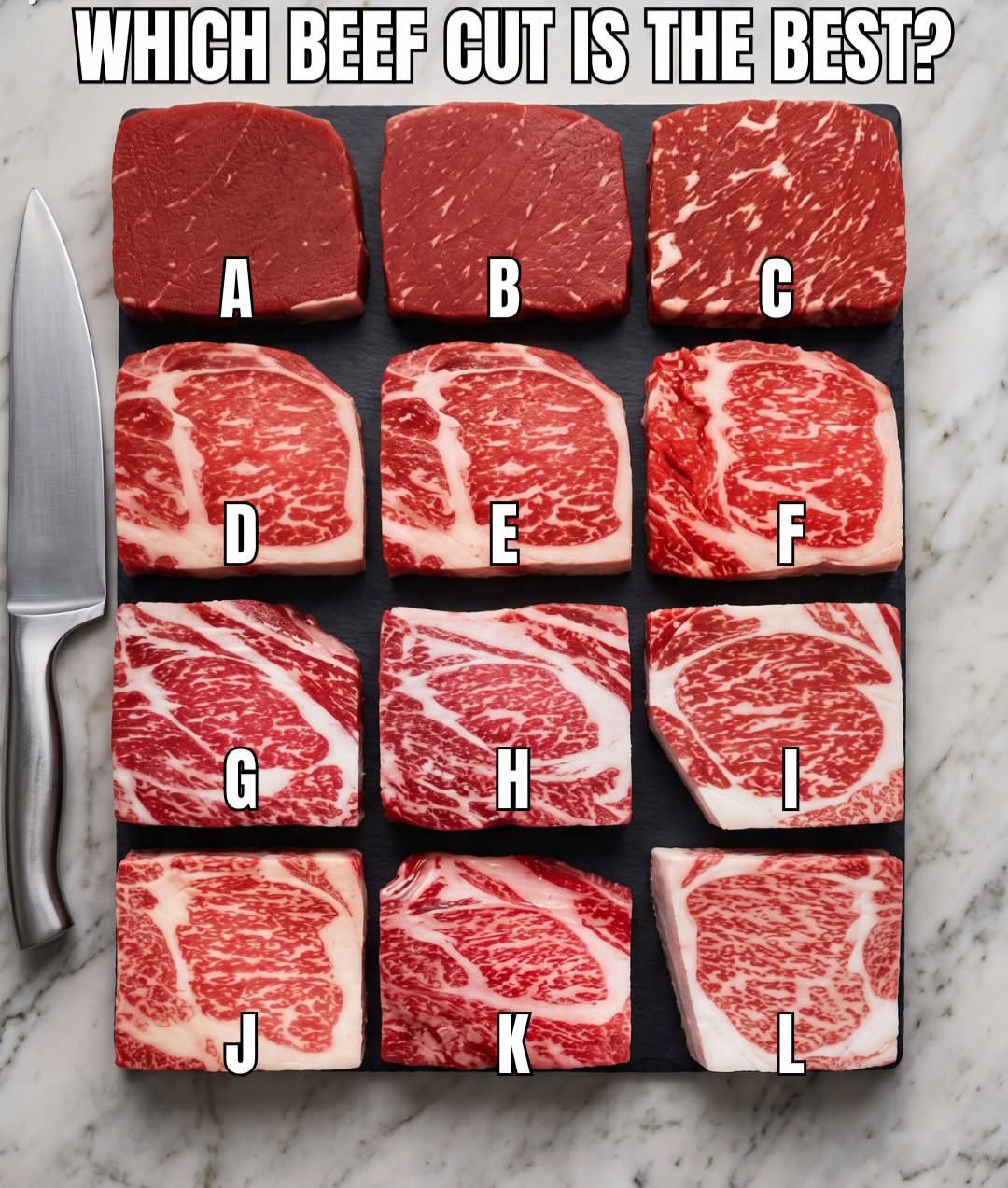
If you walked up to a butcher counter and saw a selection of steaks like the ones in this picture, which one would you choose? A, B, C, D, E, F, G, H, I, J, K or L? 👀🥩
Some people immediately look for the steak with the most beautiful marbling, while others prefer a leaner piece of beef. And when it comes to steak, there isn’t one choice that’s perfect for everyone.
The best steak really depends on what you enjoy: rich and buttery, lean and tender, juicy and flavorful, or somewhere in between.
So let’s talk about what you’re actually looking for when choosing beef.
🥩 What Is Marbling?
Those white lines running through the meat are called marbling. They are small deposits of intramuscular fat distributed throughout the muscle.
When a well-marbled steak is cooked, some of that fat melts and contributes to a juicy texture and rich flavor.
Generally, more marbling can mean:
- A richer flavor
- A juicier bite
- A more buttery texture
- More rendered fat during cooking
But more marbling doesn’t automatically mean a steak is better. Some people simply prefer the flavor and texture of leaner beef.
👀 Which One Would You Pick?
Look at the steaks in the picture and make your choice before reading the comments.
A — Leaner Choice
A steak with relatively little visible marbling may appeal to someone who prefers a leaner bite.
The advantage is that there is less fat to trim or render. The downside is that lean beef can become dry if it is cooked too far.
Best for: People who prefer lean beef and don’t want a very fatty steak.
B — A Little More Marbling
B has more visible fat than A while still looking relatively lean.
For someone who wants a balance between a lean steak and a richer steak, this type of appearance may be appealing.
Best for: A middle-ground choice.
C — Noticeably Marbled
C has considerably more visible intramuscular fat.
That extra marbling can provide a richer eating experience when the steak is cooked properly.
Best for: People who love a flavorful, juicy steak.
D, E and F — Richly Marbled
These steaks have significantly more visible marbling than the leaner examples.
This is the kind of beef that catches the eye of people who believe “the more marbling, the better!” 😍
The amount and distribution of marbling can vary even among steaks from the same general cut, so appearance is only one part of the equation.
Best for: Steak lovers who prioritize richness and tenderness.
G, H and I — For the Serious Steak Lover
These examples show even more extensive marbling.
When cooked correctly, highly marbled beef can develop an exceptionally rich texture and flavor.
However, extremely fatty steaks aren’t everyone’s favorite. Some diners prefer a stronger beef flavor with less fat.
Best for: Anyone who loves a decadent, buttery steak.
J, K and L — The Fat-Lovers’ Picks
These steaks have substantial marbling throughout the meat.
If you’re the person who sees those white streaks and thinks, “That’s exactly what I want!”, these may be your favorites.
Just remember that marbling can render significantly during cooking, so the finished steak won’t look exactly like it did when it was raw.
🥩 More Marbling vs. Less Marbling
So which is actually better?
It depends.
A highly marbled steak can be incredibly juicy and rich, but a leaner steak can still be delicious when it comes from a tender cut and is cooked appropriately.
There are also other factors that matter when selecting beef:
1. The Cut
Different cuts naturally have different amounts of fat and tenderness.
Ribeye, strip steak, tenderloin, sirloin and other cuts each have their own characteristics.
2. Quality Grade
In systems such as the USDA grading system, marbling is an important factor in determining quality grades for beef.
Higher grades generally indicate more marbling, although the grading system involves more than simply looking at one steak.
3. Thickness
A thicker steak gives you more control over the cooking process.
It can be easier to develop a browned exterior while keeping the center at your preferred doneness.
4. Cooking Method
A beautiful steak can still be disappointing if it’s overcooked.
High-heat grilling, pan-searing, broiling and reverse-searing can all produce excellent results when matched with the right cut and thickness.
5. Personal Taste
This might be the most important factor of all.
One person may want a heavily marbled steak dripping with buttery richness.
Another may look at the same steak and say, “Way too much fat!” 😂
Neither person is wrong.
🔥 How to Get the Most From a Good Steak
Regardless of which steak you choose, a few simple habits can make a big difference.
Pat the Steak Dry
Before cooking, use paper towels to remove excess surface moisture. A dry surface helps the steak brown rather than steam.
Season Simply
For a great steak, you don’t necessarily need a complicated marinade.
Salt and freshly ground black pepper are classic choices. You can add garlic, herbs or butter if you enjoy them.
Use a Hot Cooking Surface
A properly heated grill or skillet helps create the browned crust that makes a steak so appealing.
Don’t Guess the Doneness
A meat thermometer is much more reliable than cutting into the steak repeatedly to check its center.
For food safety, use the recommended safe cooking temperatures for the type of beef you’re preparing.
Let It Rest
After cooking, give the steak a short rest before slicing. This allows the juices to redistribute rather than immediately running onto the cutting board.
🥩 Does More Fat Always Mean More Flavor?
Not necessarily.
Fat can contribute significantly to the flavor and mouthfeel of beef, but the type of cut, aging, cooking technique, seasoning and quality of the meat all matter too.
A beautifully cooked moderately marbled steak can be every bit as satisfying as an extremely fatty one.
That’s why choosing beef isn’t simply a competition to find the steak with the most white lines.
It’s about finding the steak that matches your taste.
❤️ So… What’s Your Pick?
Now it’s your turn!
Forget the price for a moment. Imagine all 12 steaks were sitting at the butcher counter in front of you.
Which one are you taking home?
🥩 A – Leaner
🥩 B – Lightly marbled
🥩 C – Moderately marbled
🥩 D – Richly marbled
🥩 E – Richly marbled
🥩 F – Very marbled
🥩 G – Extra marbled
🥩 H – Extra marbled
🥩 I – Very rich
🥩 J – Heavily marbled
🥩 K – Heavily marbled
🥩 L – Heavily marbled
Tell us your letter in the comments! 👇
And here’s the real question:
🥩 Are you choosing the leanest steak, the most marbled steak, or somewhere right in the middle?
There is no wrong answer—the best steak is the one you enjoy eating! ❤️
