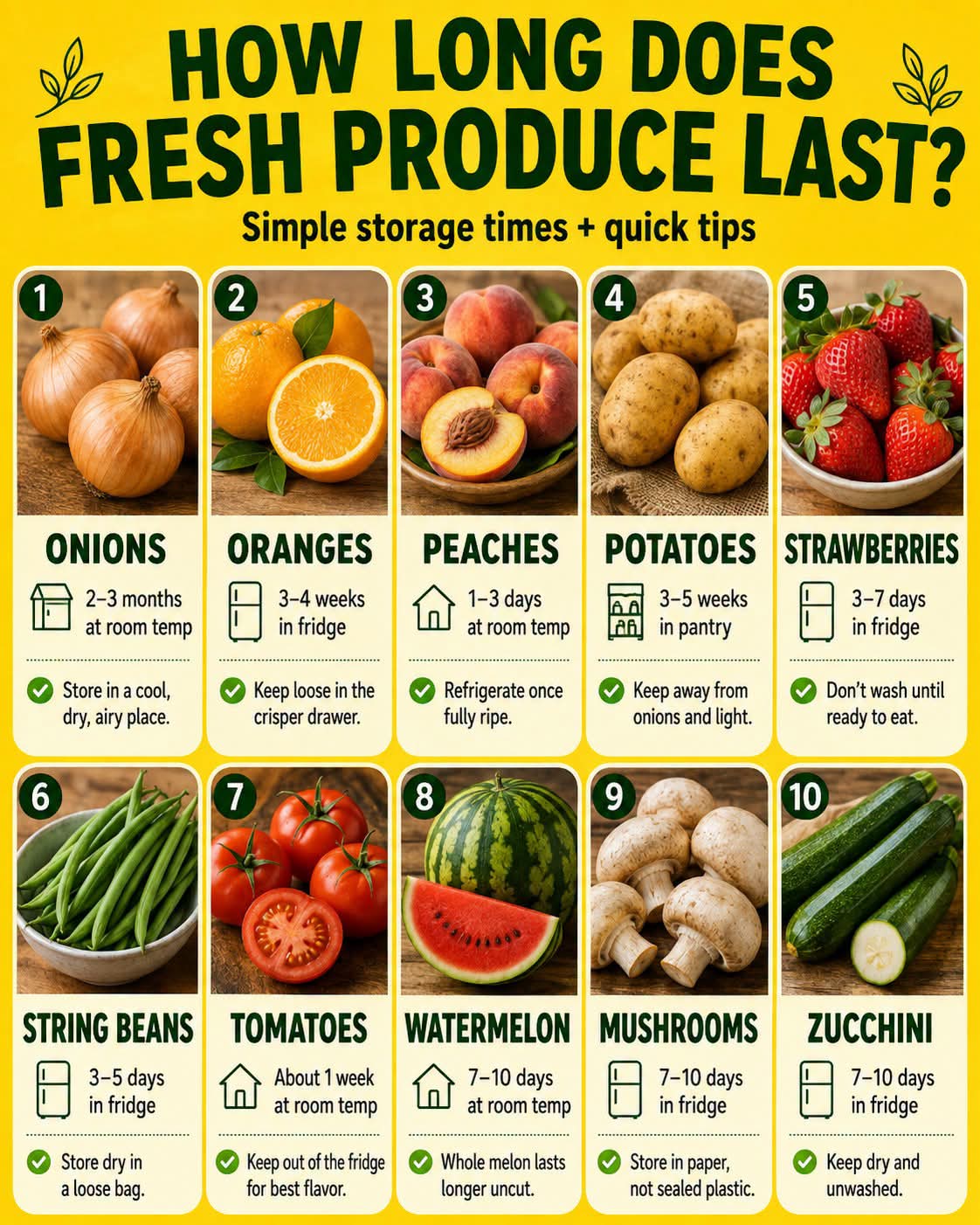
These Produce Tips Help Food Last Longer 🍅🍓
Have you ever brought home a beautiful bag of fresh produce, only to find yourself throwing half of it away a few days later?
The problem may not be the produce itself. Sometimes, where you store it makes all the difference.
Not every fruit or vegetable belongs in the refrigerator. Some actually keep better on the counter or in a cool, dark place, while others need refrigeration to stay fresh and safe.
Learning a few simple storage rules can help your produce last longer, taste better, and keep more food from ending up in the trash.
🧅 Onions: Keep Them Cool, Dark and Dry
Whole, dry onions generally do best in a cool, dry, dark, well-ventilated place rather than the refrigerator.
A mesh bag, basket, or another container that allows air to circulate works well. Avoid sealing whole onions in an airtight plastic bag because trapped moisture can encourage spoilage.
And here’s an important rule:
Don’t store onions right next to your potatoes.
Both need similar cool, dark conditions, but storing them together can cause them to spoil faster. Keep them separated for better results. USDA guidance also recommends storing dry onions and potatoes in dry storage rather than refrigeration. (fna.usda.gov)
🥔 Potatoes: Skip the Fridge
Whole potatoes generally prefer a cool, dark, dry place with good air circulation.
A pantry, cupboard, basement storage area, or another suitable cool space can work better than the refrigerator.
Keep potatoes away from direct sunlight, which can cause unwanted changes in color and quality.
And remember: potatoes and onions may both love a dark pantry, but they don’t need to share the same storage container.
🍅 Tomatoes: Counter First
Whole tomatoes are one of the classic examples of produce that doesn’t necessarily belong in the refrigerator.
For the best flavor and texture, keep ripe tomatoes at room temperature and away from direct sunlight.
Refrigeration can affect their texture and flavor, so if your tomatoes are perfectly ripe and you’re planning to eat them soon, the counter is usually the better choice.
If you have very ripe tomatoes that you need to keep a little longer, refrigeration can help slow further deterioration, although the texture may suffer.
🍓 Strawberries: Straight to the Fridge
Strawberries are delicate and highly perishable.
They should be refrigerated rather than left sitting on the counter. The FDA specifically lists strawberries among perishable fresh produce that should be stored in a refrigerator at 40°F (4°C) or below. (U.S. Food and Drug Administration)
A helpful habit is to remove any berries that are already moldy or badly damaged so they don’t affect the rest.
For the best quality, avoid washing the entire container until you’re ready to use the berries. Excess moisture can encourage spoilage.
🍄 Mushrooms: Keep Them Chilled
Fresh mushrooms also belong in the refrigerator.
Keep them cold and avoid trapping unnecessary moisture around them. Mushrooms are among the perishable produce items the FDA recommends refrigerating. (U.S. Food and Drug Administration)
If they came packaged in a container designed for ventilation, you can generally leave them in their original packaging until you’re ready to use them.
🥒 Zucchini: The Refrigerator Is Your Friend
Fresh zucchini generally lasts longer when refrigerated.
Place whole zucchini in the refrigerator and use it while it is still firm and free from soft or damaged spots.
If you have more zucchini than you can eat quickly, don’t forget that it can also be cooked, frozen, or turned into things like zucchini bread, fritters, soups, or casseroles.
🫘 Green Beans: Refrigerate Them
Fresh green beans are another vegetable that benefits from refrigeration.
Keep them cold and use them while they’re still crisp and firm.
Avoid washing them far in advance if you’re not ready to cook or eat them, since excess moisture can contribute to deterioration.
🍊 Oranges: Fridge or Counter?
Oranges are a little more flexible.
Whole oranges can be kept at room temperature if you’re planning to eat them relatively soon. However, refrigeration can extend their usable life, making the refrigerator a good option when you have more oranges than you can eat in a few days.
If you have a large bag of oranges, putting some in the refrigerator can help you enjoy them over a longer period instead of trying to eat them all at once.
🍑 Peaches: Let Them Ripen First
Peaches are another fruit where timing matters.
If your peaches are still firm and need to ripen, leave them at room temperature until they reach the ripeness you want.
Once they’re ripe, you can move them to the refrigerator if you need to slow them down and buy yourself a little extra time.
That’s especially helpful when you have several peaches ripening at once.
Counter for ripening. Refrigerator for slowing things down.
🍉 Watermelon: Counter Before Cutting, Fridge After
An intact watermelon doesn’t necessarily need to occupy valuable refrigerator space.
If it’s whole and uncut, it can be kept at room temperature in a suitable location.
But once you cut it, the situation changes.
Cut watermelon belongs in the refrigerator.
Store cut pieces in a clean, covered container or tightly covered with suitable food-storage material.
The FDA recommends refrigerating pre-cut produce, including cut watermelon. (U.S. Food and Drug Administration)
This is an important distinction: whole watermelon and cut watermelon should not be treated the same way.
🍌 What About Bananas?
Bananas are another fruit that generally does better outside the refrigerator while they are ripening.
Keep them at room temperature until they’re where you like them.
Once ripe, refrigeration can slow further ripening, although the peel may turn dark. Don’t let the darker peel fool you into thinking the inside has automatically gone bad.
🧄 Garlic: Keep It Dry
Whole, unpeeled garlic generally prefers a cool, dry, well-ventilated place rather than a humid refrigerator.
A basket or mesh container is often better than a sealed plastic bag.
Once garlic has been peeled or cut, its storage needs change, so refrigerate prepared garlic appropriately.
🥬 Leafy Greens: Refrigerate
Lettuce, spinach, kale and similar leafy greens generally need refrigeration.
Keep them cold and try to minimize excess moisture. A clean towel or paper towel can help absorb moisture inside a storage container or bag.
Don’t pack greens so tightly that air can’t circulate.
🌽 Fresh Corn: Refrigerate It
Fresh corn is best refrigerated if you aren’t cooking it right away.
Keep the husks on until you’re ready to prepare it when possible. Refrigeration helps slow the loss of quality.
And if you find a great deal on corn, remember that you can also blanch and freeze it for later.
🫑 Bell Peppers: Refrigerate
Whole bell peppers generally last longer in the refrigerator.
Keep them dry and avoid storing damaged peppers alongside perfectly fresh ones.
If you have several peppers approaching their prime, chopping and freezing them is an easy way to prevent waste.
🍎 Apples: Refrigerator for Longer Storage
Apples can sit on the counter for a short time, but refrigeration can help extend their quality.
If you buy a large quantity, the refrigerator can be especially useful.
Just remember that apples produce ethylene gas, which can speed ripening and deterioration in some nearby produce. Keeping ethylene-producing fruits separated from sensitive vegetables can help. (fna.usda.gov)
🍋 Lemons and Limes: You Have Options
Whole citrus fruit can generally be kept at room temperature for shorter-term use.
If you want to keep lemons or limes fresh for longer, refrigeration can help.
This is especially useful when you’ve bought a large quantity or stocked up because they were on sale.
🥑 Avocados: Don’t Refrigerate Too Early
Unripe avocados generally need room temperature to ripen.
Once they’re ripe, refrigeration can help slow the process if you’re not ready to eat them.
So once again, think about what you’re trying to accomplish:
Ripen = counter.
Slow down = refrigerator.
🍐 Pears: Ripen on the Counter
Like peaches, pears can be allowed to ripen at room temperature.
Once they’re ripe, refrigeration can help extend their useful life.
This simple two-step approach can keep you from ending up with several overripe pears at once.
A Simple Fridge-or-Counter Cheat Sheet
Keep in a cool, dark, dry place:
- 🧅 Whole dry onions
- 🥔 Whole potatoes
- 🧄 Whole garlic
- 🍅 Whole tomatoes
- 🍌 Bananas while ripening
- 🍑 Unripe peaches
- 🍐 Unripe pears
- 🍉 Whole, uncut watermelon
Refrigerate:
- 🍓 Strawberries
- 🍄 Fresh mushrooms
- 🥒 Zucchini
- 🫘 Green beans
- 🥬 Leafy greens
- 🌽 Fresh corn
- 🫑 Bell peppers
- 🍎 Apples for longer storage
- 🍊 Oranges when you want to extend their freshness
- 🍉 Cut watermelon
Ripen first, refrigerate later:
- 🍑 Peaches
- 🍐 Pears
- 🥑 Avocados
- 🍌 Bananas, if you want to slow them after ripening
One More Rule: Cut Produce Changes Everything
One of the most important things to remember is that whole produce and cut produce have different storage needs.
Once you cut, peel, chop, or slice fruits and vegetables, refrigeration becomes much more important.
The FDA recommends refrigerating pre-cut or packaged produce, and keeping the refrigerator at 40°F (4°C) or below. (U.S. Food and Drug Administration)
So that whole watermelon sitting on the counter is one thing.
The container of sliced watermelon in your refrigerator is another.
Don’t Forget to Wash Produce Properly
Storage is only part of the equation.
Before preparing fresh produce, wash your hands and rinse fruits and vegetables under running water. The FDA recommends washing produce before cutting or peeling it, because cutting through unwashed surfaces can transfer dirt or bacteria from the outside to the inside. (U.S. Food and Drug Administration)
You don’t need soap or a special produce wash. Plain running water is recommended.
For firm produce such as melons and cucumbers, a clean produce brush can help remove dirt from the surface. (U.S. Food and Drug Administration)
The Goal Isn’t Just Longer Shelf Life
Proper produce storage isn’t about making every fruit and vegetable last forever.
It’s about giving each one the environment it prefers.
Some produce needs cold.
Some prefers the counter.
Some needs darkness and good airflow.
And some needs to ripen before you put it in the refrigerator.
Once you learn these simple differences, your refrigerator starts making a lot more sense.
Instead of automatically putting everything in the fridge, take a second to ask:
“Does this actually belong here?”
That tiny change can help preserve texture, protect flavor, and reduce the amount of perfectly good food that ends up in the trash.
Final Takeaway
The best place for your produce isn’t always the refrigerator.
Onions and potatoes like cool, dark and dry storage — but keep them apart. Tomatoes generally taste better at room temperature. Strawberries and mushrooms need refrigeration. Peaches and pears can ripen on the counter and then move to the fridge. Whole watermelon can stay out, while cut watermelon needs to be refrigerated.
A few small storage changes can make a surprisingly big difference.
Store it where it lasts best, and you may find yourself throwing a lot less food away. 🍅🍓🥔🍑🍉
I can also turn this into a shorter Facebook-style viral article with a “FRIDGE or COUNTER?” graphic-style checklist if you’d like.
