A Crisp, Colorful Treat That Still Brings Back Memories
There’s something wonderfully nostalgic about a classic wafer cookie. Light, crisp, slightly sweet, and covered in that unmistakable grid pattern, wafer cookies have been a favorite snack for generations.
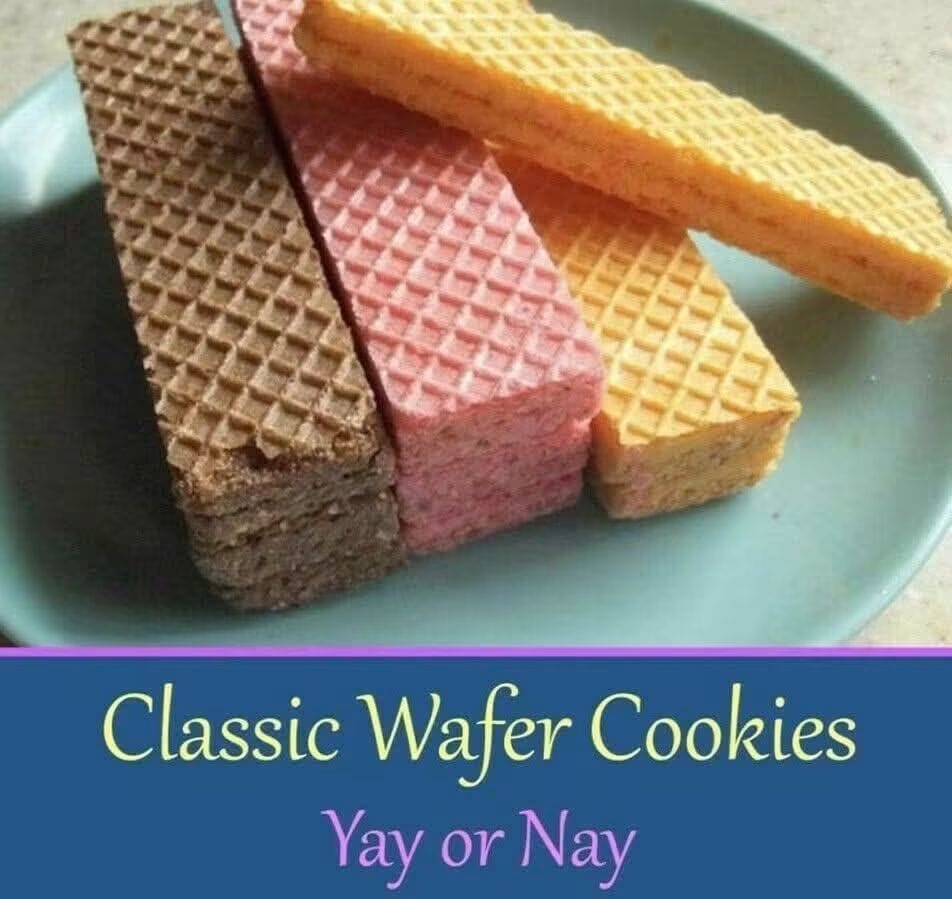
The picture shows a simple plate of classic wafer cookies in three familiar flavors—chocolate, strawberry, and vanilla. Their straightforward appearance may seem old-fashioned, but that is exactly what makes them so appealing. They remind many people of childhood snack boxes, family gatherings, afternoon tea, and the simple pleasure of enjoying a sweet treat without needing anything elaborate.
What Makes Wafer Cookies Special?
Unlike thick, chewy cookies, wafers are designed around lightness and crunch. Traditional wafers are made by baking a relatively thin batter between heated patterned plates, producing their characteristic crisp texture and geometric surface.
S
ScienceDirect
+1
Some wafer cookies are eaten as thin sheets, while others are built into sandwiches with layers of flavored cream between them. Chocolate, vanilla, hazelnut, lemon, strawberry, and other flavors are common variations.
S
ScienceDirect
+1
The cookies in the image appear to be the simpler, layered-sheet style, with the three colors immediately suggesting different flavors.
A Little History Behind the Wafer
Wafers have a surprisingly long history. Thin baked wafers were made in Europe centuries ago, originally using special irons that pressed patterns into the dough. Historical accounts describe wafer-making in medieval Europe, including the use of decorative irons to create crisp, patterned sheets.
S
Smithsonian Magazine
Over time, wafers evolved from relatively simple baked sheets into the filled cookies and confectionery products that are familiar today.
One important development came in the late 19th century, when commercial production helped transform wafers into widely available packaged treats. The modern cream-filled wafer became particularly associated with Central European confectionery.
G
Gambero Rosso
In the United States, vanilla wafer cookies also became a long-running favorite. Nabisco’s Nilla Wafers, for example, date back to 1898 and became especially associated with desserts such as banana pudding.
G
getnabisco.com
🍫 Chocolate Wafer
The brown wafer in the picture is the choice for chocolate lovers.
Chocolate wafers have a deeper, richer flavor than plain vanilla varieties. The cocoa flavor works especially well with the delicate crunch of the wafer because the cookie doesn’t become overwhelmingly heavy.
A chocolate wafer can be enjoyed straight from the package, paired with coffee or milk, or crumbled over ice cream and other desserts.
🍓 Strawberry Wafer
The pink wafer is perhaps the most visually distinctive of the three.
Strawberry-flavored wafers combine the crisp texture of the cookie with a sweet, fruity filling or flavor. The pink color gives them a playful appearance that makes them particularly nostalgic.
For many people, strawberry wafers are associated with childhood because they look almost like a colorful candy while still having the satisfying crunch of a biscuit.
🍦 Vanilla Wafer
The golden or cream-colored wafer represents the classic vanilla option.
Vanilla is arguably the most versatile wafer flavor. Its mild sweetness makes it easy to enjoy on its own, but it also works beautifully in desserts.
Vanilla wafer cookies are commonly used as ingredients in puddings, pie crusts, layered desserts, and other recipes because their crisp texture and gentle vanilla flavor complement creams and fruit.
G
getnabisco.com
Why Do We Love the Crunch?
One of the biggest attractions of a wafer is texture.
The first bite produces a delicate crackle rather than the dense crunch of a traditional cookie. The thin layers break easily, creating a light, almost airy sensation.
When cream is added between layers, you get a contrast between crisp wafer and smooth filling. Food science references describe this layered structure as one of the defining characteristics of wafer cookies.
S
ScienceDirect
That contrast is a big part of their appeal.
More Than Just a Snack
Classic wafers can also be surprisingly versatile.
They can be:
Enjoyed straight from the package
Served alongside coffee or tea
Paired with a glass of cold milk
Crushed over ice cream
Used in layered desserts
Added to pudding
Used as a base or decoration for cakes
Served alongside fresh fruit
Their delicate texture also makes them useful when you want a dessert component that adds crunch without overwhelming the other flavors.
The Nostalgia Factor
Perhaps the biggest reason people still love classic wafers isn’t their complexity—it’s their simplicity.
Modern desserts can contain dozens of ingredients, elaborate decorations, and complicated flavor combinations. A classic wafer cookie doesn’t need any of that.
You open the package, choose your favorite color, take a bite, and immediately get that familiar combination of sweetness and crunch.
The three colors in the photograph almost turn the cookies into a small personality test:
Brown for chocolate lovers.
Pink for strawberry fans.
Golden for vanilla traditionalists.
And, of course, some people will happily choose all three.
Which Flavor Would You Choose?
If you were handed the plate in this picture, which one would disappear first?
🍫 Chocolate — rich and indulgent
🍓 Strawberry — sweet and fruity
🍦 Vanilla — classic and comforting
There really isn’t a wrong answer.
Classic wafer cookies have survived for generations because they get the basics right: a delicate crunch, a pleasant sweetness, familiar flavors, and a little nostalgia in every bite.
So, looking at the picture, the question is simple:
Chocolate, strawberry, or vanilla—which one gets your vote? 🍪
S
S
G
Sources
