🍑 Where Is the Real Apricot? 🤔
Can You Spot It? Only One of These Is the Real Fruit!
At first glance, this looks like a simple fruit-identification game—but take a closer look! 👀
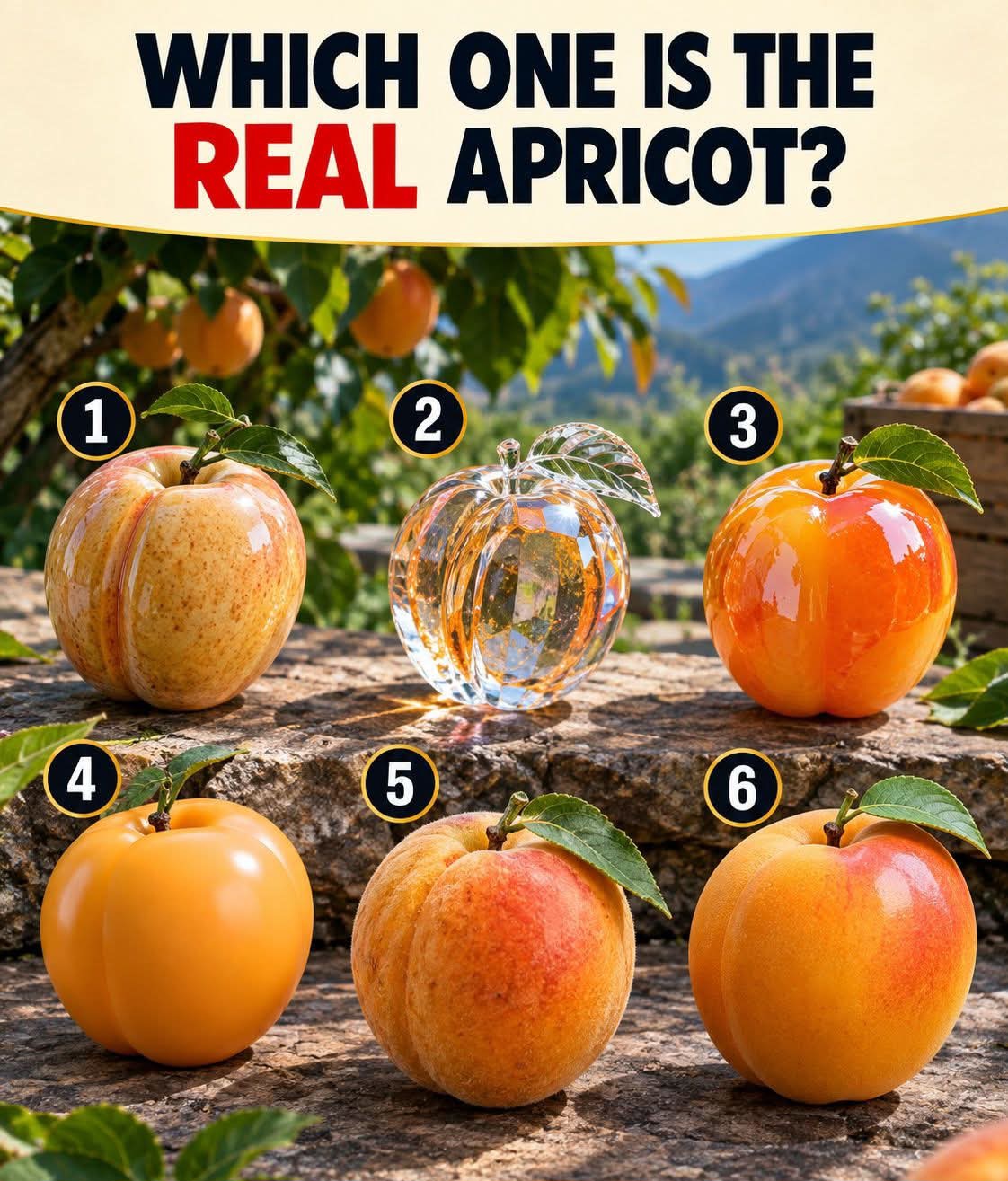
Six “apricots” are shown in the picture, but only one is actually a real apricot. The others are designed to look convincing, making this a fun little test of how well you know your fruit.
So before you scroll down to the answer…
Which number do you think is the real apricot? 🍑
1, 2, 3, 4, 5, or 6?
Make your guess first! 👇
🍑 What Does a Real Apricot Look Like?
A true apricot is the fruit of Prunus armeniaca, a member of the rose family. It is a stone fruit, meaning that its soft flesh surrounds one hard pit or stone. (Gardening Solutions)
Apricots are generally round to slightly oval, with colors ranging from yellow to golden orange. Many varieties develop a beautiful reddish or rosy blush on the side exposed to the sun. (Gardening Solutions)
The skin is another helpful clue.
Unlike a peach, which is noticeably fuzzy, an apricot usually has much finer, shorter hairs, making it look considerably smoother. Some cultivated varieties can even appear nearly smooth. (Gardening Solutions)
And there’s usually a distinctive vertical groove or suture running down one side of the fruit. (Gardening Solutions)
🔎 The Clues to Look For
If you were handed an unfamiliar stone fruit, these clues could help you identify an apricot.
1. The Color
A ripe apricot is typically yellow, golden, or orange, sometimes with a reddish blush.
It shouldn’t necessarily be bright orange all over. Color can vary considerably among cultivars and depending on how ripe the fruit is. (American Chemical Society Publications)
2. The Shape
Apricots are generally round or somewhat oval and resemble small peaches. (Gardening Solutions)
3. The Skin
This is one of the best clues.
Apricot skin is generally smoother than peach skin, although it can have a very fine velvety texture.
4. The Groove
Look for the characteristic suture line running down the fruit.
It can be quite noticeable and is one of those little details that helps distinguish stone fruits from one another. (Gardening Solutions)
5. The Pit
Cut a real apricot open and you’ll find a single hard stone inside.
The flesh surrounding it is usually orange or yellow, although flesh color can vary among varieties. (Gardening Solutions)
🍑 Apricot vs. Peach
This is where things can get tricky!
Apricots and peaches are closely related and can look surprisingly similar.
The easiest clue is often size and fuzziness.
Peaches are generally larger and noticeably fuzzy, while apricots tend to be smaller with much finer fuzz and a more delicate appearance. (Gardening Solutions)
Both can have orange or yellow flesh and reddish coloring, so don’t rely on color alone.
🍑 Apricot vs. Nectarine
Nectarines can be even more confusing because they are essentially smooth-skinned peaches.
If you’re trying to identify an apricot, look for the combination of:
- Smaller size
- Golden-orange coloring
- Fine or nearly imperceptible fuzz
- Characteristic central groove
- Firm but delicate flesh
- Single stone
The overall appearance is more useful than any one characteristic by itself.
🏆 So… Which One Is the Real Apricot?
The real apricot in the picture is #5! 🍑
Number 5 has the characteristic soft golden-orange color, reddish blush, slightly velvety surface, rounded shape, and central suture that are typical of an apricot.
The other “fruits” are there to make the challenge harder—including the crystal-looking #2, which definitely isn’t going to make a very satisfying fruit salad! 😂
🌳 A Little Apricot History
Apricots have a fascinating history. Although their scientific name is Prunus armeniaca, evidence points to origins in northern China and Central Asia, with the fruit spreading westward through cultivation over many centuries. (American Chemical Society Publications)
Today, apricots are grown in many parts of the world, including Mediterranean regions. Morocco is among the countries where apricots are cultivated, with research documenting numerous local Moroccan apricot clones and varieties. (ScienceDirect)
That means apricots can look quite different depending on the variety, growing conditions, and stage of ripeness.
🍑 Why We Love Apricots
A perfectly ripe apricot is one of those fruits that doesn’t need much added to it.
It’s delicious:
- Fresh off the tree
- Sliced over yogurt
- Chopped into oatmeal
- Added to fruit salads
- Made into jam
- Baked into cakes and tarts
- Dried for a naturally sweet snack
- Paired with cheese
- Used in savory sauces and glazes
Their flavor can range from sweet to pleasantly tart, depending on the variety and ripeness. (Gardening Solutions)
And when they’re perfectly ripe, the aroma is absolutely wonderful.
🤔 Did You Get It Right?
Before looking at the answer, did you choose #5?
🍑 YOUR TURN!
Which number did you think was the real apricot?
👇 1 — 2 — 3 — 4 — 5 — 6 👇
Did you get it right, or did one of the impostors fool you? 😂🍑
Share this with someone and see if they can spot the real apricot!
