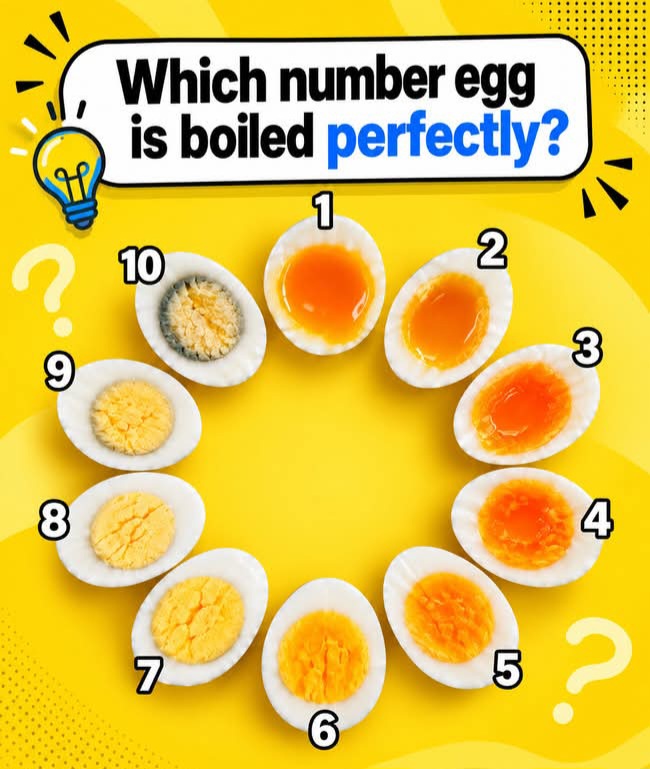
🥚 Which Number Egg Is Boiled Perfectly?
There are few breakfast debates more personal than the perfect boiled egg. Some people want a bright, runny yolk that spills onto their toast. Others want a soft, creamy center. And some won’t call an egg finished until the yolk is completely firm.
This fun egg challenge puts 10 different levels of doneness in front of us and asks one simple question:
🥚 Which number egg is boiled perfectly?
The answer depends on what you call perfect! 😍


🥚 What Happens as an Egg Cooks?
When an egg is heated, the proteins in the white and yolk gradually set. The longer the egg cooks, the firmer the yolk becomes.
That’s why the eggs in the picture move from liquid and glossy at the beginning to firm and crumbly toward the end.
The difference can be just a few minutes, which is why timing matters so much.
For large eggs placed into already-boiling water, culinary guides commonly put soft, jammy, medium, and hard-boiled textures across a range of roughly 4–12 minutes, depending on the exact texture desired and the cooking method. (Ask USDA)
🥚 Egg #1 — Very Runny
Egg number one has a beautifully liquid center.
This is for people who love dipping toast into a warm, runny yolk.
The white is generally set while the yolk remains very soft and fluid.
Best for: toast soldiers, breakfast plates, or anyone who loves a runny yolk.
🥚 Egg #2 — Soft & Creamy
Now we’re getting closer to a classic soft-boiled egg.
The center is still runny, but slightly thicker than #1.
This is a wonderful choice when you want a yolk that’s somewhere between liquid and creamy.
🥚 Egg #3 — Jammy
This is where things get really interesting.
The yolk is thick, glossy, and almost custard-like rather than completely liquid.
A jammy egg is especially popular sliced over toast, noodles, rice bowls, salads, and ramen.
If you like a yolk with some structure but don’t want it fully cooked, this is the territory to explore.
🥚 Egg #4 — Soft Set
Egg #4 has noticeably more structure.
The yolk is still moist and rich, but there’s less liquid remaining in the center.
This is a great option for people who want a soft yolk without worrying about it running all over the plate.
🥚 Egg #5 — Creamy Center
Now we’re approaching the middle of the spectrum.
The yolk has become mostly set while retaining a rich, moist texture.
For many people, this is an excellent compromise between a soft-boiled and hard-boiled egg.
🥚 Egg #6 — Mostly Set
The yolk is becoming firmer and more uniform.
There’s still some moisture and tenderness, but the center isn’t runny anymore.
This is the kind of egg that works beautifully when sliced in half for breakfast, salads, sandwiches, or avocado toast.
🥚 Egg #7 — Firm but Moist
We’re officially entering hard-boiled territory.
The yolk is firm enough to slice cleanly but still looks moist rather than dry.
For someone who wants a traditional boiled egg without an overly crumbly yolk, this can be a great stopping point.
🥚 Egg #8 — Firm
Egg #8 has a fully cooked yolk with a classic hard-boiled texture.
This is a particularly useful texture for:
- Egg salad
- Deviled eggs
- Cobb salads
- Sandwiches
- Snack boxes
🥚 Egg #9 — Very Firm
The yolk is now quite firm and crumbly.
Some people specifically prefer this texture for deviled eggs or egg salad because there’s no soft center remaining.
But if you prefer creamy yolks, this may already be too far.
🥚 Egg #10 — Overdone?
And then we have number 10.
The yolk appears extremely firm, dry, and crumbly, with a gray-green ring around the outside.
That greenish ring can develop when eggs are cooked for too long. It isn’t necessarily a sign that the egg is spoiled; it’s associated with reactions involving sulfur from the egg white and iron from the yolk.
The best way to avoid it is simply not to overcook the eggs.
⏱️ So, How Long Should You Cook Your Eggs?
There’s no single timing that produces the same result in every kitchen. Egg size, starting temperature, altitude, water temperature, and cooking method can all affect the result. (FSIS)
As a general starting point for large eggs placed into already-boiling water, you can experiment with:
| Approx. time | Result |
|---|---|
| 4–5 minutes | Very soft/runny |
| 6–7 minutes | Soft or jammy |
| 8 minutes | Creamy/medium |
| 9–10 minutes | Mostly to fully set |
| 10–12 minutes | Firm hard-boiled |
These are starting points rather than absolute rules. Different methods produce different results, so the best way to find your perfect egg is to test a few timings. (Pillsbury)
🧊 Don’t Forget the Ice Bath
If you’re cooking eggs to a specific level of doneness, an ice bath can be extremely helpful.
Once your eggs reach your preferred cooking time, transfer them immediately to ice water.
This rapidly cools them and helps stop the cooking process.
For hard-cooked eggs, the USDA recommends cooling them under cold running water after cooking and refrigerating them within two hours. Hard-cooked eggs should be refrigerated and used within one week. (Ask USDA)
🥚 What’s YOUR Perfect Egg?
Now comes the important question!
Look at the picture again and choose your number:
🥚 1 — Super runny
🥚 2 — Soft
🥚 3 — Jammy
🥚 4 — Soft set
🥚 5 — Creamy
🥚 6 — Mostly set
🥚 7 — Firm & moist
🥚 8 — Firm
🥚 9 — Very firm
🥚 10 — Extra firm
👇 BE HONEST!
Which number is your perfect boiled egg?
Do you love that beautiful runny yolk, or do you want your egg cooked until the yolk is completely firm?
Drop your number in the comments! 🥚👇
