Before Fancy Skates, We Strapped Wheels Straight to Our Shoes 🛼
There was a time when roller skating didn’t involve sleek boots, colorful wheels, adjustable trucks, or high-tech bearings. If you wanted to roll, you had to strap a small metal contraption directly onto your ordinary shoes and hope for the best.
And honestly? Looking at these old-fashioned skates, it’s hard not to wonder how anyone stayed upright! 😄
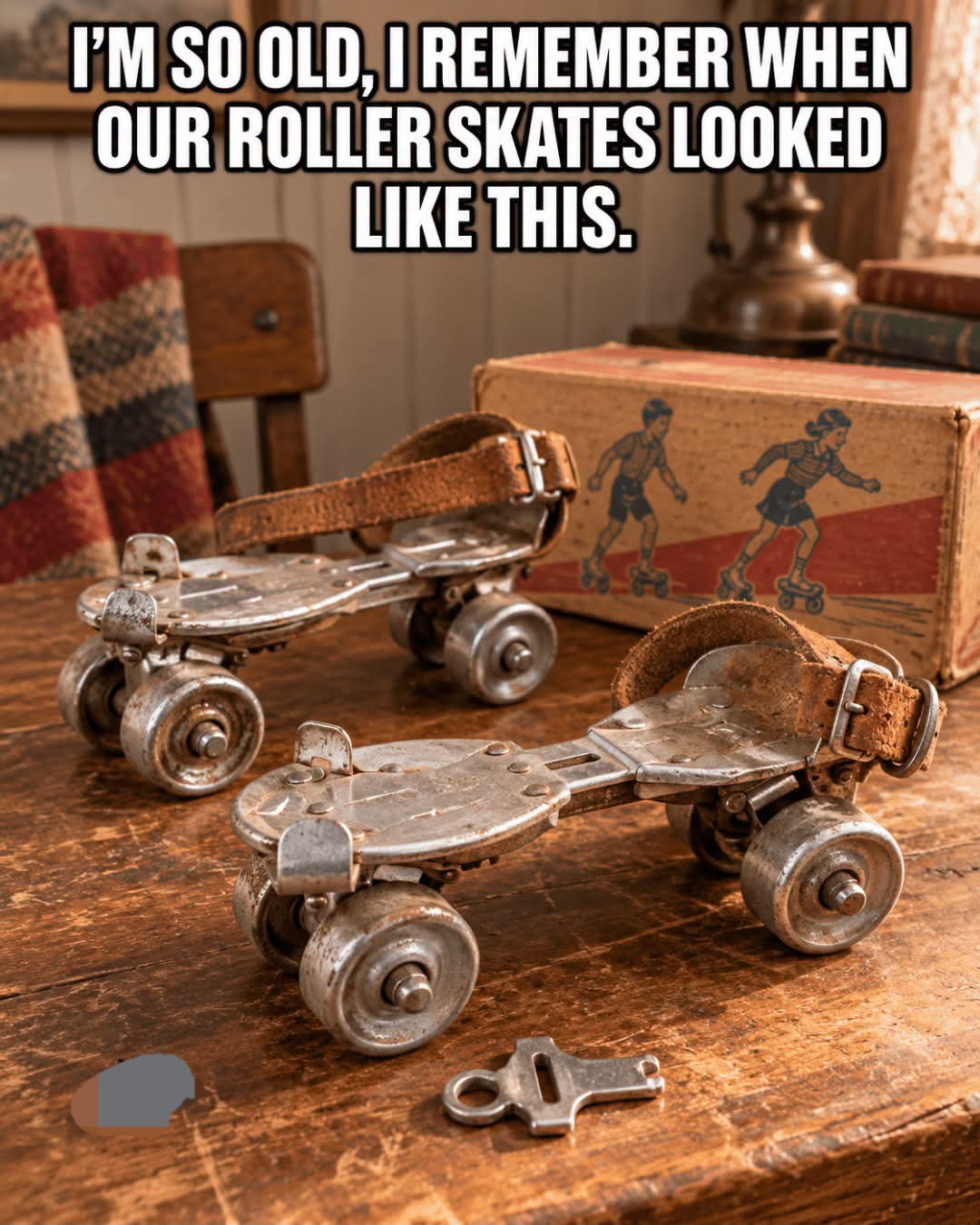
The vintage pair in the image is a wonderful reminder of just how much everyday technology has changed. Heavy metal frames, chunky wheels, leather straps, buckles and a little adjustment key made up what was once cutting-edge skating equipment.
The original idea was wonderfully simple
Instead of putting wheels underneath a purpose-built boot, early roller skates were designed to attach to the shoes you were already wearing.
The skate would sit beneath the sole while clamps or straps held it in place. Some designs could be adjusted to fit different shoe sizes, making them considerably more practical than having to own a dedicated pair of skating shoes.
The result was essentially a tiny wheeled platform attached to your feet.
Simple?
Yes.
Easy to use?
That’s another question. 😂
A little history on wheels
Experiments with wheeled footwear go back well before the modern roller skate. But the development of practical roller skates accelerated during the 19th century.
In 1863, American inventor James Leonard Plimpton patented a four-wheeled roller skate design that helped transform roller skating. His improvements made skating more controllable and contributed to the sport becoming increasingly popular. (Blogs du Congrès)
Roller skating eventually became a major recreational craze, particularly in the late 19th and early 20th centuries. The Library of Congress notes that roller skating was already becoming a widespread pastime, with another major revival occurring around 1905 as new rinks opened. (Bibliothèque du Congrès)
So those humble-looking wheels weren’t merely children’s toys. They were part of a much larger cultural phenomenon.
And then there was the famous clamp-on skate
One particularly recognizable style used metal clamps to grip the shoe.
A historical account of skating in Philadelphia describes older skates being replaced by low, all-steel designs held to the foot with plates and clamps operated with a key. (Bibliothèque du Congrès)
That little metal tool sitting in front of the skates in the photograph is therefore an especially fun detail.
It wasn’t decoration.
It was useful.
You needed it to adjust or secure the skate properly.
Imagine being a child and being handed these things before heading out to skate. There was no simply slipping your feet into a modern boot and tightening some laces.
You had hardware to deal with first!
These were built like tiny tanks
Look closely at the construction and you can see why surviving examples have such a distinctive appearance.
There’s a lot of metal.
The wheels are substantial. The platforms are thick. The leather straps have large buckles. And everything looks designed to withstand plenty of abuse.
Compared with today’s lightweight recreational skates, they look almost industrial.
But that was part of the charm.
These weren’t disposable gadgets. They were mechanical objects that could be adjusted, repaired and used repeatedly.
And after decades of storage, examples like these can still tell a story simply through their worn leather and scratched metal.
Skating wasn’t always effortless
Modern skates benefit from decades of engineering improvements.
Better bearings, improved wheel materials, purpose-built boots, more sophisticated trucks and improved braking systems have all made skating more accessible.
Older skates were a different experience.
The wheels were comparatively unforgiving, the metal construction was heavy, and the connection between your shoe and the skate was nowhere near as integrated as it is today.
Then there was the small matter of stopping.
Anyone who has ever watched somebody discover that their feet can move faster than their ability to control them knows how quickly skating can become an adventure! 😂
From old metal wheels to modern skating culture
What makes these old skates particularly fascinating is that they represent the beginning of something that eventually became a huge part of popular culture.
Roller rinks became social gathering places. Music, dancing, competitions and roller derby all became associated with skating.
The Library of Congress describes roller skating as a pastime enjoyed by people of many ages for well over a century. (Blogs du Congrès)
The basic concept remained remarkably consistent:
Put wheels under your feet and move.
Everything else was refinement.
There’s something special about old technology
Today, we tend to think of technological progress as making things smaller, lighter and easier.
Looking at these skates reminds us that earlier inventions could be wonderfully straightforward.
There are no screens.
No batteries.
No electronics.
No complicated instructions.
Just metal, leather, wheels and a mechanical fastening system.
You put them on, tightened them up and pushed off.
And perhaps that’s exactly why old objects like these create such powerful nostalgia. Even if we never personally used this particular style, they remind us of a time when entertainment often depended on simple physical objects rather than digital technology.
Imagine opening the old box
There’s something wonderfully nostalgic about the entire scene in the photograph: the wooden table, the worn leather, the old metal wheels and the illustrated box sitting behind them.
You can almost imagine somebody opening that box decades ago and finding a brand-new pair inside.
The metal would have been bright.
The leather would have been fresh.
The wheels would have been ready for their first trip around the rink.
And somebody was probably incredibly excited to put them on.
Years later, they’re no longer just pieces of sporting equipment.
They’re little pieces of history.
The wheels may have changed, but the fun hasn’t
Modern roller skates might be smoother, lighter and considerably more comfortable, but the fundamental thrill remains the same.
You put wheels under your feet.
You push.
You glide.
And for a moment, you’re moving in a completely different way.
That’s what makes these old strap-on skates so fascinating. They show us that the idea didn’t need to be complicated.
Before fancy skates, before specialized boots and modern materials, we simply strapped wheels to our shoes and went for it.
And judging by these things, we probably did it with considerably more courage than common sense. 😄🛼
Would you have happily strapped these onto your shoes and taken them for a spin—or would you have taken one look at those metal wheels and said, “Absolutely not”? 👀
