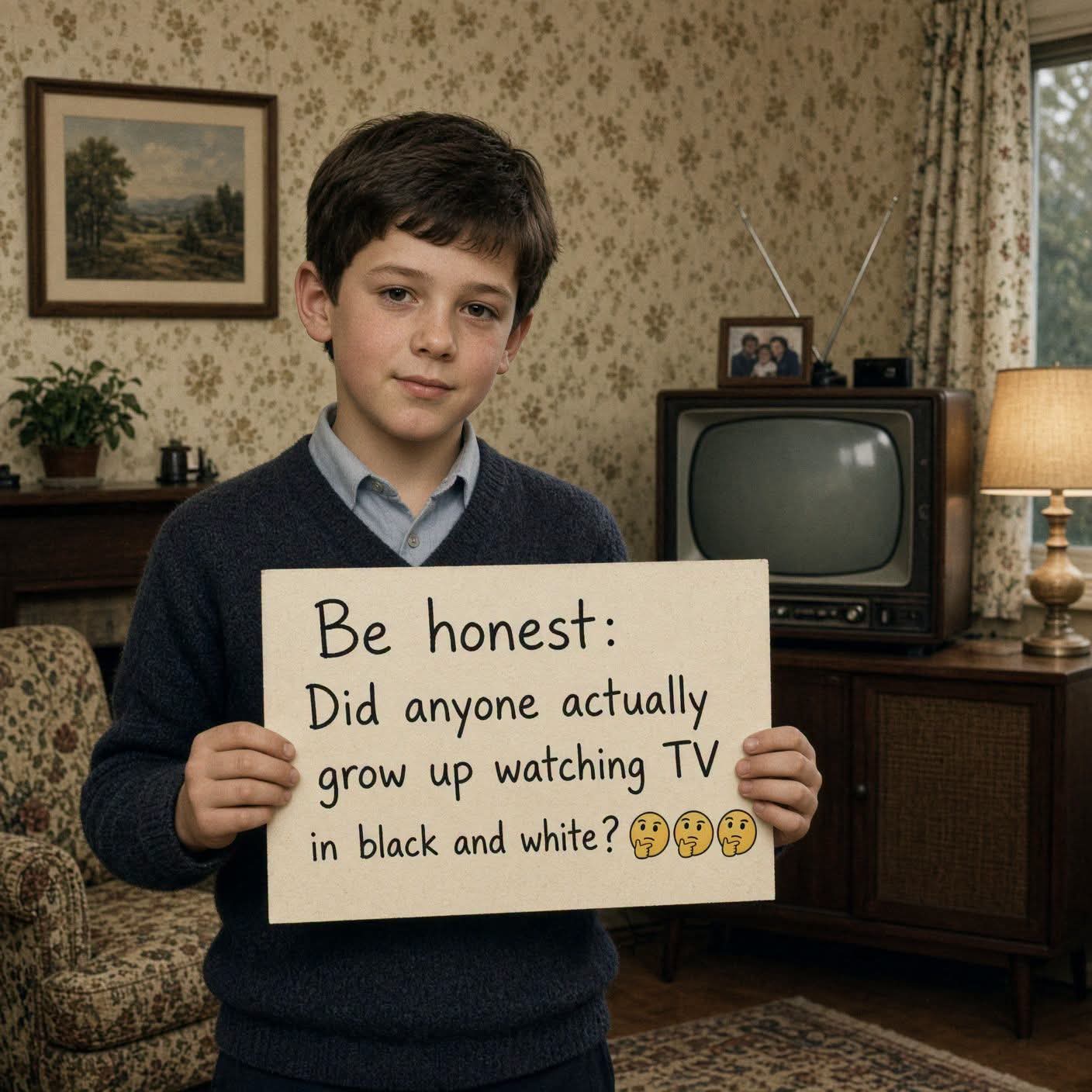
Be Honest: Did Anyone Actually Grow Up Watching TV in Black and White? 📺🖤🤍
Be honest: did you actually grow up watching television in black and white? 🤔
For anyone who remembers those days, a black-and-white television wasn’t some retro novelty sitting in a vintage shop.
It was simply the TV.
There were no high-definition screens, no streaming services, no endless channels, and certainly no remote control disappearing between the sofa cushions.
You turned the television on, waited for it to warm up, adjusted the controls if necessary—and that was it.


📺 When Television Was Black and White
Early television broadcasting was predominantly black and white, and color television was introduced gradually rather than appearing in every household overnight.
In the United States, regular color broadcasting began in the 1950s, but color television sets remained expensive for many families for years. In other countries, the transition happened at different times.
That meant generations of people grew up watching their favorite programs in shades of black, white, and gray.
And nobody thought it was strange.
It was simply how television looked.
🏠 The Television Was a Big Deal
For many families, the television was one of the most important pieces of technology in the house.
It wasn’t unusual for the whole family to gather in the living room around it.
There might be one television for the entire household.
Not one in every bedroom.
Not one in the kitchen.
Not one on the phone.
One TV.
And when someone else was watching something, you either watched it with them—or waited your turn.
📡 Remember the Antenna?
Before cable and streaming, television reception could be an adventure.
Many sets had rabbit-ear antennas, while outdoor rooftop antennas were common in many homes.
If the picture became snowy or distorted, someone might get up and adjust the antenna.
And sometimes the classic solution was:
“Don’t move it! It’s perfect right there!” 😂
You could find yourself standing beside the television holding the antenna while someone across the room shouted directions.
“Move it a little!”
“No, the other way!”
“Stop! That’s better!”
Technology has certainly changed.
🔘 No Remote Control
One of the biggest differences between then and now?
You actually had to get up to change the channel.
The television had physical knobs or buttons.
Want another channel?
Get up.
Want to adjust the volume?
Get up.
Want to turn it off?
Yep—get up again.
Kids today might find it difficult to imagine that changing channels could involve actual exercise. 😂
📺 There Weren’t Hundreds of Channels
Today, you can scroll through seemingly endless programming.
Back then, depending on where you lived and the era, television choices could be much more limited.
You might have only a handful of channels available.
And when programming ended for the night, that was it.
The screen might display a test pattern, static, or a station identification before the television was switched off.
There was no:
“I’ll just watch one more episode.”
🌙 Staying Up to Watch Something Special
Because there wasn’t an enormous library of on-demand programming, certain broadcasts felt like genuine events.
A special movie.
A major sporting event.
A popular variety show.
A holiday program.
A favorite weekly series.
If you missed it, you couldn’t simply open an app and watch it five minutes later.
You had to be there when it aired—or hope for a repeat.
That made television feel more like a shared experience.
🍿 Family Television Night
Remember when watching television was something the family did together?
Someone might bring snacks into the living room.
Parents would sit on the sofa.
Children would find a spot on the floor.
And everyone would watch the same program.
There was no second screen sitting in your hand.
No one was checking social media during the commercial break.
No one was asking:
“What should we watch next?”
You watched what was on.
And somehow, that was enough.
🎨 Then Came Color
For families who eventually bought a color television, the change could feel enormous.
Suddenly, programs that had always existed in shades of gray were filled with color.
Actors’ clothing looked different.
Sports fields looked greener.
Cartoons became much more vibrant.
Even ordinary household scenes seemed somehow more exciting.
And if you grew up with a black-and-white television before getting a color set, you probably remember the moment that transition happened.
It was a genuine “wow” moment.
💰 Why Didn’t Everyone Have Color Television Immediately?
Color television sets were more expensive than black-and-white sets, and the availability of color programming varied by country and broadcaster.
For many households, there simply wasn’t a reason to replace a perfectly functioning black-and-white television.
If the old set worked, why spend money on another one?
That practical attitude kept black-and-white televisions in homes long after color broadcasting had become available.
🧒 If You Grew Up With One…
You may remember some of these:
📺 Turning the television knob by hand
📡 Adjusting the antenna for a clearer picture
🔘 Getting up to change the channel
🖤 Watching everything in shades of gray
👨👩👧👦 Sharing one television with the whole family
🍿 Waiting all week for your favorite program
🌙 Watching the final program before the station signed off
📺 Finally getting a color television
For younger generations, some of these things sound almost unbelievable.
But for millions of people, they were simply everyday life.
❤️ A Different Kind of Television
Television has changed enormously.
Today we have enormous screens, crystal-clear pictures, streaming libraries, personalized recommendations, and programs available whenever we want them.
Those conveniences are wonderful.
But there’s something nostalgic about remembering when watching television was a shared event rather than an endless selection of individual entertainment.
The television was smaller.
The picture wasn’t nearly as sharp.
There weren’t thousands of choices.
Yet people still gathered around it.
And maybe that’s what many people remember most.
Not the quality of the picture.
The people sitting beside them. ❤️
🤔 Be Honest…
Did you actually grow up watching TV in black and white?
🖤🤍 YES — that’s how I remember it!
📺 We had one until I was older.
🌈 No — ours was always color.
😂 I remember having to get up to change the channel!
Tell us what you remember about your first television. 👇❤️
