🍔 Who Should Clean Up at McDonald’s? The Great Fast-Food Table Debate
You finish your meal, gather your things, and head toward the exit.
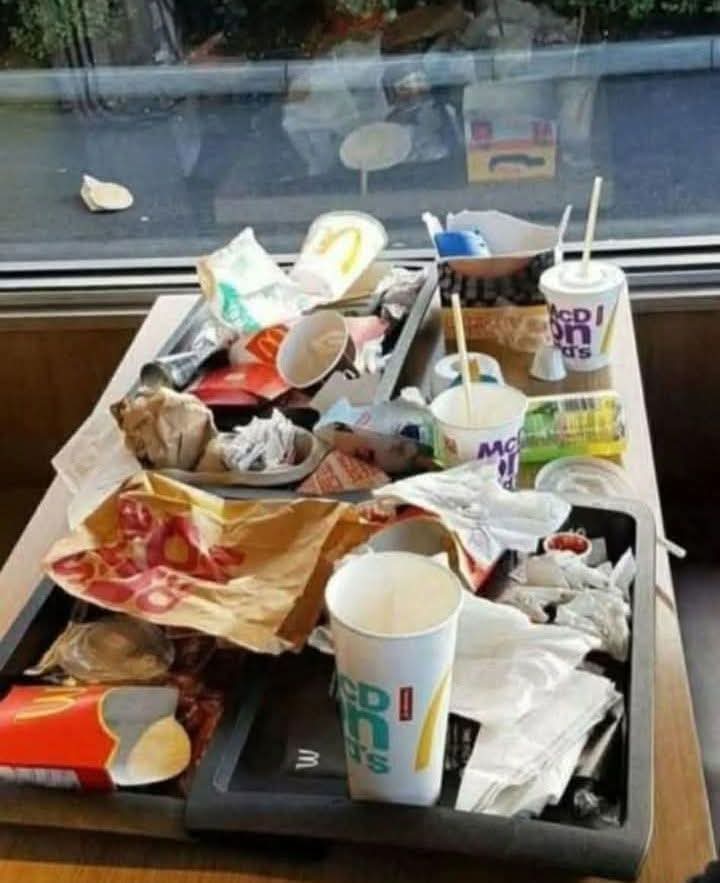
You leave the tray, wrappers, cups, and napkins on the table.
Then someone stops you.
“You should clean that up.”
Suddenly, a completely ordinary fast-food visit turns into an argument about manners, responsibility, and what customers are actually expected to do.
So who’s right?
The answer isn’t quite as simple as “customers should always clean up” or “that’s the staff’s job.”
🍟 The Fast-Food Gray Area
Fast-food restaurants occupy an interesting middle ground.
They’re not traditional full-service restaurants where a server brings your food to the table, clears your plates, replaces your napkin, and handles the table between courses.
But they’re also not completely self-service spaces.
You order at a counter or kiosk, collect your food, sit down, eat, and usually leave when you’re finished.
Behind the scenes, restaurant employees are responsible for keeping the dining area clean. That can include wiping tables, collecting trays, emptying bins, cleaning floors, and dealing with spills and other messes.
So it’s understandable why some customers think:
“I’m paying for the food and the service. Cleaning the table is part of the restaurant’s job.”
And technically, there is some truth to that.
But there’s another side to the argument.
🧹 “It’s Just Common Courtesy”
Many people believe that if a trash bin or tray-return station is conveniently located nearby, customers should use it.
Their reasoning isn’t necessarily that employees can’t clean the table.
It’s that customers shouldn’t deliberately create extra work when they can easily take care of their own rubbish.
There’s a difference between:
“The staff are responsible for cleaning.”
and
“Customers should leave absolutely everything wherever they finish eating.”
For people who grew up with the habit of clearing their own table, leaving a tray behind can feel inconsiderate.
To them, returning the tray is simply basic courtesy.
🍔 But Is It Actually Required?
This is where things get interesting.
Unless a particular restaurant clearly communicates a customer requirement—through signs, instructions, or its service setup—people may have different expectations about what they’re supposed to do.
Some fast-food locations have obvious tray-return areas.
Others have large bins designed for customers to dispose of their own rubbish.
And some restaurants may have employees regularly clearing tables.
So the practical expectation can vary from one location to another.
That’s why assuming everyone knows the same rule can be problematic.
If customers are expected to clear their trays, the clearest solution is simple:
Tell them.
A visible sign near the exit saying “Please return your tray and dispose of your rubbish” removes most of the ambiguity.
🤷 The Real Problem: Nobody Agreed on the Rules
What makes situations like this frustrating is that both sides can feel completely justified.
One person thinks:
“It’s a fast-food restaurant. Staff clean the dining area.”
Another thinks:
“There is a bin right there. Why wouldn’t you throw your rubbish away?”
Neither position necessarily means someone is trying to be rude.
They may simply have different expectations.
And that’s how something as small as a discarded wrapper can turn into an argument.
🗑️ There’s Also a Difference Between “Leaving Your Tray” and “Making a Mess”
This distinction matters.
Leaving a tray and some wrappers on a table isn’t quite the same thing as intentionally leaving food scattered everywhere, spilling drinks, stuffing rubbish into strange places, or leaving a table covered in unnecessary mess.
Restaurants expect employees to clean.
But customers can still make reasonable efforts not to create unnecessary work.
A little consideration goes a long way.
👴 And Then There’s the Stranger Factor
The most unusual part of the story isn’t necessarily the tray.
It’s the stranger confronting another customer about it.
If someone sees a person leave their rubbish behind, they might think it’s rude.
That’s their opinion.
But there’s a big difference between thinking something is rude and getting into someone’s face about it.
A stranger doesn’t necessarily need to police every small behavior they disagree with.
If the restaurant has a rule, employees can enforce it.
If there isn’t a clearly communicated rule, turning a minor disagreement into a confrontation can make the situation much bigger than it needs to be.
🚪 Why Were You Asked to Leave?
Being asked to leave can also feel incredibly unfair when you believe you’re simply defending yourself.
But restaurants sometimes remove people from an escalating argument regardless of who started it.
From the staff’s perspective, they may not be trying to determine who was morally correct.
They may simply want:
No shouting.
No confrontation.
No disruption.
Once voices are raised, the restaurant has a practical reason to end the situation quickly.
That doesn’t necessarily mean the person who was asked to leave was judged to be “the bad guy.”
It can simply mean employees wanted the conflict out of their dining room.
🍟 So Should Customers Clear Their Tables?
A reasonable approach is:
If there’s a tray-return station or clearly marked rubbish bin:
Use it.
It takes very little effort and helps keep the restaurant moving.
If there isn’t an obvious place to return everything:
Leaving the tray neatly on the table may be understandable.
Employees can clear it as part of maintaining the dining area.
If you’ve made a significant mess:
Clean up what you reasonably can.
Especially spills or food that has fallen onto the floor.
And if you’re unsure:
Look around.
If everyone else is returning trays, that’s a pretty good clue about the local expectation.
❤️ It’s Not Really About the Tray
At the heart of this debate is something much bigger:
What do we owe each other in shared spaces?
One side emphasizes the customer’s payment and the restaurant’s responsibility to provide service.
The other emphasizes courtesy and the idea that being able to do something yourself doesn’t mean you should leave it for someone else.
Both ideas can coexist.
Restaurant employees are there to clean.
Customers can still choose to make their jobs a little easier.
Neither requires shouting at a stranger.
🤔 What Would You Do?
If you finish your meal at a fast-food restaurant and there’s a tray full of wrappers sitting in front of you, what do you do?
A. Take everything to the bin and return the tray. 🗑️
B. Leave it neatly on the table because cleaning tables is part of the staff’s job. 🍔
C. It depends on the restaurant and whether there’s a tray-return station. 🤷
Personally, the most peaceful approach is usually pretty simple:
If there’s an obvious place to put your rubbish, use it.
It’s a small gesture, it avoids confusion, and it doesn’t require anyone to turn it into a confrontation.
Because at the end of the day, it’s a tray—not a battle worth having. 😂🍟
👀 But be honest…
When you finish eating at McDonald’s, do you clear your own tray or leave it for the staff?
