🇺🇸🇪🇺 : Why Do They Look So Different?
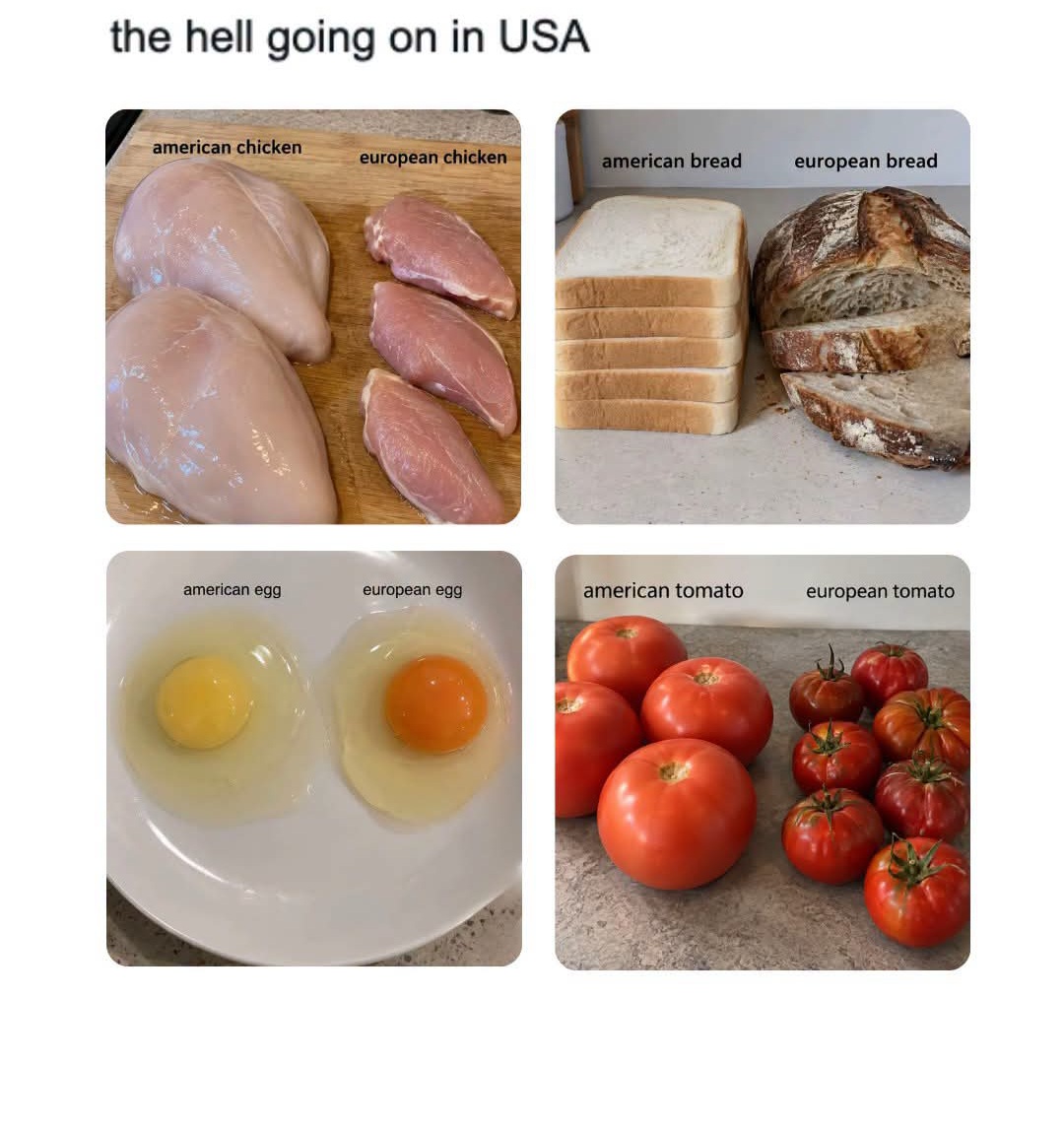
At first glance, this image looks like a simple comparison between American and European food. One side shows chicken breasts, sliced bread, eggs, and tomatoes, while the other shows smaller chicken portions, rustic bread, darker egg yolks, and more varied tomatoes.
And the caption—“the hell going on in USA”—is clearly designed to get people talking. 😂
But there’s more going on here than simply saying one side is “better” than the other.
Food can look dramatically different depending on breed, farming practices, processing, season, variety, storage, and where the product was purchased. 🌾🍅🥚
Let’s break down the four comparisons.
🍗 American Chicken vs. European Chicken
The chicken comparison is probably the first thing that catches your eye.
The American chicken breasts shown in the image look enormous compared with the European portions.
That difference can be real in some markets, but it doesn’t mean that all American chickens look like this or that all European chickens are small.
Chicken size is influenced by several factors, including genetics, age at processing, breeding practices, and production systems.
In the United States, large commercially raised broiler chickens are common, and chicken breast meat is especially popular. That can result in very large breast portions appearing in supermarkets.
European markets contain plenty of conventionally produced chicken as well, but shoppers may also encounter smaller portions, different breeds, different production standards, or products marketed around particular farming systems.
🍗 Why does size matter?
For cooking, enormous chicken breasts can sometimes create their own challenges.
A very thick breast may take longer to cook through while the outside is already browning.
That’s one reason cooks often:
- Cut large breasts into smaller pieces
- Butterfly them
- Pound them to an even thickness
- Slice them into cutlets
So bigger doesn’t automatically mean better—or worse.
It’s simply a different product presentation.
🍞 American Bread vs. European Bread
This might be the most recognizable difference in the image.
On the American side is soft, evenly sliced sandwich bread.
On the European side is a rustic-looking loaf with a darker crust and irregular slices.
But here’s the important part:
“American bread” and “European bread” are enormous categories.
The United States has everything from basic supermarket sandwich loaves to sourdough, rye, baguettes, artisan country bread, whole-grain loaves, and regional specialties.
Europe has plenty of packaged white bread too.
So the image is really comparing two particular styles of bread, not every American and European loaf.
🥖 Why does rustic bread look different?
Traditional crusty breads are often made with relatively simple ingredients such as flour, water, salt, and yeast or sourdough starter.
They are generally associated with:
- A crisp crust
- Chewier texture
- Larger holes in the crumb
- More pronounced fermentation flavors
- Irregular shapes
Soft sandwich bread is designed for a different purpose.
It’s convenient, uniform, easy to slice, and ideal for sandwiches and toast.
Neither style is automatically the winner.
It really depends on what you’re making.
Toast with butter? Soft bread can be fantastic.
Soup and a crusty loaf? That rustic bread suddenly looks pretty tempting. 😋
🥚 American Eggs vs. European Eggs
Now we get to the comparison that causes endless internet arguments:
The yolk. 😂🥚
The image shows a pale yellow yolk on the left and a much deeper orange yolk on the right.
Many people assume that a darker orange yolk automatically means a healthier or better egg.
That’s not necessarily true.
🌽 What determines yolk color?
A chicken’s diet has a major influence on yolk color.
Certain pigments in feed—particularly carotenoids—can make yolks appear more yellow or orange.
So a darker yolk doesn’t automatically prove that the egg is:
- More nutritious
- Fresher
- Organic
- Free-range
- Better tasting
Those characteristics need to be evaluated separately.
🐔 What about European eggs?
Egg production systems and labeling rules vary between European countries, and European consumers may encounter eggs produced under different housing and feeding systems.
But again, there isn’t one universal “European egg.”
A supermarket egg from one European country can look quite different from another.
And American eggs aren’t all pale yellow either.
Visit a farmers’ market or a store carrying different varieties and you may find eggs with beautifully deep-colored yolks in the United States as well.
🍅 American Tomatoes vs. European Tomatoes
This comparison is especially interesting.
The American side shows smooth, large, uniform tomatoes.
The European side shows smaller, irregularly shaped tomatoes with different colors and forms.
And this is another case where variety matters enormously.
Tomatoes come in an incredible number of cultivars.
You can find:
🍅 Beefsteak tomatoes
🍅 Roma tomatoes
🍅 Cherry tomatoes
🍅 Grape tomatoes
🍅 Heirloom tomatoes
🍅 Vine-ripened tomatoes
🍅 Plum tomatoes
🍅 Cocktail tomatoes
Some are bred primarily for size and uniformity.
Others are selected for flavor, appearance, texture, or specific culinary uses.
That’s why two tomatoes can look completely different even though they’re technically the same type of fruit.
🌱 Why Does American Produce Often Look More Uniform?
One reason supermarket produce can look remarkably consistent is that large-scale food systems place significant emphasis on transportability, shelf life, consistency, and appearance.
Imagine shipping thousands of tomatoes across a large country.
Uniform fruits that can withstand handling and transportation can be extremely useful.
That doesn’t mean American farmers don’t grow unusual or heirloom varieties.
They absolutely do.
It simply means that the products chosen for large-scale supermarket distribution may be selected with different priorities than tomatoes grown for a local market.
🛒 Supermarket Food vs. Local Food
This is perhaps the biggest lesson from the image.
A comparison like this can make it seem as though the entire American food system looks one way and the entire European food system looks another.
Reality is much more complicated.
Walk through a farmers’ market in the United States and you can find:
🥖 Artisan sourdough
🍅 Heirloom tomatoes
🥚 Farm eggs with deep-colored yolks
🍗 Locally raised chicken
🥬 Seasonal vegetables
🧀 Regional cheeses
And walk through a European supermarket and you’ll also find:
🍞 Packaged sandwich bread
🍗 Large chicken portions
🥚 Pale-yolk eggs
🍅 Uniform tomatoes
🥫 Highly processed foods
Food cultures overlap far more than memes suggest.
🤔 Is One Side Actually “Better”?
That’s where things get complicated.
Appearance alone can’t tell you everything about a food’s quality, nutrition, farming system, or taste.
A giant chicken breast isn’t automatically inferior.
A rustic loaf isn’t automatically healthier.
An orange egg yolk isn’t automatically more nutritious.
An ugly tomato isn’t automatically tastier.
And a perfectly round tomato isn’t automatically bland.
Those conclusions require more information than a photograph can provide.
🌍 Food Culture Is About More Than Appearance
The really fascinating part of food is that it reflects the systems behind it.
What people eat is influenced by:
- Agriculture
- Geography
- Climate
- Regulation
- Consumer preferences
- Farming traditions
- Economics
- Transportation
- Supermarket practices
- Cooking traditions
Two countries can sell the same basic foods while presenting them in completely different ways.
That’s why comparing food cultures can be so interesting.
🥖🍅🥚🍗 What Would You Choose?
If you had to build a meal using the foods shown in this picture, which combination would you pick?
Would you go for the big chicken breast, soft sandwich bread, pale yolk, and classic tomato?
Or would you choose the smaller chicken portions, crusty bread, deep-orange yolk, and colorful tomatoes?
Or perhaps you’d mix everything together.
Because honestly, that’s probably the best part of food culture:
You don’t have to choose one side. You can enjoy the best of both. 😋🌍
💬 Your turn!
Which comparison surprised you the most—chicken 🍗, bread 🍞, eggs 🥚, or tomatoes 🍅? And which one would you actually put on your dinner table?
