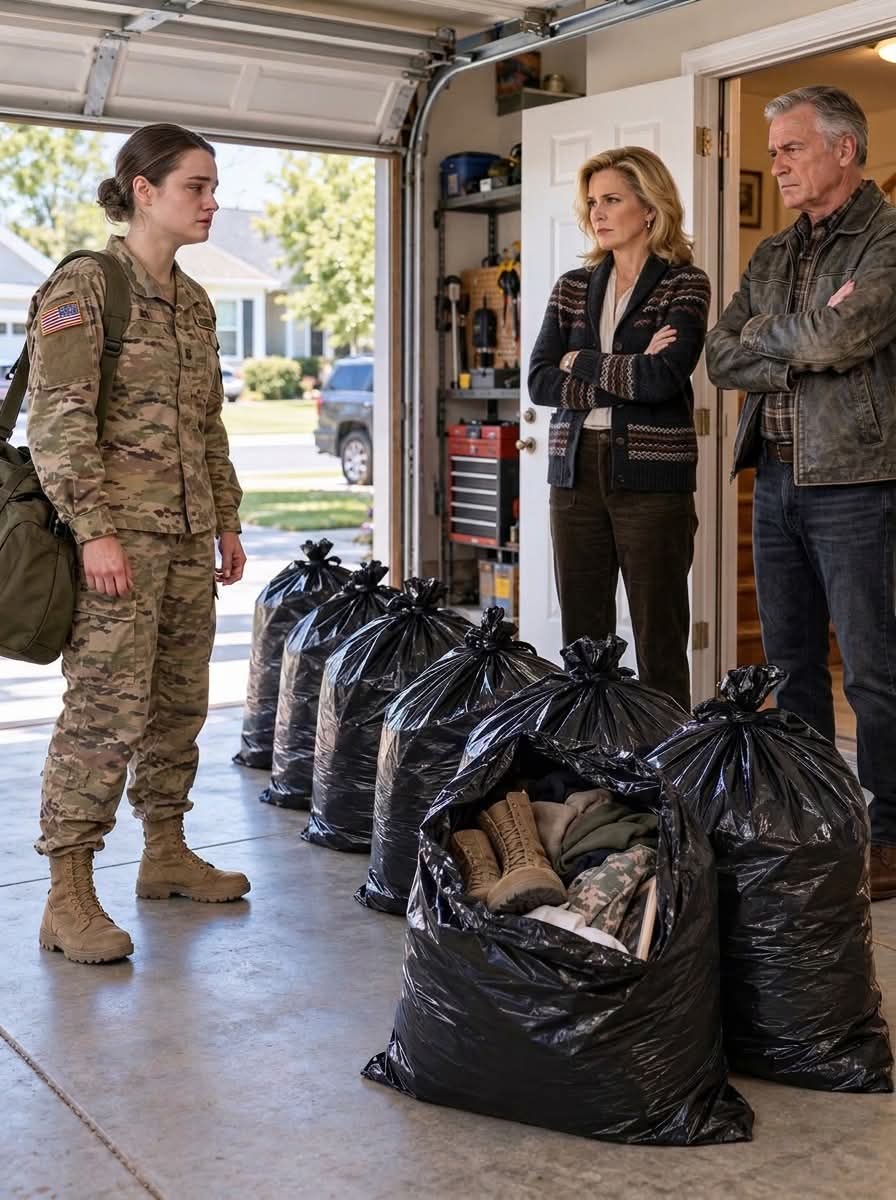
I finished tying the garbage bag and turned toward them.
Evelyn stood there in her usual pressed blouse as if she had somewhere important to be. My dad, Richard, stood behind her with his arms crossed, posture straight, still carrying himself like the colonel title had never retired with him.
Neither was smiling.
“You’re back earlier than we expected,” Evelyn said.
I blinked slowly.
“I told you my return date,” I said.
She waved that away like deployment schedules and time zones were optional suggestions.
“Well, things changed.”
Of course they had.
I lifted one of the garbage bags slightly.
“Yeah,” I said. “I can see that.”
Richard stepped forward, not aggressively, just enough to take up space.
“We needed to make some adjustments while you were gone.”
Adjustments.
That word carried a lot of weight in this house.
I looked past them into the living room. The furniture had been rearranged. New throw pillows. A framed photo I didn’t recognize.
None of it was mine.
“Where’s Chloe?” I said.
Evelyn finally smiled.
“Oh, she’s here upstairs resting.”
Resting.
That told me enough.
“And Vance?” I asked.
“Moved in.”
My duffel still sat on the porch behind me like it hadn’t gotten the message.
“And my room?” I asked.
Evelyn tilted her head like she was explaining something obvious.
“Well, honey, Chloe needed the master suite.”
Of course she did.
“She’s been under a lot of stress,” Evelyn continued. “You know how sensitive she is.”
Yeah.
Sensitive enough to need a king-size bed that wasn’t hers.
I nodded once.
“So, where am I sleeping?”
Richard answered.
“You’ve got options,” he said.
Options.
“The basement is available,” he added.
They had moved in last month.
Not visiting.
Not temporarily.
Moved in.
“Or you can head back to the barracks on base. Might be easier with your schedule anyway.”
I stared at him.
An unfinished basement with a cold concrete floor and half-installed drywall, or return to base like deployment had never ended.
Those were my options.
Evelyn stepped closer, using her soft public voice.
“We just thought it made more sense,” she said. “You’re single. You’re gone half the time. You don’t need all this space.”
There it was.
No guilt or hesitation, only certainty, as though they had justified this decision repeatedly before I ever got home.
“Be a good sister for once,” Evelyn added.
And there was the role I had played my whole life.
The reliable one.
The one who adjusted.
The one who made everything work.
They expected an argument.
I gave them none.
Instead, I walked between them.
Richard shifted slightly, maybe expecting me to go upstairs and make a scene.
I didn’t.
I passed the living room and kitchen and went straight to the basement.
The air grew colder as I descended.
Same unfinished walls.
Same dust and old paint.
Nothing had changed because no one cared enough to change it.
Behind several storage bins, I knelt beside a floor panel that didn’t quite match the others.
Still there.
Good.
I lifted it carefully.
The safe sat exactly where I had left it.
Digital keypad.
No scratches.
No sign anyone had touched it.
They hadn’t looked.
They didn’t know.
I entered the code.
Click.
Inside, protected by a waterproof sleeve, was one folder.
I opened it.
The original deed.
Still crisp.
Still untouched.
Not in Richard’s name.
Not in some shared family trust.
Mine.
Transferred years earlier, quietly and legally, protected through layers they had clearly never bothered to understand.
My grandfather had made sure of that.
A general didn’t leave loose ends.
My heartbeat steadied.
Upstairs, I heard movement and laughter.
They thought this house belonged to them.
They thought I was the one who no longer belonged.
I looked at the deed and smiled.
Barely.
They had no idea what they had done.
I kept the folder beside me and pulled my laptop from my duffel.
If they wanted to play house, I was going to check the rest of my life.
The laptop screen lit the concrete floor.
I connected to the Wi-Fi.
Same password.
Of course.
Nothing in this house changed unless it benefited Chloe.
I logged into my military banking portal.
Before the dashboard even finished loading, something felt wrong.
Experience teaches you not to ignore that feeling.
Then the balance appeared.
Wrong.
Not slightly off.
Wrong.
Hazardous-duty pay gone.
Deployment bonuses gone.
Not pending.
Not delayed.
Gone.
“Okay,” I muttered.
No panic.
Assessment.
I opened the transaction history.
Multiple transfers.
Clean.
Structured.
Whoever had done this knew when I was deployed, when communication was unreliable, and when I had almost no oversight.
I opened the first large withdrawal.
Domestic wire.
Then another.
Then another.
Different amounts.
Same pattern.
I pulled out a notebook and recorded dates, transaction numbers, and amounts.
This wasn’t emotional anymore.
It was a problem.
Problems could be documented.
I traced the destination accounts until one connected to Evelyn.
I checked twice.
Same routing number.
Same bank.
Same name.
“Of course,” I whispered. “Of course, it was her.”
Then I checked login records.
Every login leaves a footprint.
There were account accesses from my home while I was halfway around the world.
Same device signature.
Same location.
No attempt to hide it.
They had simply assumed I would never check.
Then I found a document uploaded three months earlier.
Power of attorney.
My name at the top.
Evelyn listed as authorized agent.
My signature at the bottom.
Except it wasn’t mine.
It resembled mine enough to fool someone unfamiliar with it, but the pressure and flow were wrong.
Copied.
Not written.
There was a witness signature and notary stamp too.
Official-looking.
Which made it worse.
This wasn’t simply theft.
It had been planned, documented, and filed.
I returned to the transactions and totaled them twice.
$45,000.
The money mattered.
But the access, intent, and forged paperwork mattered more.
I followed the trail beyond Evelyn’s account.
Large credits.
Irregular payments.
Then I saw the name attached to the debts.
Vance.
I stared at the screen and laughed once.
Sharp.
Of course.
Lieutenant Vance.
Perfect uniform.
Perfect posture.
Always talking about integrity and career progression.
Meanwhile, he was buried in gambling debt severe enough to require $45,000 to disappear quietly.
Debt that could destroy his security clearance.
And his career.
Everything clicked.
Evelyn hadn’t stolen from me for herself.
She had done it to protect Vance.
To protect Chloe’s perfect life.
At my expense.
I closed my eyes briefly and locked the facts into place.
Federal wire fraud.
Identity theft.
Forgery.
And an active-duty officer.
Vance wasn’t simply a man with bad habits anymore.
He was a liability in uniform.
I documented everything.
Screenshots.
Transaction logs.
IP records.
Copies of the forged power of attorney.
Everything duplicated and organized.
Then I connected my portable printer.
The pages came out one by one.
$45,000.
Forged authorization.
A paper trail running through my mother and directly to my sister’s husband.
I aligned the pages and slid them into the tactical folder I normally used for deployment briefings.
Appropriate.
Upstairs, they still thought this was about a bedroom.
About me being difficult.
It wasn’t.
This was evidence.
And I knew where evidence belonged.
I packed the laptop and went upstairs.
Before reaching the top, I smelled barbecue.
Then came laughter and clinking glasses.
I opened the door.
They were hosting a party in my backyard.
String lights.
Folding tables.
A full barbecue spread.
Officers everywhere.
Captains.
A major I recognized.
Even a lieutenant colonel near the cooler.
I hadn’t been home twelve hours, and somehow I was the guest.
Evelyn moved through the crowd effortlessly, touching shoulders, smiling warmly, laughing at exactly the right moments.
Perfect.
Always perfect.
“Harper,” she called loudly enough to turn heads.
Performance time.
I walked forward calmly.
Every person who looked at me seemed to perform the same quick assessment.
Posture.
Expression.
Condition.
They were trying to match me to whatever version of me they had already heard about.
Evelyn gave me a quick hug.
Too quick to mean anything.
“We’re so proud of you,” she said just loud enough for the nearby group to hear.
I didn’t hug her back.
“Didn’t know I was getting a welcome party,” I said.
Her smile tightened.
“Oh, it’s just a small thing. You know how your father likes to keep connection strong.”
Translation: this wasn’t for me.
Across the yard, Vance stood near the grill, laughing too loudly and networking like his career depended on it.
Beside him stood Chloe.
New dress.
Perfect hair.
Perfect makeup.
And an expensive designer watch on her wrist.
I looked at it half a second longer than necessary.
She noticed.
Her smile widened, and she lifted her wrist while adjusting her hair to make sure I saw it.
Message received.
I walked past her.
“Captain Harper.”
I turned.
Major Collins.
I had met him once during a logistics briefing.
“Sir,” I said with a nod.
“Welcome back,” he said. “Heard you had a rough deployment.”
“Nothing I couldn’t handle.”
Before he could continue, Evelyn appeared beside us.
“Oh, she’s being modest,” she said with a soft laugh. “It’s been difficult.”
I didn’t look at her.
“She’s had a lot of stress,” Evelyn continued. “We’re just trying to give her space to adjust.”
Major Collins shifted slightly.
Tiny movement.
But I noticed.
This was how Evelyn worked.
Not accusations.
Suggestions.
Plant the idea first, then let everything I did afterward be interpreted through it.
“I’m fine,” I said.
Simple.
Direct.
Evelyn smiled as though my answer proved her point.
“Of course you are, honey,” she said gently. “We all just want what’s best for you.”
Concern used as control.
I took a sparkling water from the table.
No alcohol.
I wanted a clear head.
As I moved around the yard, I listened.
Richard mentioned I might need time.
Combat zones changed people.
Good thing I had family.
Every comment carefully framed.
By the time I told anyone the truth, they wanted everyone prepared to question it.
Smart.
Almost impressive.
I stopped near the grill.
Vance looked up.
“Hey Harper,” he said like we were old friends. “Good to see you back.”
“Lieutenant.”
His smile twitched.
Rank mattered to men like him.
“How is overseas?” he asked.
“Hot,” I said.
He laughed too loudly.
“Yeah, I bet. Nothing like being back home though, right?”
I looked directly at him.
“Depends on the home.”
His smile remained, but his eyes changed.
Chloe moved beside him and slipped her arm through his.
“We made your room really nice,” she said. “I think you’ll like the basement once it’s finished.”
Once it was finished.
They already had future plans for my house.
I took another drink without answering.
Across the yard, Richard watched me.
He nodded toward the side of the house.
Private conversation.
Of course.
I followed him.
“You need to handle something tomorrow,” he said immediately.
No greeting.
Just an order.
“What kind of something?”
“A transfer,” he said. “Paperwork. Simple.”
I already knew where this was going.
“Transfer of what?”
“The house.”
There it was.
“Chloe needs stability,” he continued. “You’re not here enough to justify holding on to a property like this.”
Holding on to.
Interesting.
“I’m here now,” I said.
He ignored that.
“You’ll go down to the office tomorrow,” he said. “Sign the documents. Make it official.”
Not a request.
“And if I don’t?”
His tone shifted.
“I still have connections,” he said. “People who remember what I’ve done, who I’ve helped.”
The old colonel emerged.
“You’re up for major soon,” he added. “It would be a shame if something complicated that process.”
I looked at him carefully.
This wasn’t family.
It was leverage.
Pressure.
Control.
Same tactics.
Different battlefield.
He still thought he was in command.
I let the silence sit.
Then I smiled.
“I’ll make sure the paperwork is handled exactly as it should be, Dad.”
He searched my face for resistance.
Found none.
“Good,” he said.
Then he walked away.
I stayed there, listening to the party.
Chloe still displaying the watch.
Vance still networking.
Evelyn still smiling as though everything was under control.
My smile stayed.
Through sunset.
Through the guests leaving.
Through the night.
And into the fluorescent-lit JAG office early Monday morning.
I carried my folder under one arm.
Clean floors.
Quiet halls.
No emotion.
Perfect.
A specialist checked me in, and two minutes later I sat across from Captain Morales.
Sharp eyes.
No small talk.
“You said this was urgent,” she said.
I slid the folder toward her.
“It is.”
She started with the bank records, then the IP logs, then the power of attorney.
I let her read.
Her expression barely changed until she reached the forged signature.
“That’s not yours,” she said.
“No,” I replied.
She continued.
“45,000,” she said. “Transferred while you were deployed.”
“Yes, ma’am.”
“And this individual, Vance, he’s active duty lieutenant.”
She leaned back.
“All right,” she said. “This is already bad.”
I knew it got worse.
“I need to bring in someone else,” she said. “This overlaps with civilian property law if there’s more tied to it.”
“Call him,” I said.
Ten minutes later, I sat with a civilian real-estate attorney in his mid-fifties.
Mr. Dalton.
Direct.
No wasted words.
“Captain,” he said, “Let’s see what we’re dealing with.”
Morales handed him the folder.
Dalton moved through it quickly, focusing less on the fraud and more on where it led.
Then he stopped.
“Hold on,” he muttered.
He pulled out a document I hadn’t seen.
“That yours?” he asked.
Purchase agreement.
My address.
My house.
Buyer: private development firm.
Sale price: $650,000.
“Where did you get this?” I asked.
“Pulled from preliminary filings,” he said. “This was submitted for processing last week.”
Last week.
While I was overseas.
Seller: Richard.
Signature: Richard.
Co-signed by Evelyn.
Then an attached deed bearing my name and another forged signature.
Cleaner than the power of attorney.
Still wrong.
“They don’t own this property,” Dalton said.
“I do,” I replied.
“Through what structure?”
“A revocable trust,” I said. “Transferred by my grandfather.”
His attention sharpened.
“Is it recorded?” he asked.
“Not at the county level,” I said. “Protected. Private.”
Dalton nodded.
“Then they assumed it was still part of the estate,” he said. “Thought they could transfer it clean.”
“They didn’t check.”
“They didn’t know what to check,” he corrected.
Fair.
Morales leaned forward.
“So they forged a deed,” she said. “Attempted to sell a property they don’t legally own while also committing financial fraud using a forged power of attorney.”
Dalton whistled quietly.
“That’s not a mistake,” he said. “That’s a pattern.”
Exactly.
“They planning to pocket the money?” he asked.
I pictured Chloe’s watch and the way she had told me they made my room nice.
“Yes,” I said.
“All of it?”
I nodded.
“All right,” he said. “Then we don’t warn them.”
Morales agreed.
I leaned forward.
“What’s the fastest way to stop this?”
Dalton answered immediately.
“Lis pendens,” he said.
A formal notice of legal dispute tied to the property.
Once filed, the transaction stopped.
No sale.
No clean title.
No access to the property until the dispute was resolved.
“And the trust?” Morales asked.
“We record it,” Dalton said. “Public record. That kills their claim completely.”
“Do it.”
If we moved quickly, everything could be filed when the county clerk opened at eight the next morning.
“I’ll be there,” I said.
Morales closed the folder.
“I’m opening an official report on the financial side,” she said. “This will trigger an investigation into Vance’s conduct under UCMJ.”
“Understood.”
She studied me.
“You’re handling this well,” she said.
“I’ve had worse problems.”
That earned a small smile.
The meeting ended in under an hour.
No drama.
Only process.
At eight the next morning, Dalton was already waiting at the county clerk’s office with coffee and paperwork.
“You’re on time,” he said.
“I don’t miss deadlines.”
We filed the lis pendens.
Stamped.
Recorded.
Then the trust documentation.
Public record.
Permanent.
Dalton handed me the receipt.
“That’s it,” he said. “They’re done.”
The pages weighed almost nothing.
But they carried everything.
“Now we wait,” he said.
I had no problem waiting.
By late afternoon, my phone buzzed.
Unknown number.
Then a voicemail.
Richard.
“Who the hell is this developer talking about?” his voice snapped through the speaker. “They’re saying there is a legal dispute on the property. That the title is invalid. What did you do?”
I listened without replying.
“You need to call me back now.”
The message ended.
I could picture him pacing the living room, trying to understand how a deal he believed was finished had collapsed.
In his mind, the paperwork was signed.
The sale was secure.
The money was practically his.
Now the developer was telling him the property wasn’t his, the transfer was invalid, and the documents exposed him.
Another message arrived.
This time I answered.
“Harper,” I said.
“What did you do?” he demanded.
“I handled the paperwork,” I said.
Silence.
“What paperwork?”
“The kind that reflects reality,” I said.
His breathing quickened.
“Don’t play games with me,” he snapped. “This developer is threatening legal action. He’s saying fraud. Breach of contract. I don’t even understand what he’s talking about.”
“You should read what you signed,” I said.
“I know what I signed,” he shot back.
“No,” I said. “You thought you did.”
Silence again.
For once, he had no control.
“I’ll deal with this,” he said finally. “Just stay out of it.”
“Too late,” I said.
Then I hung up.
I knew what came next.
Confusion.
Panic.
Anger.
Richard didn’t process losing control quietly.
TO CONTINUE READING THE ARTICLE PLEASE SEE PAGE 2
