🧺✨ Who Remembers Using One of These? The Twin-Tub Washing Machine That Made Laundry a Whole-Day Event
Before washing machines became sleek, quiet appliances that practically do everything for you, there was another kind of laundry machine sitting proudly in kitchens and utility rooms:
The twin-tub washing machine. 🧺
If you remember one of these, you probably remember that doing laundry wasn’t exactly a “press a button and walk away” experience.
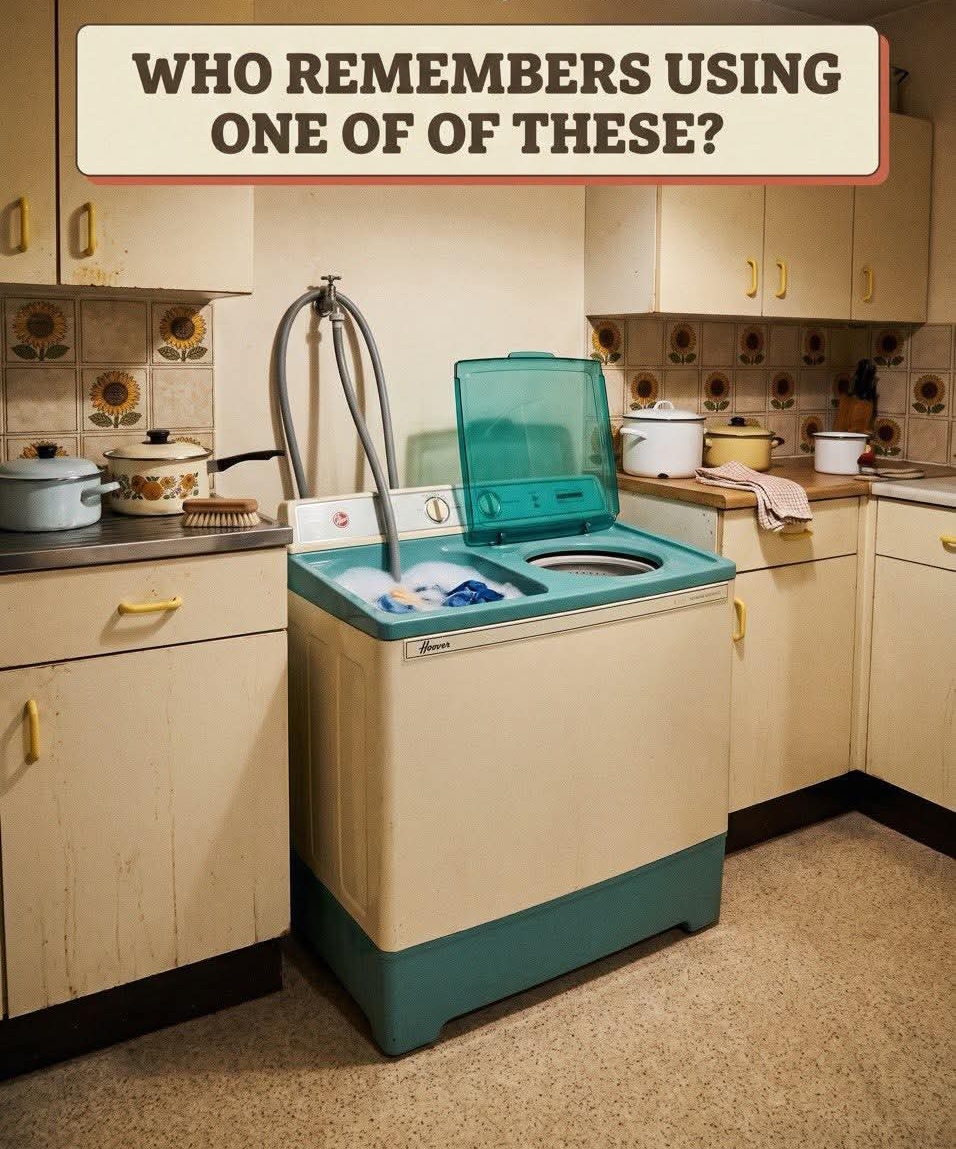
The machine in the picture is a classic Hoover twin-tub style, with two separate compartments—one for washing and one for spinning. Twin-tub machines became especially popular in Britain from the 1950s onward and were an important step between washing by hand and today’s fully automatic machines. (Science Museum Group Collection)
And for anyone who grew up around one, that familiar humming, splashing and spinning could instantly bring back memories.
🧺 Two Tubs, Two Jobs
The name tells you almost everything.
Twin tub = two tubs.
One side was used to wash the clothes.
The other was used to spin water out of them.
It sounds straightforward—and it was—but there was a lot more hands-on work involved than with a modern washing machine.
Once the washing cycle was finished, you had to physically move the wet clothes from the washing compartment into the spin tub.
Then you’d spin them.
Then rinse.
Then spin again.
Depending on the model and setup, you might also have to fill the machine with water and deal with draining it manually. The Science Museum Group notes that users often had to move clothes between the tubs themselves, while some models also required manual filling and emptying. (Science Museum Group Collection)
So yes…
Laundry was an active job. 😂
🚿 And That Hose Wasn’t Just Decoration
Look closely at the picture.
That long hose hanging beside the machine isn’t there for nostalgia.
Machines of this era often needed to be connected to the kitchen sink or another water source.
Some households had to move the machine into position, attach hoses, fill the appropriate tub, and then deal with the water afterward.
The National Museum of Ireland notes that early washing machines sometimes had to be moved into the middle of the kitchen so they could be filled and emptied through pipes connected to the sink. (National Museum of Ireland)
Imagine doing that every week.
And then imagine doing it with a mountain of family laundry waiting beside you. 😅
🧼 Washday Really Was A “Washday”
Today, laundry can feel almost invisible.
Put clothes in.
Add detergent.
Choose a program.
Press start.
Walk away.
Back then, washing clothes could be a much more involved routine.
Before household washing machines became widespread, many people washed clothing by soaking, stirring, scrubbing and squeezing water from garments by hand. The Science Museum Group describes this work as long and physically demanding. (Science Museum Group Collection)
The arrival of machines didn’t immediately eliminate all that work.
Instead, early washing machines gradually reduced the physical effort.
And that was a huge change.
🏠 The Rise of the Twin Tub
Twin-tub machines became increasingly popular in Britain during the 1950s and 1960s.
Hoover was one of the major names associated with them. A Hoover MK1 washing machine with a wringer, for example, was produced at the company’s Merthyr Tydfil factory in 1948. Hoover’s twin-tub machines subsequently became a familiar household appliance. (Science Museum Group Collection)
The Science Museum Group records a Servis Supertwin manufactured around 1962 and notes that twin tubs had become popular because they promised to make laundry quicker and easier. (Science Museum Group Collection)
And there’s something fascinating about that transition.
People weren’t necessarily looking for a machine that did absolutely everything.
They wanted something that made an exhausting household chore easier.
The twin tub did exactly that.
💰 But Owning One Wasn’t Always Cheap
It’s easy to look at an old washing machine and imagine that everyone simply had one sitting in the kitchen.
That wasn’t the reality.
Household washing machines could represent a significant expense, particularly during the 1950s and 1960s.
The Science Museum Group records a 1962 Servis Supertwin at around 79 guineas, with many machines being rented or purchased through installment arrangements. (Science Museum Group Collection)
Other manufacturers and sellers used hire-purchase arrangements to make these appliances more accessible.
So getting a washing machine wasn’t necessarily an ordinary impulse purchase.
For many families, it was a major household investment.
👵 “I Remember That Sound!”
If you grew up around one, you may remember the sounds as much as the machine itself.
The water filling.
The wash cycle churning away.
The motor humming.
The clothes being transferred.
The unmistakable sound of the spin cycle.
And then the endless question:
“Is that load ready yet?” 😂
There was also something wonderfully mechanical about the whole process.
You weren’t simply watching a computer-controlled appliance.
You were part of the process.
👐 You Had to Move the Clothes Yourself
This might be the biggest difference between these machines and modern washers.
Imagine opening the washing tub and pulling out a heavy bundle of soaking-wet towels.
Now move them over to the spin tub.
And don’t forget the socks.
And the shirts.
And the children’s clothes.
And the towels.
And that one piece of clothing that somehow weighs approximately 40 pounds when it’s completely soaked. 😂
The twin tub could save enormous amounts of hand-scrubbing and wringing, but it still demanded attention.
Historical accounts describe users filling the wash tub, transferring laundry between compartments, and managing rinsing and spinning manually. (Love in a little black diary)
🌀 That Spin Tub Was a Game Changer
The second tub wasn’t just an extra compartment.
It contained a spin dryer.
Instead of manually squeezing water out of every garment, centrifugal force could remove much of the water.
That was a major improvement.
Clothes still needed to be dried afterward—often on a clothesline or indoor drying rack—but they weren’t coming out of the washer absolutely dripping.
The basic idea remains familiar today:
Spin the clothes quickly → water gets forced out → clothes dry faster.
It’s one of those technologies we now take completely for granted.
⚙️ Why Didn’t Twin Tubs Last Forever?
Because eventually people wanted something even easier.
The twin tub still required the person doing laundry to intervene.
A fully automatic washing machine could eventually take over much more of the process:
Fill → wash → rinse → spin → drain
without requiring the user to constantly transfer clothes between compartments.
The Science Museum Group notes that twin tubs were eventually overtaken in popularity by fully automatic machines with a single tub that handled filling, washing, spinning and draining automatically. (Science Museum Group Collection)
And once people experienced that convenience…
There was probably no going back.
🧺 From “Hands-On” to “Press Start”
Think about how much household technology has changed.
Then:
🧺 Sort the clothes
🚰 Fill the machine
🧼 Wash
👐 Move the wet clothes
🌀 Spin
🚿 Rinse
🌀 Spin again
🌬️ Hang everything up
Now:
🧺 Put clothes in
🧴 Add detergent
🔘 Press a button
And some modern machines can even automatically adjust water levels, washing time and other settings.
That’s quite a journey from the old twin tub.
❤️ But People Still Remember Them
And that’s what makes old appliances so fascinating.
A modern washing machine might be more efficient and convenient, but an old twin tub can represent something much bigger than an appliance.
It can remind someone of:
- Their childhood home
- Their parents or grandparents
- Saturday morning chores
- Clotheslines in the garden
- The smell of freshly washed laundry
- Old kitchens
- Family routines
- The sound of a machine spinning in the background
Sometimes an object doesn’t need to be valuable to be memorable.
It just needs to have been part of everyday life.
📸 A Little Piece of Household History
The twin-tub washing machine represents an interesting moment in domestic history.
It wasn’t the beginning of washing machines, and it wasn’t the final destination.
It was the middle step.
It helped move households away from exhausting manual washing while still requiring people to actively participate in the process.
And that’s why seeing one decades later can produce such a strong reaction:
“Oh wow… I remember those!” 😍
For younger generations, it might look almost impossibly complicated.
For someone who actually used one, it might look completely familiar.
🧺 The Question Everyone Wants to Answer…
WHO REMEMBERS USING ONE OF THESE? 👀
Did your family have a twin-tub washing machine?
Did you ever have to transfer soaking-wet clothes from one side to the other?
Or do you remember your parents or grandparents doing it?
And be honest…
Did you actually like these old machines, or were you thrilled when the fully automatic washer finally arrived? 😂🧺
