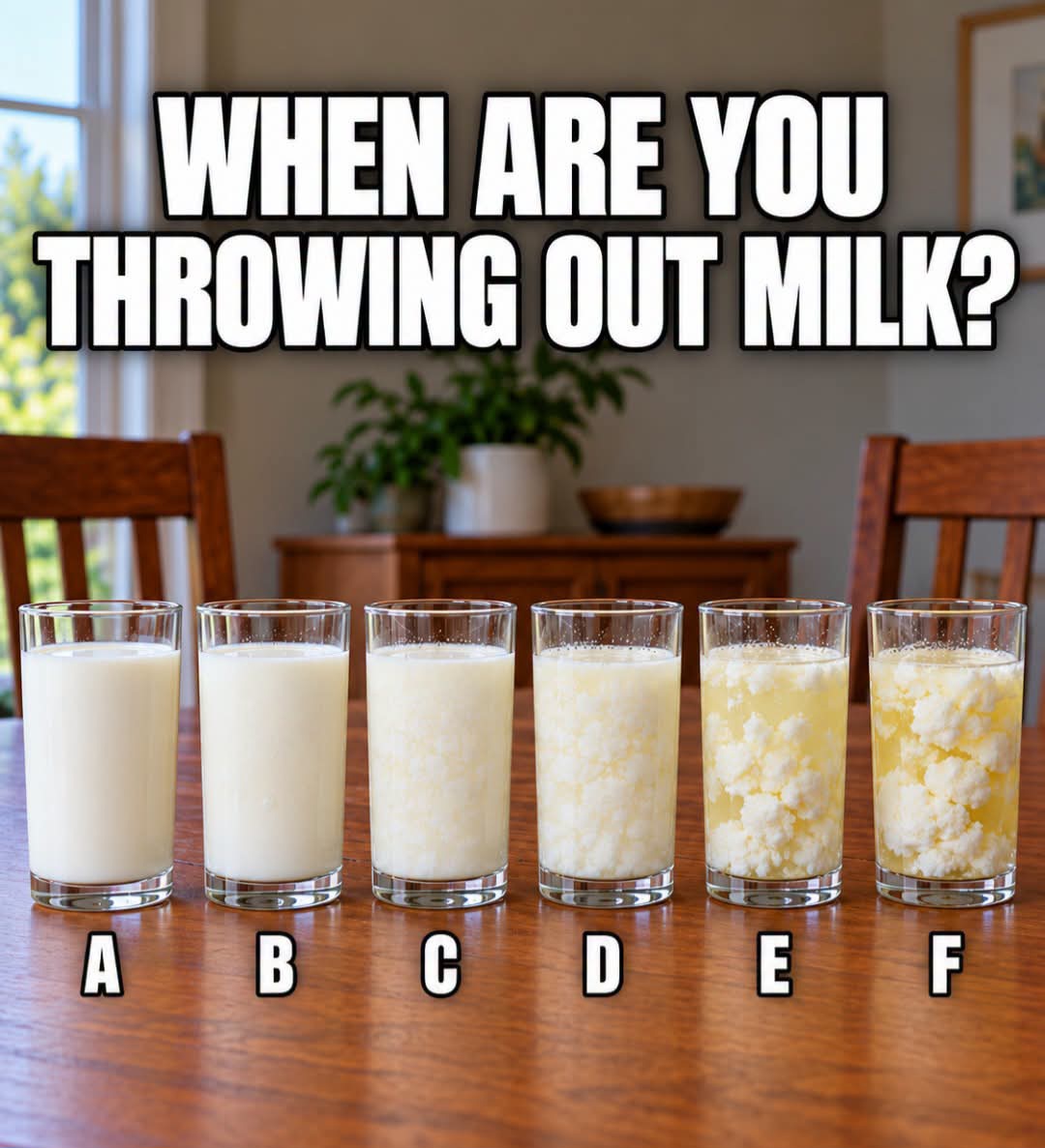
🥛 When Are You Throwing This Milk Out? 👀
We’ve all opened the refrigerator, looked at a carton of milk, checked the date, and wondered: “Is this still good?”
But milk doesn’t always spoil exactly when the date on the carton says it will. Storage temperature, how long it has been sitting out, and whether it has developed changes in smell or texture can all matter.
So, looking at the glasses in the picture, which one would make you throw the milk away? A, B, C, D, E, or F? 👀
🥛 What Are We Looking At?
The glasses appear to show milk becoming progressively more separated, lumpy, and curdled—from smooth milk to a much more obvious curdled appearance.
That makes this a fun food-safety question, but there’s an important point:
You can’t determine whether milk is safe to drink from appearance alone.
Milk can spoil before dramatic curdling appears, while milk can also separate or form small changes for reasons that don’t necessarily mean the same thing as dangerous bacterial contamination.
A — Fresh-Looking Milk
The first glass looks smooth, uniform, and creamy.
There are no obvious lumps or signs of separation. If properly refrigerated and otherwise within its safe storage period, this is what fresh milk typically looks like.
But remember: appearance isn’t a guarantee of safety.
B — Still Smooth
The second glass looks very similar, although it may appear slightly different in texture.
At this stage, many people would probably still consider the milk normal.
The best practice is to consider the entire picture: storage conditions, age, smell, packaging, and appearance.
C — Beginning to Change
The third glass shows more visible changes.
You may notice small particles or areas of separation. This is where many people start wondering whether the milk should still be used.
If milk has developed an unusual smell, obvious curdling, a swollen container, or other signs of spoilage, don’t drink it.
D — Noticeably Curdled
Now the change is much more obvious.
The milk appears separated and contains visible curds. At this point, it certainly doesn’t look like milk most people would want to drink.
Some people intentionally use sour or curdled milk in cooking, but spoiled milk shouldn’t simply be treated as a safe cooking ingredient. Heating doesn’t necessarily make spoiled food safe.
E — Heavily Separated
The fifth glass shows substantial separation and large curd-like pieces.
This is a definite “I’m not drinking that” moment for most people.
When milk has a strong sour or unpleasant odor and a distinctly abnormal texture, it’s best to discard it rather than trying to rescue it.
F — Completely Curdled
The final glass is dramatically separated, with large amounts of curdled material.
This is the stage that makes the answer pretty easy for most people: into the trash it goes!
And there’s no reason to take a sip just to find out.
👃 Don’t Use the “Taste Test”
One of the worst ways to check questionable milk is to taste it.
If you’re unsure whether a food has spoiled, you don’t need to taste it to find out. Look for signs of spoilage and consider how the food has been stored.
Milk that has been improperly refrigerated can become unsafe even when it doesn’t look dramatically different.
📅 What About the Date on the Carton?
The date printed on milk can be confusing.
Depending on where you live and the labeling system being used, a date may refer to freshness or quality rather than being a simple “this food becomes unsafe after midnight” deadline.
Instead of relying on the date alone, consider:
- Has the milk been kept properly refrigerated?
- Has it been left out for an extended period?
- Does the container look swollen or damaged?
- Does it smell noticeably sour or unpleasant?
- Has the texture changed significantly?
- Does it look different from normal?
When in doubt, throw it out.
🌡️ How to Keep Milk Fresh Longer
Proper storage can make a big difference.
Keep milk cold
Store milk in the refrigerator rather than leaving it on the counter.
Don’t store it in the refrigerator door
The refrigerator door tends to experience more temperature fluctuations. Keeping milk toward the back of the refrigerator, where temperatures are generally more stable, can help maintain quality.
Put it away promptly
After pouring a glass, return the carton to the refrigerator rather than letting it sit out during a long meal.
Keep the container closed
Close the carton or bottle tightly after each use.
Don’t pour unused milk back
If you’ve poured milk into a glass and it has been sitting out, don’t pour it back into the original container.
🥛 What Causes Milk to Curdle?
Milk contains proteins and other components that can change when exposed to acidity, heat, or microbial activity.
As milk becomes increasingly acidic, its proteins can clump together, creating the familiar curdled appearance.
This is also why ingredients such as lemon juice or vinegar can intentionally cause milk to separate when making certain foods.
So curdling doesn’t always mean exactly the same thing—the cause and circumstances matter.
🚨 When Should You Just Throw It Away?
If you’re dealing with milk that has an unusual odor, obvious spoilage, significant curdling, a damaged or swollen container, or uncertain storage history, don’t take chances.
Food waste is frustrating, but getting sick from questionable food is worse.
And remember: never taste suspicious milk as a test.
👀 So… Which One Are You Throwing Out?
Let’s make this one a little controversial!
Looking at the picture, which glass would be your cutoff?
🥛 A — Looks perfectly fine
🥛 B — Still drinking it
🥛 C — Hmm… I’m getting suspicious
🥛 D — Nope, it’s going
🥛 E — Absolutely not!
🥛 F — Straight into the trash 😂
Tell us your answer: A, B, C, D, E, or F! 👇
And be honest… would you actually smell questionable milk before throwing it away, or does it go straight into the trash the second you see those lumps? 😅
