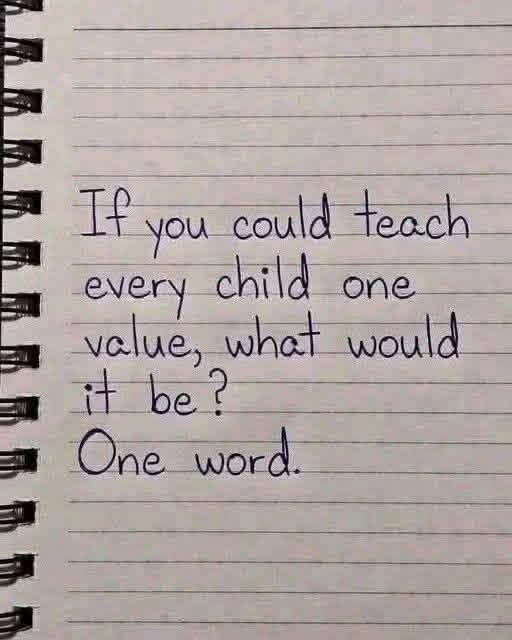
A powerful answer could be Kindness. Below is a full article inspired by this question, exploring why kindness is one of the most important values we can teach children.
Kindness: The One Value Every Child Should Learn
Introduction: The Foundation of a Better World
If we could teach every child just one value that would guide them throughout their lives, what would it be?
Some might choose honesty, others might choose respect, courage, responsibility, or compassion. All these values are important, but one value has the power to bring many of them together: kindness.
Kindness is more than saying “please” and “thank you.” It is about understanding other people’s feelings, offering help without expecting anything in return, and treating everyone with dignity, regardless of their background, appearance, beliefs, or circumstances.
Children are the future of our world. The values they learn today will influence the adults they become tomorrow. If we want to build a world filled with understanding, peace, and compassion, we must begin by teaching children to be kind.
1. Kindness Begins at Home
Children learn more from what they see than from what they are told. Parents are their first teachers, and the home is their first classroom.
When children see their parents treating others with respect, helping someone in need, apologizing for their mistakes, and speaking gently even during difficult moments, they begin to understand what kindness looks like in everyday life.
A child who grows up witnessing compassion is more likely to recognize the importance of showing compassion to others.
However, teaching kindness does not mean raising children who never disagree, never become angry, or always put others first. It means helping them understand their emotions while teaching them to respond to others with consideration.
Parents can teach kindness through small, everyday actions:
- Encouraging children to share with others.
- Teaching them to speak respectfully, even when they disagree.
- Helping them understand how their words and actions affect people’s feelings.
- Encouraging them to apologize sincerely when they hurt someone.
- Showing them that helping others is valuable, even when nobody is watching.
These simple lessons can become lifelong habits.
2. Kindness in Schools
Schools are not only places where children learn mathematics, science, languages, and history. They are also places where children learn how to live alongside others.
A child may achieve excellent grades and possess extraordinary intelligence, but academic success alone does not guarantee that they will become a considerate or responsible adult.
Education should also help children develop empathy, emotional intelligence, and respect for others.
Teachers can encourage kindness by creating classrooms where every child feels safe, included, and valued.
They can teach children to stand up for classmates who are bullied, welcome new students, respect differences, and offer help to those who struggle.
Imagine a child sitting alone during lunchtime. Other children might ignore them because they are busy with their own friends. But one child chooses to sit beside them, start a conversation, and make them feel welcome.
That small gesture might seem insignificant to everyone else. For the lonely child, however, it could mean everything.
Sometimes, the smallest act of kindness can make the biggest difference in someone’s life.
Schools should help children understand that kindness is not a sign of weakness. It takes courage to defend someone who is being mistreated, to admit when we are wrong, and to choose compassion when cruelty seems easier.
3. Kindness Can Change the World
The world does not suffer from a lack of intelligence alone. It also suffers when people fail to understand, respect, and care for one another.
Conflicts arise when people refuse to listen. Relationships break down when pride becomes more important than understanding. Communities become divided when differences are used as reasons for hatred.
Kindness cannot solve every problem, but it can change how people approach them.
A kind person listens before judging. A kind person tries to understand another person’s perspective. A kind person recognizes that disagreement does not justify humiliation, and that being powerful does not give anyone the right to mistreat others.
Now imagine a generation of children who grow up understanding these principles.
Imagine future leaders who consider the suffering of ordinary people before making decisions. Imagine doctors who treat patients with compassion, teachers who encourage struggling students, employers who respect their workers, and neighbors who support one another during difficult times.
Such a world would not be perfect, but it could be a much better place to live.
And that transformation could begin with something as simple as teaching a child to be kind.
4. Kindness Does Not Cost Anything
One of the most beautiful things about kindness is that it does not require wealth, power, or special abilities.
A smile costs nothing. A sincere compliment costs nothing. Listening to someone who needs to talk costs nothing. Helping a person carry something, offering encouragement, or thanking someone for their efforts requires very little.
Yet these small actions can have a lasting impact.
We often underestimate the struggles that other people are facing. Someone who appears happy may be dealing with loneliness. Someone who seems distant may be experiencing difficulties they cannot explain. Someone who makes a mistake may already feel disappointed in themselves.
We do not always know what another person is going through.
That is why kindness matters.
It reminds us to be careful with our words, patient with other people’s imperfections, and generous in the way we treat those around us.
Children should learn that they do not need to solve everyone’s problems to make a difference. Sometimes, simply being present, offering encouragement, or refusing to participate in someone’s humiliation is enough.
A kind act may take only a few seconds, but the memory of that act can remain with someone for years.
5. Teaching Kindness in a World That Often Rewards Cruelty
One of the greatest challenges in teaching kindness is that children do not always see it rewarded.
They may see people gain popularity by making fun of others. They may encounter online comments filled with insults, witness adults speaking disrespectfully, or hear others suggest that showing emotions is a sign of weakness.
Social media can make the problem worse by rewarding attention, outrage, and humiliation.
Children may begin to believe that being cruel makes them powerful, that apologizing makes them weak, or that kindness is something to show only to people who can offer them something in return.
Adults must challenge these beliefs.
We need to show children that true strength is not about making others feel small. It is about having the confidence to treat people well without needing to prove our superiority.
We must also teach them that kindness does not mean accepting abuse, tolerating injustice, or allowing others to take advantage of them.
A kind person can have strong boundaries. A compassionate person can say no. And a respectful person can stand up firmly against wrongdoing.
The goal is not to raise children who please everyone. It is to raise children who understand the difference between being kind and being submissive.
They should learn to protect themselves while refusing to deliberately harm others.
6. Kindness Must Include Everyone
It is easy to be kind to people we love, people who agree with us, and people who treat us well.
The real challenge comes when we encounter people who are different from us, who hold different opinions, or who have made mistakes.
Teaching children to be kind means teaching them to look beyond superficial differences.
A person’s nationality, language, religion, economic circumstances, physical appearance, or abilities should not determine whether they deserve basic respect.
Children should learn that every human being has feelings, hopes, fears, and struggles.
They should understand that someone who speaks differently is not less deserving of respect, that someone who has less money is not less valuable, and that someone who makes a mistake should not automatically be defined by that mistake.
This does not mean that all actions are acceptable or that harmful behavior should go unchallenged. It means that we can hold people accountable without denying their humanity.
When children learn to respect others regardless of their differences, they help create a society in which people can live together with greater understanding and less prejudice.
7. Kindness Also Means Being Kind to Yourself
There is another important lesson children need to learn: kindness should include themselves.
Some children grow up believing that they must always succeed, please everyone, or hide their struggles to be worthy of love and respect.
They may become extremely critical of themselves when they make mistakes.
Teaching kindness means helping children understand that they deserve patience and compassion, too.
They should learn that making a mistake does not make them a failure, asking for help does not make them weak, and experiencing difficult emotions does not make them less valuable.
Self-kindness encourages children to learn from their mistakes rather than become trapped in shame.
It also helps them develop healthier relationships with others. Children who understand their own emotions may become better equipped to recognize and respect the emotions of those around them.
Of course, self-kindness does not mean avoiding responsibility. It means acknowledging mistakes honestly while believing that growth and improvement are possible.
Children need to understand that they can be imperfect and still be worthy of love, dignity, and respect.
8. The Ripple Effect of One Kind Act
Kindness has a remarkable quality: it can spread from one person to another.
Consider a child who receives encouragement from a teacher after struggling with a difficult assignment. Feeling supported, that child may become more willing to help a classmate who is struggling.
The classmate may later offer support to someone else.
One act of kindness can inspire another, creating a chain of positive actions that extends far beyond the original moment.
We may never know how far the effects of our actions will travel.
A few encouraging words might help someone regain confidence. A small gesture of inclusion might help someone feel that they belong. A moment of patience might prevent an argument from becoming something much worse.
This is why teaching kindness matters even when the results are not immediately visible.
We are not simply teaching children how to behave in a particular moment. We are helping them develop habits that may influence their friendships, families, workplaces, and communities for the rest of their lives.
The world does not become kinder through grand gestures alone. It also becomes kinder through millions of ordinary people choosing to treat one another better every day.
9. What Can Adults Do to Raise Kinder Children?
Teaching kindness requires more than telling children to be nice. It requires consistency, patience, and example.
Parents, teachers, and other adults can help children develop kindness in several practical ways.
Lead by example. Children notice how adults treat waiters, strangers, elderly people, family members, and those who cannot offer them anything in return. Our behavior often teaches more than our words.
Encourage empathy. When a child hurts someone, ask questions that help them consider the other person’s feelings. For example, “How do you think your friend felt when that happened?”
Recognize kind behavior. Acknowledge moments when children share, help, include others, or take responsibility for their mistakes. Help them understand why those actions matter.
Teach them to apologize. An apology should be more than a word spoken to avoid punishment. Children should learn to acknowledge the harm they caused, take responsibility, and make a sincere effort to do better.
Encourage acts of service. Involve children in age-appropriate activities that help others, whether supporting a neighbor, assisting a family member, or participating in a community initiative.
Teach respect for differences. Encourage children to ask thoughtful questions, challenge unfair assumptions, and recognize the value of people whose lives differ from their own.
Be patient with the learning process. Children will make mistakes. They will sometimes act selfishly, become frustrated, or struggle to understand another person’s perspective. These moments are opportunities to teach rather than simply occasions to punish.
Most importantly, adults must practice what they teach.
It is difficult to convince a child that kindness matters if the adults around them regularly demonstrate cruelty, disrespect, or indifference.
The most powerful lesson we can offer is to live according to the values we want our children to embrace.
Conclusion: One Word, One Value, A Better Future
If I could teach every child in the world just one value, it would be kindness.
Not because honesty, courage, respect, responsibility, and fairness are unimportant, but because kindness can help bring these values into everyday life.
Kindness encourages us to be honest without being needlessly cruel, courageous enough to defend others, respectful of differences, and responsible for the effects of our actions.
It teaches us that success means little if we lose our humanity along the way.
Children do not need to become extraordinary people to make the world better. They can begin by being thoughtful classmates, supportive friends, respectful family members, and compassionate human beings.
They can learn to offer help, listen without immediately judging, speak without humiliating others, and stand up for those who are being mistreated.
These actions may seem small, but a better world is built through small choices repeated over time.
We cannot protect children from every hardship they will face, nor can we guarantee that everyone they meet will treat them kindly. But we can give them a value that helps guide their decisions throughout their lives.
We can teach them that another person’s dignity matters, that compassion is a strength, and that the way we treat people reveals something important about who we are.
Perhaps, years from now, the children we teach will become parents, teachers, doctors, engineers, artists, and leaders. They will make decisions that affect people we may never meet.
And if they carry kindness into those roles, the lessons they learned in childhood may continue to make a difference long after we are gone.
Because children do not simply inherit the world we leave behind. They also help shape the world we leave to those who come after them.
If we want a world with less hatred, less cruelty, and more understanding, we must begin by teaching the next generation to care.
One child at a time. One action at a time. One act of kindness at a time.
If I could teach every child one value, it would be kindness. Because a kinder child today can help create a kinder world tomorrow.
