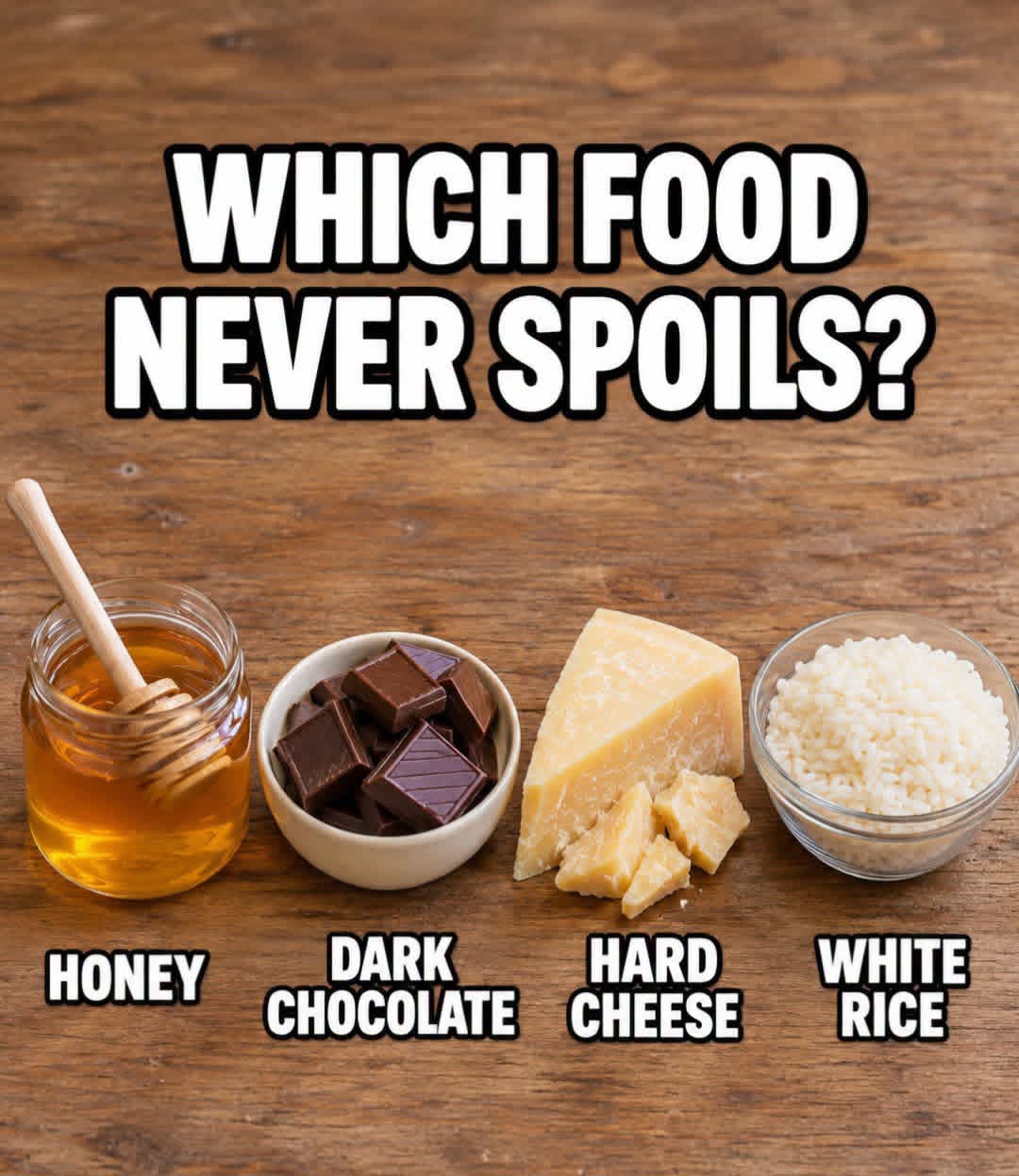
Which Food Never Spoils? The Surprising Truth About 4 Everyday Foods 🍯
Have you ever wondered if there is a food that can sit in your pantry for years, decades, or even centuries without going bad?
Some foods have surprisingly long shelf lives, but only a few are known for their extraordinary ability to resist spoilage.
Take a look at these four familiar foods:
- Honey 🍯
- Dark chocolate 🍫
- Hard cheese 🧀
- White rice 🍚
One of them is especially famous for its incredible longevity.
But which one is it?
Let’s explore why these foods last so long, how to store them properly, and which one deserves the title of the ultimate pantry survivor!
1. Honey – Nature’s Remarkable Long-Lasting Sweetener 🍯
The answer is honey!
Pure honey is one of the most shelf-stable natural foods in the world. When properly harvested, sealed, and stored, it can remain edible for an exceptionally long time.
Why does honey last so long?
It has several natural characteristics that make it difficult for many microorganisms to grow.
What makes honey so special?
- It contains very little available water.
- Its high sugar concentration makes it difficult for many microorganisms to survive.
- Its natural acidity helps discourage microbial growth.
- It contains compounds that contribute to its natural antimicrobial properties.
Honey has even been discovered in ancient Egyptian tombs, demonstrating its remarkable preservation potential.
Does Honey Ever Go Bad?
Under suitable conditions, pure honey can remain edible for an extremely long time.
However, improper storage or contamination can change that.
Always:
- Store honey in a tightly sealed container.
- Keep it in a cool, dry place.
- Use a clean, dry spoon.
- Avoid introducing water or food particles into the jar.
Why Does Honey Become Hard or Crystallized?
If your honey becomes thick, cloudy, or grainy, don’t panic!
Crystallization is a natural process in which glucose separates from the liquid honey and forms crystals.
It does not automatically mean the honey has spoiled.
To make crystallized honey runny again, place the jar in warm water and gently stir until the crystals dissolve. Avoid overheating it.
2. Dark Chocolate – A Treat With a Surprisingly Long Shelf Life 🍫
Dark chocolate can last much longer than many people expect, especially when it contains little moisture and is stored correctly.
Its sugar and cocoa solids help make it relatively shelf-stable.
However, chocolate does not last forever.
What affects its shelf life?
- Cocoa content.
- Added ingredients.
- Storage temperature.
- Exposure to moisture.
- Packaging quality.
Dark chocolate generally lasts longer than milk chocolate because it contains less milk.
Can Old Chocolate Still Be Eaten?
Sometimes, yes.
You may notice a white or grayish coating on chocolate that has been stored for a while.
This is often called chocolate bloom.
There are two common types:
- Fat bloom: Cocoa butter moves to the surface and forms a pale coating.
- Sugar bloom: Moisture dissolves sugar on the surface, which recrystallizes when the moisture evaporates.
Bloom can affect texture and appearance, but it does not automatically mean the chocolate is unsafe.
However, discard chocolate showing signs of mold, unusual odors, or other signs of spoilage.
Storage tip: Keep dark chocolate in a cool, dry place, away from direct sunlight and strong odors.
3. Hard Cheese – Delicious, But Not Spoilage-Proof 🧀
Hard cheeses such as Parmesan and aged cheddar are known for their relatively long shelf life.
Their lower moisture content and aging process help them last longer than many soft cheeses.
But here’s the important distinction: hard cheese does not last forever.
Why does hard cheese last longer?
- It contains less moisture than soft cheese.
- Salt helps control microbial growth.
- Aging changes its texture and flavor.
- Proper refrigeration slows spoilage.
What If Mold Appears on Hard Cheese?
This is where hard cheese differs from many other foods.
For a solid block of hard cheese, a small patch of surface mold can sometimes be removed safely.
Cut at least 1 inch (2.5 cm) around and below the moldy area, keeping the knife away from the mold so it does not spread contamination.
However, shredded, sliced, or crumbled cheese with mold should be discarded.
Always discard cheese that has an unusual smell, slimy texture, or other signs of spoilage.
Storage tip: Refrigerate hard cheese properly and protect it from excess moisture and contamination.
4. White Rice – A Pantry Essential With a Long Shelf Life 🍚
Uncooked white rice is another food famous for its impressive storage potential.
Because it contains less natural oil than brown rice, it generally keeps much longer when stored properly.
White rice can remain suitable for long-term storage when protected from moisture, insects, oxygen, and temperature fluctuations.
Why does white rice last so long?
- It has a low moisture content when properly dried.
- It contains less oil than brown rice.
- Its dry environment discourages microbial growth.
- Airtight packaging helps protect it from pests and moisture.
Does White Rice Really Last Forever?
No.
Ordinary pantry storage does not guarantee an unlimited shelf life.
For best results:
- Store uncooked rice in airtight containers.
- Keep it in a cool, dry location.
- Protect it from insects and rodents.
- Check regularly for moisture, pests, and unusual odors.
Important: Cooked Rice Is Different!
Never confuse uncooked white rice with cooked rice.
Cooked rice can become unsafe if left at room temperature for too long.
It may contain spores of a bacterium called Bacillus cereus, which can survive cooking and multiply if rice is stored improperly.
Refrigerate cooked rice promptly in shallow containers and use it within a few days.
Quick Comparison: Which Food Lasts the Longest?
| Food | Storage characteristics | Does it last forever? |
|---|---|---|
| Pure honey | Extremely shelf-stable when sealed | Can remain edible indefinitely under suitable conditions |
| Dark chocolate | Relatively long shelf life | No |
| Hard cheese | Lasts longer than soft cheese | No |
| Uncooked white rice | Excellent long-term storage potential | No guarantee |
Final Verdict: Honey Wins! 🍯
Although dark chocolate, hard cheese, and white rice can all last surprisingly long under the right conditions, pure honey stands out.
Its unique combination of low available moisture, high sugar concentration, and natural acidity makes it exceptionally resistant to spoilage.
That’s why honey has earned its reputation as one of nature’s most remarkable long-lasting foods.
It’s a wonderful reminder that some of the simplest foods in our kitchens have fascinating natural properties.
Now it’s your turn!
Did you know that honey could last so long?
Which of these four foods did you think would never spoil?
🍯 A. Honey
🍫 B. Dark Chocolate
🧀 C. Hard Cheese
🍚 D. White Rice
Drop your answer in the comments! And tell us whether you’ve ever found an old jar of honey in your pantry that still looked perfectly good.
