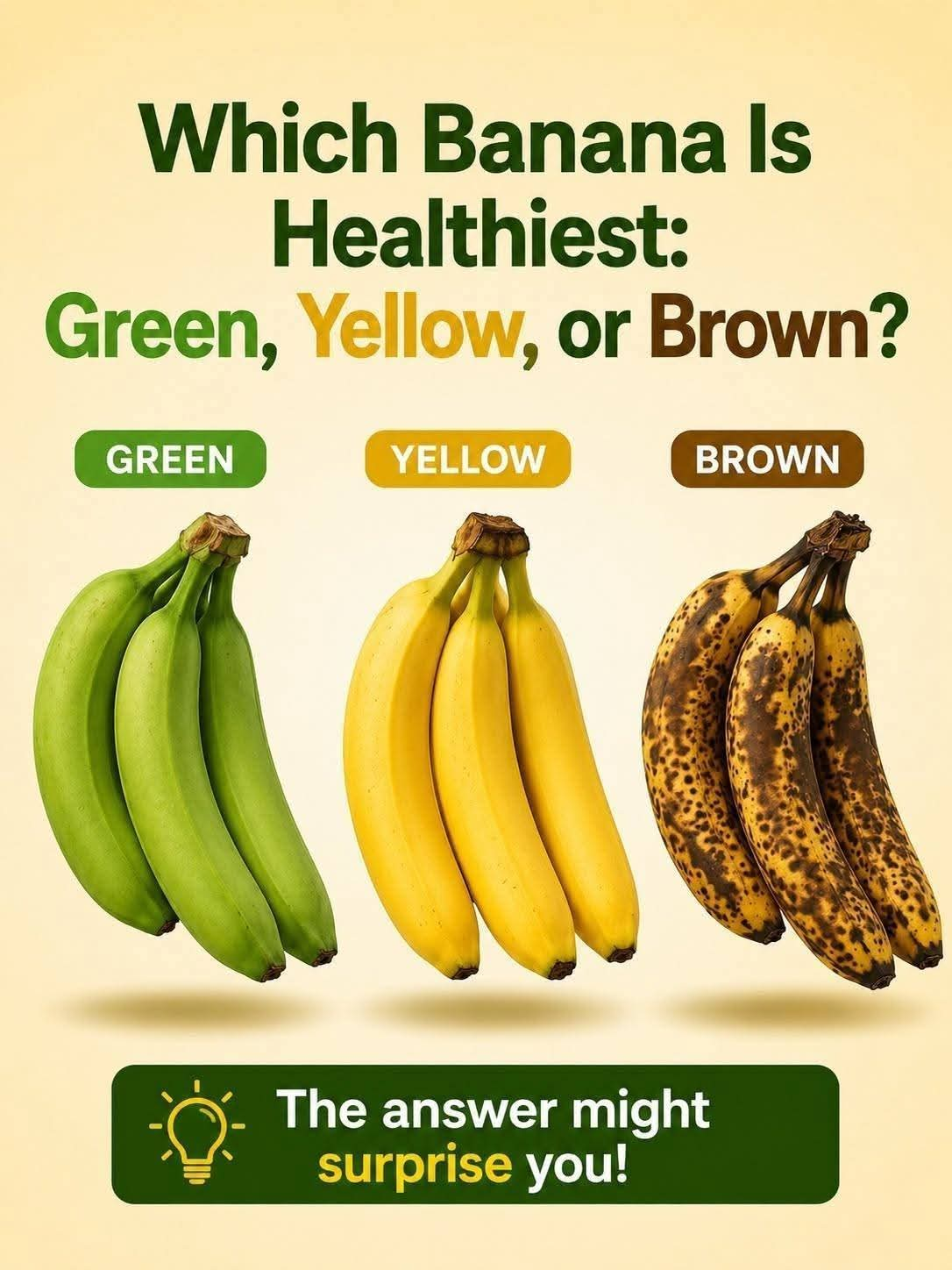
, Yellow, or Brown? The Surprising Differences Explained
Bananas are one of the world’s most popular fruits, but did you know that the color of a banana can tell you quite a bit about its nutritional properties?
Whether you prefer firm green bananas, perfectly yellow bananas, or soft brown-speckled ones, each stage of ripeness offers something different.
Some people believe green bananas are the healthiest because they contain more resistant starch. Others prefer yellow bananas because they are sweeter and easier to digest. And many people avoid brown bananas, even though they can still be nutritious and delicious!
So, which banana is actually the healthiest?
The surprising answer is that there isn’t one perfect banana for everyone. The best choice depends on your nutritional needs, digestion, taste preferences, and how you plan to use it.
Let’s explore what happens to a banana as it ripens.
1. Green Bananas: The Resistant Starch Champion
Green bananas are harvested before they fully ripen. They are firm, less sweet, and sometimes slightly bitter compared with their yellow counterparts.
But their nutritional profile has an interesting advantage.
Potential Benefits of Green Bananas
Rich in resistant starch
Green bananas contain more resistant starch than ripe bananas. Resistant starch is a type of carbohydrate that resists digestion in the small intestine and can be fermented by beneficial bacteria in the large intestine.
It behaves somewhat like dietary fiber.
May support gut health
Resistant starch can act as a prebiotic, providing nourishment for certain beneficial intestinal bacteria.
May help support blood sugar management
Because green bananas contain more resistant starch and less readily available sugar than fully ripe bananas, they may produce a different blood sugar response.
However, individual responses vary depending on portion size, ripeness, and what else you eat.
Less sweet
Green bananas contain more starch and less simple sugar than ripe bananas, making them a suitable option for savory dishes.
How to Eat Green Bananas
Green bananas are often cooked rather than eaten raw.
Try them:
- Boiled with a little salt.
- Baked in the oven.
- Added to savory stews.
- Mashed as a side dish.
- Sliced and cooked into banana chips.
Best for: People looking for a less-sweet banana with more resistant starch and those who enjoy savory banana dishes.
2. Yellow Bananas: The Everyday Nutritional Favorite
Yellow bananas are what most people picture when they think of a perfectly ripe banana.
They are naturally sweet, soft enough to eat comfortably, and easy to add to everyday meals.
As a banana ripens, much of its starch is converted into natural sugars. This makes yellow bananas sweeter and easier to digest for many people.
Potential Benefits of Yellow Bananas
A good source of potassium
Potassium is an essential mineral that helps support normal muscle function, nerve signaling, and healthy blood pressure.
Provides vitamin B6
Vitamin B6 supports normal brain development, nervous system function, and the production of certain neurotransmitters.
Contains dietary fiber
Yellow bananas provide fiber that contributes to digestive health and helps support regular bowel movements.
Naturally provides energy
Their combination of carbohydrates and natural sugars makes yellow bananas a convenient source of energy.
Easy to enjoy
Yellow bananas are versatile and can be eaten on their own or added to breakfast, smoothies, yogurt, and oatmeal.
How to Eat Yellow Bananas
Yellow bananas are delicious in many everyday recipes:
- Sliced over oatmeal.
- Blended into smoothies.
- Added to Greek yogurt.
- Served with peanut butter.
- Mixed into pancake batter.
- Enjoyed as a quick snack.
- Added to fruit salads.
Best for: Everyday snacking, convenient energy, and people who enjoy naturally sweet fruit.
3. Brown Bananas: The Sweetest and Softest Choice
Don’t throw away those brown-speckled bananas just yet!
As bananas continue to ripen, their yellow peels develop brown spots, and their flesh becomes softer and sweeter.
This happens because enzymes break down starch into simpler sugars during the ripening process.
Brown bananas are often overlooked, but they are still nutritious as long as they haven’t spoiled.
Potential Benefits of Brown Bananas
Naturally sweeter flavor
As the banana ripens, more of its starch is converted into sugars. This makes brown-speckled bananas particularly sweet.
Soft texture
Their softer consistency makes them easy to mash and incorporate into recipes.
Still provide important nutrients
Overripe bananas continue to provide potassium, vitamin B6, and other nutrients found in bananas.
Useful for reducing food waste
Instead of throwing away ripe bananas, you can turn them into delicious homemade treats.
How to Use Brown Bananas
Brown-speckled bananas are excellent for baking and cooking.
Try them in:
- Homemade banana bread.
- Banana muffins.
- Banana pancakes.
- Smoothies.
- Homemade banana ice cream.
- Oatmeal cookies.
- Banana cake.
- Frozen banana desserts.
Best for: Baking, naturally sweet recipes, smoothies, and reducing food waste.
Important: Brown spots on the peel are generally normal during ripening. However, discard bananas with visible mold, leaking liquid, or an unpleasant fermented or rotten smell. A completely brown peel does not automatically mean the fruit is spoiled.
Green vs. Yellow vs. Brown: What’s the Difference?
As bananas ripen, their nutritional composition changes.
Here’s a simple comparison:
| Feature | Green Banana | Yellow Banana | Brown-Speckled Banana |
|---|---|---|---|
| Starch | Highest | Lower | Lowest |
| Resistant starch | Generally highest | Lower | Generally lowest |
| Natural sugars | Lower | Higher | High |
| Sweetness | Mild | Sweet | Very sweet |
| Texture | Firm | Soft | Very soft |
| Best use | Cooking | Snacking | Baking |
| Digestibility | Can be harder for some people | Generally easier | Generally easier |
One important detail: The amount of traditional dietary fiber does not necessarily decrease dramatically with every stage of ripening. Different testing methods measure resistant starch and other fiber components differently. Research has demonstrated significant changes in banana starch and sugar content as the fruit ripens.
So, Which Banana Is Actually the Healthiest?
The answer depends on what you’re looking for.
Choose GREEN if:
- You want more resistant starch.
- You prefer less-sweet fruit.
- You want to experiment with prebiotic foods.
- You enjoy cooked banana dishes.
Choose YELLOW if:
- You want an everyday snack.
- You enjoy naturally sweet fruit.
- You want a convenient source of carbohydrates.
- You prefer a balance of firmness and sweetness.
Choose BROWN-SPECKLED if:
- You enjoy very sweet fruit.
- You love homemade banana bread.
- You want to use overripe fruit instead of wasting it.
- You prefer soft bananas for smoothies and baking.
My recommendation? Don’t limit yourself to just one color!
Each ripeness stage has something useful to offer, and including different stages in your diet can add variety to your meals.
4. Banana Nutrition Facts
Bananas are naturally nutritious and provide several essential vitamins and minerals.
According to Harvard’s Nutrition Source, one medium banana contains approximately:
| Nutrient | Amount |
|---|---|
| Calories | 110 |
| Total carbohydrates | 28 g |
| Natural sugars | 15 g |
| Dietary fiber | 3 g |
| Protein | 1 g |
| Fat | 0 g |
| Potassium | 450 mg |
These values are approximate and can vary depending on banana size and variety. The Nutrition Source
Why Are Bananas Good for Your Diet?
Bananas provide several nutrients that support normal body functions.
1. Potassium for muscle function
Potassium helps muscles contract properly and supports normal nerve function.
2. Vitamin B6 for the nervous system
Vitamin B6 plays an important role in brain development, metabolism, and the production of neurotransmitters.
3. Fiber for digestive health
Bananas contain dietary fiber, which supports digestion and regular bowel movements.
4. Carbohydrates for energy
Bananas provide carbohydrates that the body can use for energy throughout the day.
5. Antioxidant compounds
Bananas contain various naturally occurring plant compounds, including phenolic compounds, that contribute to their antioxidant properties.
5. Do Brown Bananas Have More Sugar Than Green Bananas?
Generally, yes!
One of the biggest changes during banana ripening is the conversion of starch into simpler sugars.
Green bananas contain considerably more starch, including resistant starch. As they ripen, this starch breaks down, producing the sweeter flavor associated with yellow and brown-speckled bananas.
A 2021 study published in PLOS ONE examined banana starch, sugar, and fiber at different stages of ripeness. Researchers found substantial changes in starch and sugar composition as bananas matured. PubMed Central (PMC)
This is why an overripe banana tastes much sweeter than a firm green one.
However, sweetness alone doesn’t determine whether a fruit is healthy. Portion size and your overall eating habits matter too.
6. Are Green Bananas Better for Blood Sugar?
Green bananas may have an advantage because they contain more resistant starch and less readily available sugar than fully ripe bananas.
Resistant starch is digested differently from ordinary starch and may help moderate the body’s glucose response.
However, this doesn’t mean yellow or brown bananas are unhealthy.
People managing diabetes can generally include bananas in a balanced eating plan, but portion size, individual glucose responses, and the total carbohydrates in a meal are important considerations.
Pairing a banana with protein or healthy fats, such as plain Greek yogurt or peanut butter, can also make a snack more satisfying.
If you have diabetes, follow the individualized dietary advice provided by your healthcare professional.
7. Can You Eat Bananas Every Day?
For most healthy adults, eating a banana every day can be part of a balanced diet.
Bananas are convenient, affordable, and easy to combine with other nutritious foods.
You can enjoy them:
- At breakfast with oatmeal.
- As an afternoon snack.
- In a fruit smoothie.
- With yogurt and nuts.
- Before or after physical activity.
- As an ingredient in homemade baked goods.
The key is variety. Bananas are nutritious, but they shouldn’t replace other fruits and vegetables.
People with certain medical conditions, particularly those requiring potassium restriction, should ask their healthcare professional about appropriate portions.
8. How to Store Bananas and Keep Them Fresh Longer
Want your bananas to stay fresh for longer?
Here are a few simple tips:
Keep green bananas at room temperature.
Allow them to ripen naturally on the kitchen counter.
Separate ripe bananas from other fruit.
Bananas release ethylene gas, which encourages ripening. Keeping them away from other ethylene-sensitive produce can help slow ripening.
Refrigerate ripe bananas.
Once bananas reach your preferred ripeness, refrigeration can help preserve the fruit inside. The peel may darken, but the flesh can remain perfectly good.
Freeze overripe bananas.
Peel ripe bananas, slice them, and place them in a freezer-safe container or bag.
Frozen bananas are excellent for smoothies, banana bread, and homemade frozen desserts.
9. Three Easy Ways to Enjoy Bananas
Here are three simple ideas for using bananas at different stages of ripeness.
Green Banana Breakfast or Side Dish
Ingredients:
- 2 green bananas.
- A pinch of salt.
- Water for boiling.
- A little olive oil (optional).
Instructions:
- Wash and peel the green bananas.
- Cut them into manageable pieces.
- Place them in a saucepan with water and a pinch of salt.
- Boil until tender, approximately 15–25 minutes, depending on size.
- Drain and serve warm.
Yellow Banana and Yogurt Bowl
Ingredients:
- 1 ripe yellow banana.
- 1 cup plain Greek yogurt.
- 2 tablespoons rolled oats.
- 1 tablespoon chopped walnuts.
- A pinch of cinnamon.
Instructions:
- Slice the banana.
- Add the yogurt to a serving bowl.
- Arrange the banana slices on top.
- Sprinkle with oats, walnuts, and cinnamon.
- Enjoy immediately.
Easy Brown Banana Bread
Ingredients:
- 3 very ripe bananas, mashed.
- 2 cups all-purpose flour.
- ½ cup melted butter.
- ¾ cup sugar.
- 2 eggs.
- 1 teaspoon baking soda.
- 1 teaspoon vanilla extract.
- ¼ teaspoon salt.
Instructions:
- Preheat the oven to 350°F (175°C).
- Grease a standard loaf pan.
- Mash the bananas in a large mixing bowl.
- Add melted butter, sugar, eggs, and vanilla. Mix well.
- Add flour, baking soda, and salt.
- Stir until just combined. Avoid overmixing.
- Pour the batter into the prepared loaf pan.
- Bake for approximately 50–60 minutes, or until a toothpick inserted into the center comes out clean.
- Allow the bread to cool before slicing.
It’s a delicious way to use bananas that might otherwise go to waste!
Frequently Asked Questions
Are green bananas healthier than yellow bananas?
Green bananas contain more resistant starch, which can support gut health. Yellow bananas, however, are sweeter and provide an easy-to-enjoy source of carbohydrates. Neither is universally healthier.
Are brown bananas safe to eat?
Yes. Brown spots and darkened peels are normal signs of ripening. However, discard bananas showing mold, leaking liquid, or signs of spoilage.
Which banana has the most resistant starch?
Generally, green, unripe bananas contain the most resistant starch. This amount decreases as the fruit ripens.
Do ripe bananas contain more calories?
The total energy content of a banana does not dramatically change simply because it ripens. However, the proportions of starch and sugars change.
Are bananas good for digestion?
Bananas provide dietary fiber, and green bananas contain resistant starch that can be fermented by beneficial gut bacteria. Individual digestive responses vary.
Can you eat bananas at night?
Yes. There is no general reason healthy people need to avoid eating bananas in the evening. They can be enjoyed as part of a balanced diet at any time.
Final Thoughts: Don’t Judge a Banana by Its Color!
Green, yellow, or brown?
The truth is that every stage of banana ripeness has something different to offer.
Green bananas are the resistant-starch champions. Yellow bananas are convenient everyday favorites, while brown-speckled bananas are wonderfully sweet and perfect for baking.
Rather than searching for one perfect color, enjoy bananas at different stages of ripeness.
And the next time you see a bunch of brown-speckled bananas sitting on your kitchen counter, remember that they might be exactly what you need for a delicious homemade banana bread!
Now It’s Your Turn!
Let’s settle this banana debate!
🍌 A – GREEN: I prefer firmer bananas with more resistant starch.
🍌 B – YELLOW: Perfectly ripe, sweet, and delicious!
🍌 C – BROWN: The sweeter and softer, the better!
Which banana do you reach for first: A, B, or C? Share your choice in the comments!
:::
