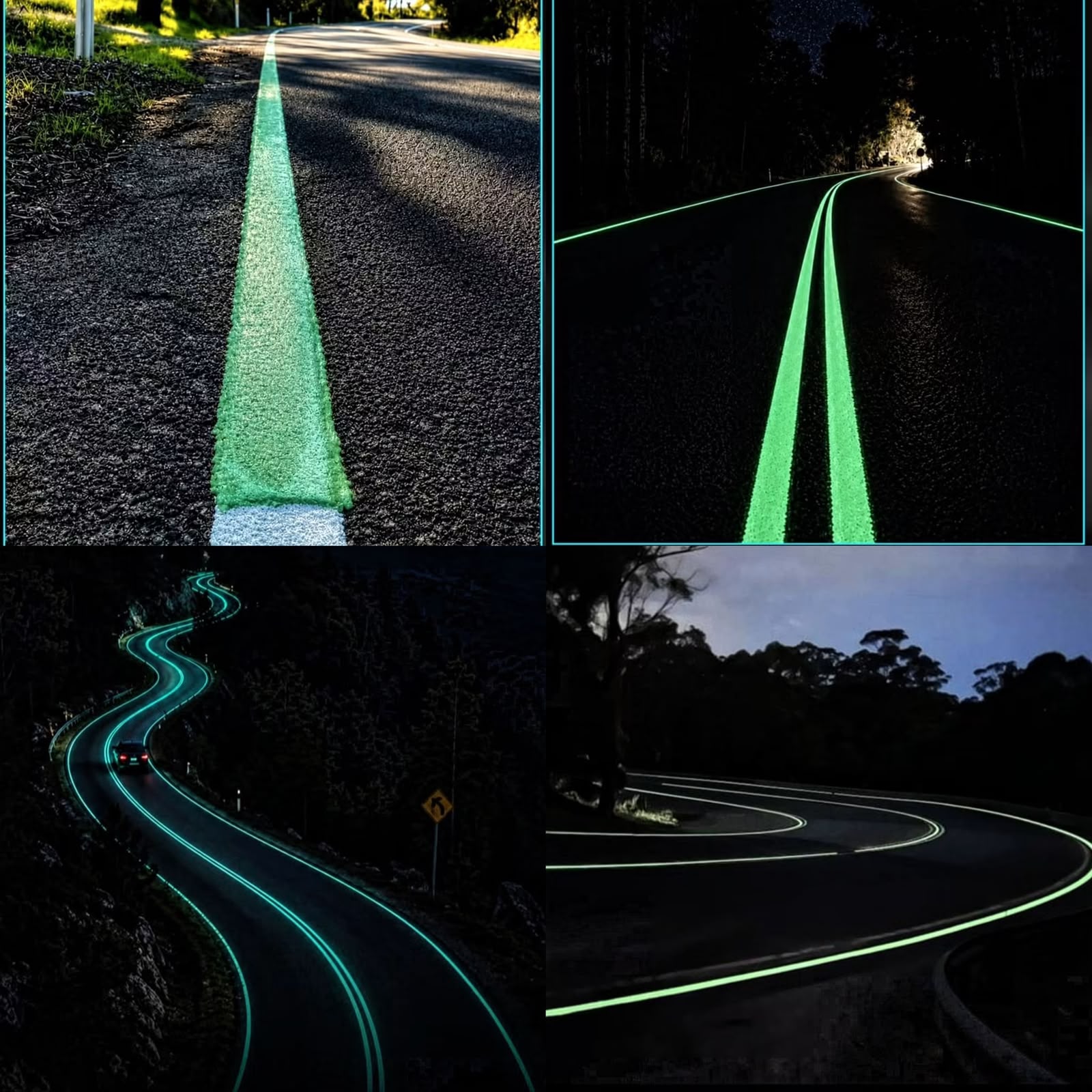
Australia Tests Glow-in-the-Dark Roads: Could This Innovative Technology Make Night Driving Safer?
Imagine driving along a dark road at night without traditional streetlights, yet still being able to clearly see the road markings, curves, and edges glowing beneath your headlights.
It might sound like something from the future, but photoluminescent road-marking technology is already being explored as an innovative way to improve visibility on roads after dark.
The concept is simple but fascinating: special materials absorb energy from natural or artificial light during the day and gradually release it in the form of a visible glow when the surroundings become dark.
Instead of relying entirely on conventional street lighting, these glowing markings could help drivers identify road boundaries, curves, and important sections of the road.
But how does this technology work, and could it really help reduce traffic accidents?
Let’s take a closer look.
1. How Do Glow-in-the-Dark Roads Work?
The technology is based on a scientific process called photoluminescence.
Special pigments are incorporated into road-marking materials. During daylight, these pigments absorb energy from sunlight and store it. When darkness arrives, they gradually release that stored energy as visible light.
This creates glowing road markings that can help drivers identify:
- Road edges and boundaries.
- Lane markings.
- Sharp bends and curves.
- Changes in road direction.
- Potentially dangerous sections of a route.
Unlike ordinary reflective road paint, which reflects light from vehicle headlights back toward the driver, photoluminescent paint can produce its own visible glow after being charged by light.
This distinction is important because headlights do not always illuminate distant road markings, particularly when approaching sharp bends or difficult sections of road.
The technology is especially interesting for rural roads, where installing conventional streetlights can be expensive or impractical.
2. Australia Has Already Tested This Technology
This isn’t simply a futuristic idea. Australia has already conducted several trials of photoluminescent road markings.
One early project took place in Victoria in 2022.
A company called Tarmac Linemarking worked with OmniGrip Direct and VicRoads to install glowing markings along approximately 700 metres of Metung Road in eastern Victoria.
The objective was to improve nighttime visibility, particularly on roads with curves, intersections, and limited street lighting.
The project was also intended to evaluate whether the technology could offer a cost-effective alternative to installing additional lighting infrastructure. ABC News
The Bulli Pass Trial in New South Wales
Another important project was announced in December 2024.
The New South Wales government selected a particularly challenging section of Bulli Pass, south of Sydney, for a glow-in-the-dark road-marking trial.
The location includes a steep descent and a sharp hairpin bend used by cars, trucks, and motorcycles.
Authorities reported 125 near-miss incidents at the location during the year ending June 30, 2024.
The new markings were designed to make the road layout more visible at night and help drivers recognize the approaching bend earlier.
The six-month trial began in December 2024. NSW Government
3. What Happened After the Trial?
The results from Bulli Pass were encouraging.
In August 2025, a report on the six-month trial revealed that recorded near-misses at the treated hairpin bend fell from 52 to 37 compared with the corresponding six-month period a year earlier.
That’s a reduction of approximately 29%.
The results encouraged authorities to consider using the technology at other high-risk locations.
However, it’s important to remember that a reduction in near-misses during one trial does not prove that the markings alone caused the improvement. Longer-term monitoring and further testing are needed to establish their effectiveness. Region Illawarra
4. Why Could This Technology Make Roads Safer?
See Continuation On Next Page 👇
