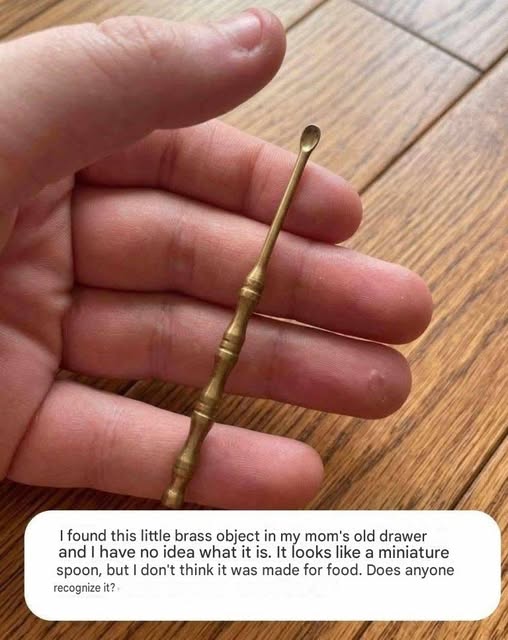
While unpacking one of my mother’s old drawers, I found a small brass object that looked almost like a very small spoon.
At first, I couldn’t help but wonder what anyone could eat with it. The spoon was too small for food, and the handle was long, thin, and decorated with tiny, raised rings. It looked old, carefully crafted, and definitely not from a modern kitchen.
The more I looked, the more curious I became.
It wasn’t a toy spoon. It wasn’t part of a dollhouse set. And it didn’t look like jewelry. It looked like a small tool from a bygone era, the kind people used to keep in personal hygiene boxes, sewing drawers, or old travel kits.
After asking around and doing a little research, I learned that this object was probably an old ear spoon, also known as an ear pick.
Advertisements
These small tools were once used for personal hygiene. The purpose of the small spoon at the end was to gently remove earwax from the outside of the ear. The long handle made it easy to grip, and the small, curved tip helped to collect the wax without the need for a large tool.
Earwax spoons like this were quite common in many parts of the world, especially in older households. Some were made of brass, others of silver, and some were sold in small grooming kits with nail clippers, tweezers, and other personal hygiene items.
The method of use was simple.
Holding the long handle, the small spoon was used only at the entrance to the ear. It did not need to be pushed in deeply. The spoon was used gently, and then wiped clean after use. Since the tool was made of metal, it could last for many years if properly washed, dried, and stored.
Some people also used similar small, spatula-shaped tools to clean under the nails. The small, curved tip made it easy to remove dirt from tight spaces, while the narrow handle made it easy to handle. Before modern nail care kits became common, small metal grooming tools like this were often a part of everyday life.
There are a few other possible uses.
Such tiny spoons were sometimes used to handle very small amounts of powder, medicine, herbs, or cosmetics. In the past, people kept many small tools for specific purposes, and not all of them had a single use. That’s why these objects can be confusing today.
Judging by the size, shape, and the spoon on the end, the most likely answer is that they were personal grooming tools, either an ear pick or a nail clipper.
Most people don’t use them anymore.
Modern personal care products are more readily available, and many people are more mindful of what they put near their ears. Gentle cleansers, modern nail care products, and safer designs have largely replaced old brass tools like this one.
But that doesn’t make them worthless.
In fact, such objects are interesting because they show how people lived in the past. Such a small tool can stay in a family for decades. It can sit quietly in a drawer, forgotten for years, until someone finds it and wonders why such a tiny spoon even existed.
That’s what made this discovery so fascinating.
At first, it seemed like an odd little spoon, too small to be useful. But once I learned what it was, it became a small reminder of an older way of life, when people kept simple tools, cared for them, and used them for years.
We might not use it today.
But it’s still worth keeping.
Not because it’s expensive, and not because it’s rare, but because it carries a bit of history. Sometimes even the smallest things in old drawers have surprising stories to tell.
