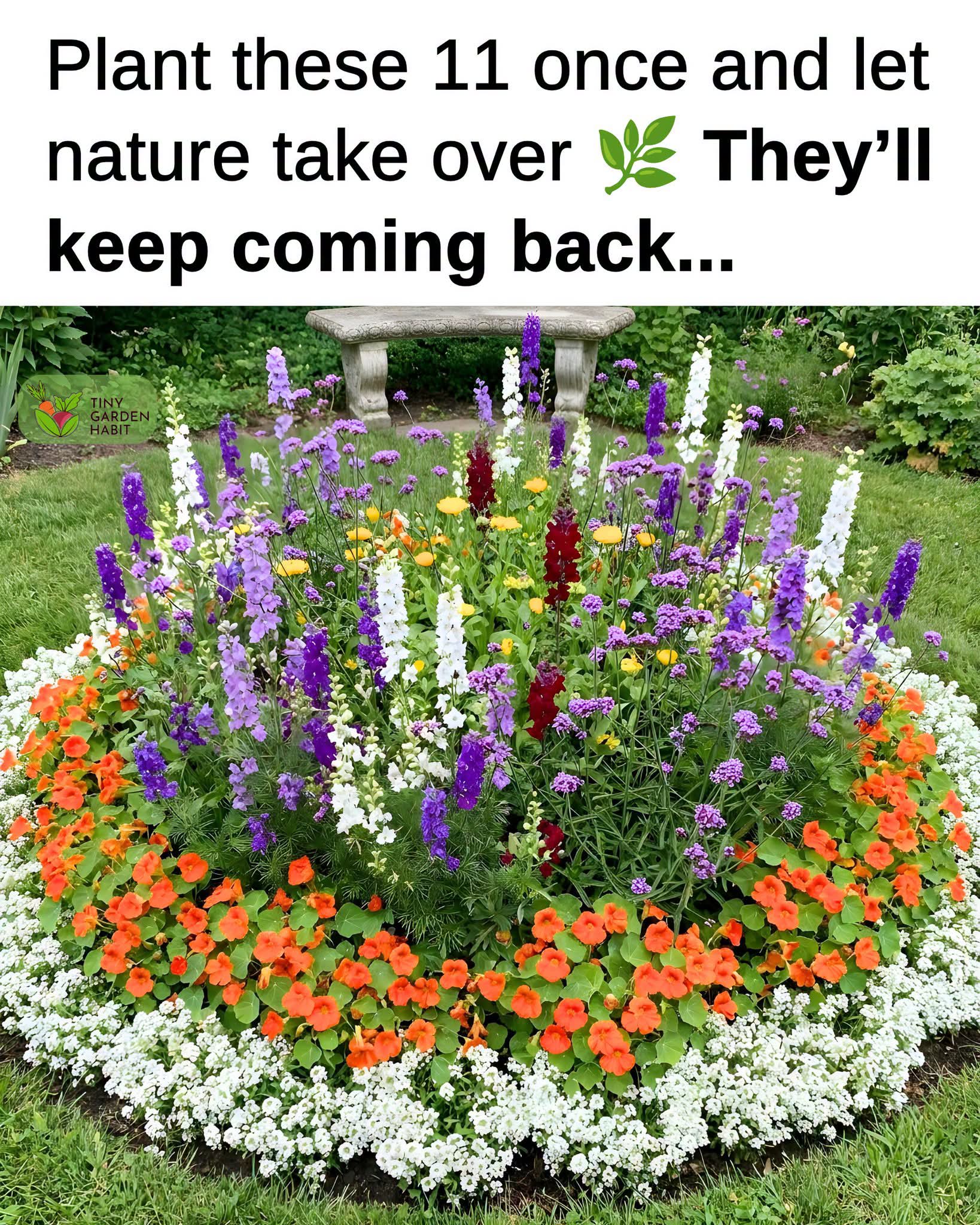
🌸 11 Self-Seeding Flowers That Provide Continuous Seasonal Color
There’s something wonderful about a garden that seems to plant itself.
Instead of buying new plants every spring, sowing trays of seeds, and carefully planning every empty space, you can grow flowers that naturally drop their seeds at the end of the season and return as new plants when conditions are right.
These self-seeding flowers—often called “volunteers”—can gradually create a fuller, more relaxed garden with very little effort. Annuals normally complete their life cycle in one growing season, but some varieties naturally scatter seed and return through those new seedlings. (Université du Maryland Extension)
The result can be a garden that changes a little every year, with unexpected pops of color appearing between established plants.
🌱 What Does “Self-Seeding” Mean?
A self-seeding flower produces mature seeds that eventually fall to the soil around the parent plant. Those seeds may survive through winter and germinate when the temperature and moisture conditions are favorable.
The new plants are sometimes called volunteers because they appear without being deliberately planted.
Some self-seeders are annuals, while others are biennials or perennials. Their ability to return depends heavily on climate, soil, moisture, winter conditions, and how much the soil is disturbed. (Tiny Garden Habit)
And that’s part of the fun: you don’t always know exactly where the next flower will appear!
🌼 11 Self-Seeding Flowers to Try
1. Calendula
Calendula officinalis
Calendula is one of those flowers that can make a garden look cheerful almost immediately.
Its yellow, gold, and orange blooms bring warm color to beds and borders. Calendula is easy to grow from seed and can flower through much of the season under suitable conditions. (Utah State University Extension)
Allow some flowers to remain on the plant rather than removing every spent bloom. Once the seed heads mature, they can drop seeds that may produce another generation.
Best for: sunny to partly shaded areas and cottage-style gardens.
2. Cosmos
Cosmos spp.
If you want tall, airy flowers that can create a soft, almost meadow-like appearance, cosmos is hard to beat.
Cosmos produces large numbers of seeds, and it can readily reseed itself. In fact, its ability to self-sow can sometimes become excessive if it is planted where you don’t want seedlings. (Utah State University Extension)
The delicate foliage and daisy-like flowers also make cosmos excellent for cutting gardens.
Best for: sunny borders, informal gardens, and cutting gardens.
Tip: If you want it to reseed, don’t remove every spent flower.
3. Love-in-a-Mist
Nigella damascena
Love-in-a-mist is a favorite for gardeners who enjoy unusual flowers and interesting seed pods.
Its delicate foliage surrounds the flowers, giving the plant an almost misty appearance. After flowering, decorative seed pods develop and eventually release seeds.
Once established, it can continue appearing year after year.
Best for: sunny borders and informal cottage gardens.
4. California Poppy
Eschscholzia californica
California poppies bring brilliant yellow, orange, and gold tones to sunny spaces.
They are particularly useful for gardeners who want flowers that can handle relatively lean, well-drained soil. University of New Hampshire Extension notes that California poppy is well suited to full sun and well-drained sandy or loamy soil. (Extension | University of New Hampshire)
Allowing mature flowers to form seed gives the plant an opportunity to establish itself naturally.
Best for: sunny borders, rock gardens, slopes, and naturalized areas.
5. Larkspur
Consolida spp.
Larkspur adds height and color without requiring a complicated gardening routine.
The tall flower spikes can bring shades of blue, purple, pink, and white into the garden, while the plants can produce seeds that help establish future generations.
Larkspur is also among the annual flowers commonly recommended for direct sowing. (Extension PSU)
Best for: cottage gardens, borders, and areas where vertical color is needed.
6. Black-Eyed Susan
Rudbeckia hirta
Black-eyed Susan is practically made for a relaxed garden.
Its golden-yellow petals surrounding a dark central cone create a classic summer flower, and the seed heads can provide food for birds while also allowing the plant to reproduce naturally.
Black-eyed Susan is among the perennial or reseeding flowers that can establish from seed in suitable conditions. (Ask Extension)
Best for: sunny borders, pollinator gardens, and naturalized areas.
7. Columbine
Aquilegia spp.
Columbine brings an entirely different look to the garden.
Its nodding, intricate flowers appear in a variety of colors and can add an almost woodland or old-fashioned cottage-garden feeling.
Columbine can self-seed readily, and because it can cross-pollinate, volunteer seedlings may not always look exactly like the parent plants. (Gardening Know How)
That means every new generation can bring a little surprise.
Best for: borders, woodland edges, and partly shaded gardens.
8. Sweet Alyssum
Lobularia maritima
Sweet alyssum is small, but it can make a big difference.
The low-growing plants form little mounds covered with tiny flowers and are especially useful around the edges of beds, along pathways, and in containers.
Sweet alyssum is also recognized by university Extension sources as a plant that can self-sow. (Université du Maryland Extension)
Best for: borders, containers, pathways, and filling small gaps.
9. Poppies
Papaver spp.
Poppies are one of the classic self-seeding garden flowers.
Their papery blooms make a dramatic statement, while their distinctive seed pods can scatter seeds throughout the surrounding soil.
Many poppies are especially good choices for naturalized and informal planting schemes. Poppies are also listed among annual flowers suitable for direct sowing. (Extension PSU)
Best for: sunny beds, cottage gardens, and wildflower-style plantings.
10. Nasturtiums
Tropaeolum majus
Nasturtiums are colorful, easygoing, and useful in more than one way.
Their bright flowers can appear in shades of yellow, orange, and red, while their rounded leaves add another layer of texture.
Mature seeds can fall and produce new plants in suitable conditions. Nasturtiums are also among the annuals commonly recommended for direct sowing. (Yard and Garden)
Best for: containers, vegetable gardens, borders, and informal beds.
11. Marigolds
Tagetes spp.
Marigolds are a garden favorite for good reason.
They provide warm yellow, orange, and gold color and can bloom generously throughout the growing season.
Some marigolds can reseed if mature flower heads are left in place. They are also straightforward to grow from seed and are widely used in vegetable and flower gardens.
Best for: sunny beds, vegetable gardens, containers, and borders.
🌿 How to Encourage Flowers to Self-Seed
The biggest mistake gardeners make when trying to create a self-seeding garden is cleaning it up too thoroughly.
If you remove every spent flower immediately, there may be very few mature seeds left to fall to the ground.
Instead, consider leaving selected flower heads in place until the seeds mature.
Try these simple tricks:
1. Don’t deadhead everything.
Leave some spent flowers on the plants so they can form mature seeds.
2. Give the seeds somewhere to land.
A thick layer of mulch can make it harder for some self-sown seeds to reach suitable soil. (Tiny Garden Habit)
3. Avoid excessive soil disturbance.
Constantly digging or cultivating the area can interfere with naturally dropped seeds.
4. Let nature do some of the planning.
A volunteer flower appearing in an unexpected location isn’t necessarily a problem.
5. Thin the seedlings.
If dozens of seedlings appear in one small area, keep the strongest ones and remove or transplant the extras.
6. Save seeds when you want more control.
You can collect mature, dry seeds and sow them where you actually want the next generation. (Extension PSU)
🌸 The Beauty of a Slightly Wild Garden
One of the best things about self-seeding flowers is that they don’t always follow your garden plan.
A cosmos might appear beside a pathway.
A poppy may emerge between two perennials.
Calendula might pop up in the vegetable garden.
A columbine may appear several feet away from where you originally planted it.
These surprises are part of what makes self-seeding gardens feel alive.
Instead of having every flower arranged in perfectly predictable rows, you get a garden that gradually evolves.
⚠️ One Important Thing to Remember
Self-seeding isn’t always a good thing in every location.
Some plants can spread enthusiastically and become difficult to control. University Extension sources specifically note that some self-seeding annuals can scatter beyond their intended areas, and certain plants may become overly aggressive in favorable conditions. (Utah State University Extension)
Also, volunteer plants grown from hybrid varieties may not look exactly like the original plant. The next generation can sometimes have different colors, forms, or other characteristics. (Extension PSU)
That’s why it’s best to think of self-seeding as controlled freedom.
Let a few areas become wild and natural, while keeping plants from taking over places where you don’t want them.
🌺 Create Your Own Self-Seeding Flower Garden
Imagine planting a few packets of seeds once and then watching the garden change year after year.
You could combine:
🌼 Calendula for golden color
🌸 Cosmos for tall summer blooms
💜 Larkspur for vertical color
🌺 Poppies for dramatic flowers
💙 Columbine for spring interest
🌿 Sweet alyssum for low-growing color
🧡 Nasturtiums for bright flowers
🌻 Black-eyed Susan for summer blooms
Rather than trying to make everything perfectly orderly, allow some flowers to mature and scatter their seeds.
Over time, you may find that your garden begins to plant itself.
🌱 Final Thought
A beautiful garden doesn’t always have to mean more work.
Sometimes the easiest way to get more flowers is simply to stop cleaning up quite so much.
Leave a few seed heads. Let some seeds fall. Give volunteer seedlings a chance. Then see what comes back.
The result may be a garden that’s fuller, more colorful, less expensive to maintain, and a little different every single year.
Which self-seeding flower would you let take over a corner of your garden? 🌸🌼🌺
