💵 “If You Can’t Afford a 25% Tip, Stay Home” — What Do You Think?
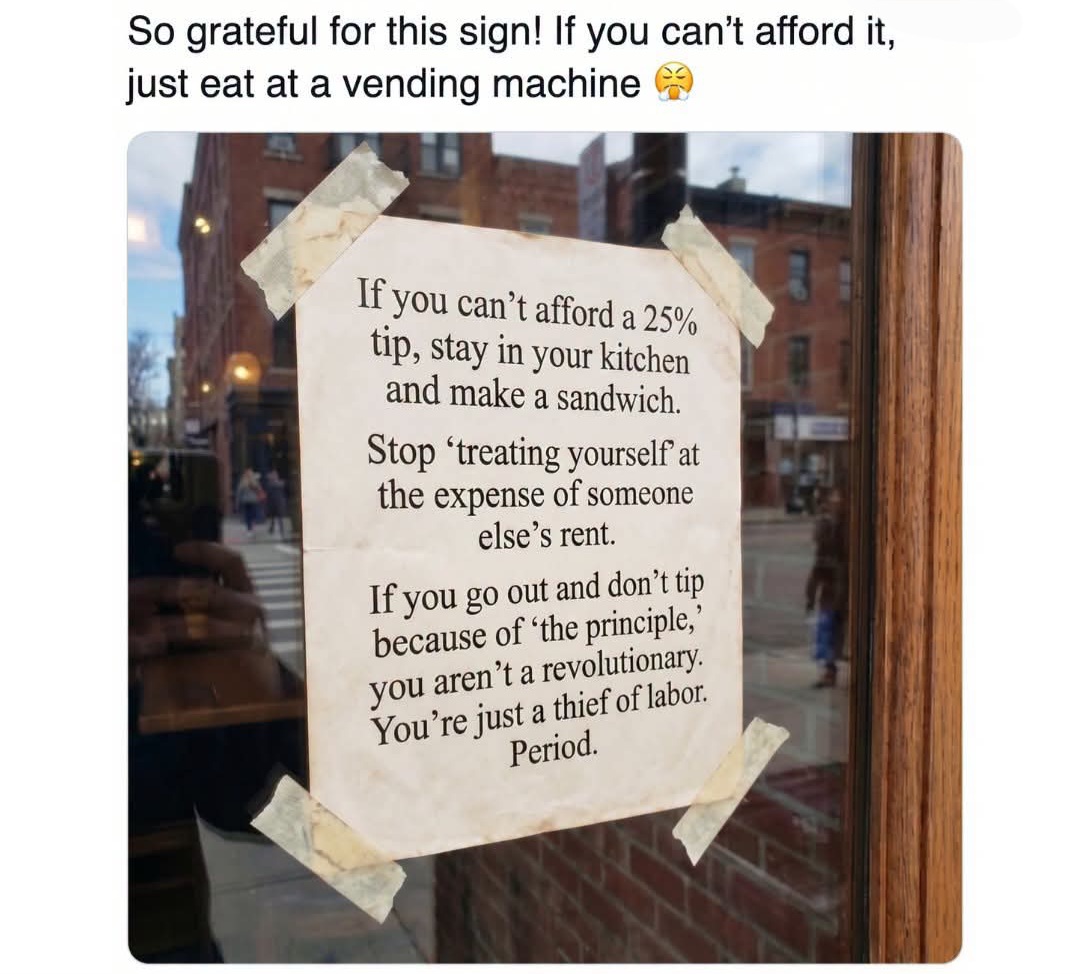
A sign posted outside a restaurant has sparked a pretty heated conversation about tipping.
Its message is blunt: if you can’t afford a 25% tip, don’t eat at the restaurant. Make a sandwich at home instead. It goes even further, suggesting that people who dine out but refuse to tip are taking advantage of someone else’s livelihood.
🫣 But is that fair—or has tipping culture gone too far?
That’s the question worth discussing.
🍽️ The Message Behind the Sign
The sign is clearly trying to make one point:
Restaurant workers depend on tips, so customers shouldn’t treat tipping as optional if they can’t afford the expected amount.
There’s certainly a reasonable argument behind that.
In the United States, restaurant tipping has been part of the dining culture for generations. Today, a large majority of Americans who eat at sit-down restaurants say they always or often leave a tip. Pew Research Center found that 92% of people who dine at sit-down restaurants say they always or often tip. (Pew Research Center)
So for many diners, leaving a tip isn’t an unusual extra expense—it’s an established part of the cost of eating out.
But the controversial part of this sign is the 25% requirement.
💰 Is 25% Really the Standard?
Not necessarily.
Tipping expectations have changed significantly over the years, and there isn’t one universally accepted percentage.
Pew Research Center’s survey found that when Americans were asked about an average, not exceptional, sit-down restaurant experience, 57% said they would leave 15% or less, while 25% said they would leave 20% or more. (Pew Research Center)
That doesn’t mean 25% is wrong.
It simply means that 25% isn’t a universally accepted minimum.
Some people consider 15% appropriate. Others prefer 18%, 20%, or 25%. Some leave more for exceptional service.
And some people believe restaurants should pay workers higher wages so customers aren’t expected to calculate another percentage on top of every meal.
🤔 The Bigger Problem: Tipping Has Become Confusing
One reason conversations about tipping have become so heated is that customers are increasingly being asked to tip in situations where tipping wasn’t traditionally expected.
Digital checkout screens can present suggested percentages before a customer even knows what amount feels appropriate.
Pew found that 72% of U.S. adults believe tipping is expected in more places than it was five years earlier. The same research found that 40% oppose suggested tip amounts, while only 24% favor them. (Pew Research Center)
That helps explain why people have such different reactions to signs like this one.
A diner might think:
“Of course I tip my server.”
But they might also think:
“Why am I being told that 25% is mandatory?”
Those are two very different questions.
❤️ There Are Real People Behind the Tip
It’s also important not to forget the worker on the other side of the receipt.
For many restaurant employees, tips are an important part of their income.
Under federal law, employers can take a tip credit for eligible tipped employees, meaning a tipped worker’s direct cash wage can be as low as $2.13 per hour under federal rules, provided the worker’s direct wages plus tips reach at least the federal minimum wage. State and local rules can require higher amounts and vary considerably. (Département du Travail des États-Unis)
That means the economics of tipping aren’t as simple as:
“The restaurant charges $30, so the worker gets paid for that $30 meal.”
In some circumstances, the tip is an important part of the worker’s compensation.
That’s why deliberately refusing to tip after receiving normal table service can have a very real effect on the person who served you.
🥪 But Is “Stay Home and Make a Sandwich” the Answer?
This is where the sign becomes much more controversial.
Someone might genuinely be unable to afford a 25% tip.
That doesn’t automatically mean they’re irresponsible or trying to take advantage of anyone.
People have different budgets.
Someone might save for months to celebrate a birthday at a restaurant. Someone else might be struggling financially but still want one inexpensive meal outside the house.
Telling everyone who can’t afford 25% to stay home reduces a complicated economic issue to a simple judgment.
And that’s probably why the sign has people divided.
🧾 What About Service?
Another important question is how good the service was.
Pew found that 77% of Americans say the quality of service is a major factor when deciding whether and how much to tip. (Pew Research Center)
That makes sense.
A server who is attentive, helpful, friendly, and professional can make a meal much more enjoyable.
On the other hand, diners sometimes encounter long waits, incorrect orders, inattentive service, or other problems.
Does the same percentage make sense in every situation?
That’s something people will disagree about.
⚖️ Tipping Is Also Different From a Service Charge
There’s another distinction that often gets lost in these conversations.
A tip is generally voluntary and goes to employees, while a service charge is a mandatory fee imposed by the business and can be handled differently. Pew notes that these charges are legally and practically distinct from tips. (Pew Research Center)
So if a restaurant already adds a 20% service charge, a customer may reasonably wonder whether another 20–25% tip is expected.
That’s something restaurants should make extremely clear.
🌎 Not Everyone Lives by American Tipping Rules
It’s also important to remember that tipping culture varies dramatically from country to country.
What feels completely normal in one place can seem strange somewhere else.
In some countries, workers receive wages structured differently and tipping may be modest, optional, or uncommon.
So the idea that one percentage is morally correct everywhere doesn’t really work.
Tipping is influenced by local wages, laws, restaurant customs, and social expectations.
💬 So, Who Is Right?
Maybe neither side has the entire answer.
The “Always Tip” Side Says:
✔ Servers depend on tips.
✔ Customers know tipping is part of restaurant culture.
✔ If you can’t afford the expected cost of dining out, eating at home may be more economical.
✔ Refusing to tip as a protest can hurt the worker rather than the restaurant.
The “Tipping Has Gone Too Far” Side Says:
✔ Customers shouldn’t be pressured into a specific percentage.
✔ 25% isn’t universally accepted as the minimum.
✔ Restaurants should clearly communicate wages and service charges.
✔ People shouldn’t be shamed for having a limited budget.
✔ Employers and policymakers also have a role in ensuring workers are fairly compensated.
And honestly, there are reasonable points on both sides.
🧐 What Would You Do?
Imagine you’re sitting at a restaurant.
The food is good.
The server is friendly.
The service is perfectly normal—not amazing, but not bad either.
Your bill is $100.
Would you leave:
A. 15% — $15
B. 18% — $18
C. 20% — $20
D. 25% — $25
E. Something else?
And here’s the harder question:
Would your answer change if the service was exceptional?
Or if the service was disappointing?
❤️ My Take
I think the most productive conversation isn’t “25% or you’re a terrible person.”
It’s:
“What should customers reasonably be expected to pay, and how should restaurant workers be fairly compensated?”
Customers shouldn’t be shamed simply because they can’t afford an arbitrary percentage.
At the same time, diners should understand that in a traditional U.S. full-service restaurant, tipping is often an expected part of the dining experience—and the person affected by a missing tip may be the worker, not the restaurant owner.
Ultimately, clear pricing, fair wages, transparent service charges, and reasonable tipping expectations would make things much easier for everyone.
Until then, we’re left with signs like this one—and plenty of arguments around the dinner table. 😅
🫣 So… What Do YOU Think?
Is the sign making a fair point, or is 25% an unreasonable expectation?
Would you rather:
🥪 Stay home and make a sandwich?
🍽️ Eat out and tip 20%?
💵 Tip 25% because that’s the expectation?
🤔 Decide based on the service?
Be honest—what would you do? 👇
