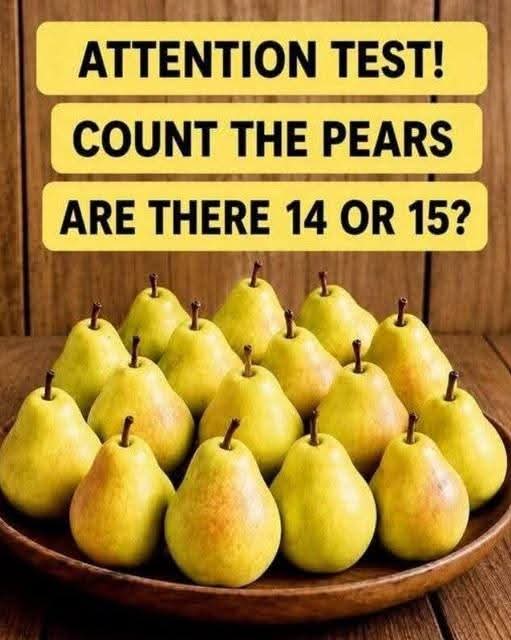
🍐👀 Attention Test! Can You Count All the Pears?
ARE THERE 14 OR 15?
At first glance, this looks like an easy little brain teaser. Just count the pears, right?
Well… not so fast! 😂🍐
The image is designed to make your eyes jump from one pear to the next while the overlapping rows make it surprisingly easy to lose your place.
So grab a cup of coffee, slow down, and count them carefully.
🍐 Start at the Back
The easiest way to solve a crowded picture like this is not to randomly count from left to right.
Instead, look for rows.
Starting at the very back, you can see 3 pears.
Move forward one row and there are 4 more.
The next layer contains 5 pears.
Then the front row has 4 pears.
That gives:
3 + 4 + 5 + 4 = 16 pears.
👀 So What’s the Answer?
Here’s the funny part:
The picture asks whether there are 14 or 15—but carefully counting the visible pears in the image actually gives 16. 🍐🍐🍐
So if you answered 14 or 15, the image may have successfully tricked you!
That’s what makes these attention-test pictures so entertaining. They often give you two possible answers and encourage your brain to choose one before you’ve actually finished counting.
🧠 Why Are These Puzzles So Easy to Get Wrong?
Our brains are remarkably good at recognizing patterns and groups.
When we see a pile of similar objects, we don’t necessarily process every single object individually. Instead, we tend to recognize the overall arrangement.
That’s useful in everyday life—but it’s not always helpful when you’re trying to solve a visual counting puzzle.
The pears overlap one another, they’re similar in color and shape, and they’re arranged at different depths.
Your eyes naturally jump around.
You might count one pear, move to another, then accidentally count the first one again.
Or you may see a pear partly hidden behind another and assume you’ve already counted it.
🍐 The Best Way to Count a Crowded Picture
If you want to beat these puzzles, try a simple technique:
1. Don’t rush.
The words “14 or 15?” are designed to make you choose quickly.
Ignore the suggested answers.
2. Find a pattern.
Look for rows, columns, or layers.
3. Count one layer at a time.
Don’t move randomly around the image.
4. Keep a running total.
For this picture:
Back row: 3
Second row: 4
Third row: 5
Front row: 4
Total: 16
5. Count again from the opposite direction.
If you get the same number twice, you’re probably on the right track.
👀 Why Do We Fall for “Attention Tests”?
These puzzles aren’t really testing intelligence.
They’re testing attention and visual organization.
Someone can be extremely intelligent and still miss an object in a crowded picture.
Our brains are constantly filtering information and deciding what deserves our attention. When objects overlap or look nearly identical, it’s easy for the brain to group them together rather than consciously counting every single one.
That’s why slowing down makes such a difference.
🍐 And Let’s Talk About the Pears!
Besides being a fun puzzle, this picture is a great reminder of just how beautiful fresh pears can be.
Pears are naturally sweet and juicy and provide fiber, vitamin C, potassium, and other beneficial plant compounds. A medium pear contains roughly 5–6 grams of fiber, depending on the variety and size. (Verywell Fit)
And don’t automatically peel them!
Much of a pear’s fiber and some of its plant compounds are concentrated in or near the skin, so eating the whole pear can provide more nutritional value. (Verywell Fit)
They’re delicious eaten fresh, but they’re also wonderful baked, poached, roasted, added to salads, or paired with cheese.
🍐 A Fun Little Family Challenge
This would make a great dinner-table challenge.
Show the picture to everyone and ask:
“How many pears do you see?”
Don’t let anyone shout out the answer immediately.
Give everyone 20–30 seconds.
Then have them explain how they counted them.
You’ll probably get several different answers—and that’s exactly what makes these puzzles fun!
😂 Did You Get Tricked?
The picture gives you only two choices:
14 or 15?
But the careful count of the visible pears is:
🍐 16! 🍐
So don’t feel bad if you picked one of the choices. The puzzle practically tells your brain that one of those two numbers must be correct.
That’s the trick!
Sometimes the hardest part of an attention test isn’t counting the objects.
It’s remembering to question the question. 👀🧠🍐
👇 Your Turn!
How many pears did you count the first time?
Be honest…
14, 15, or did you catch all 16? 😂🍐
