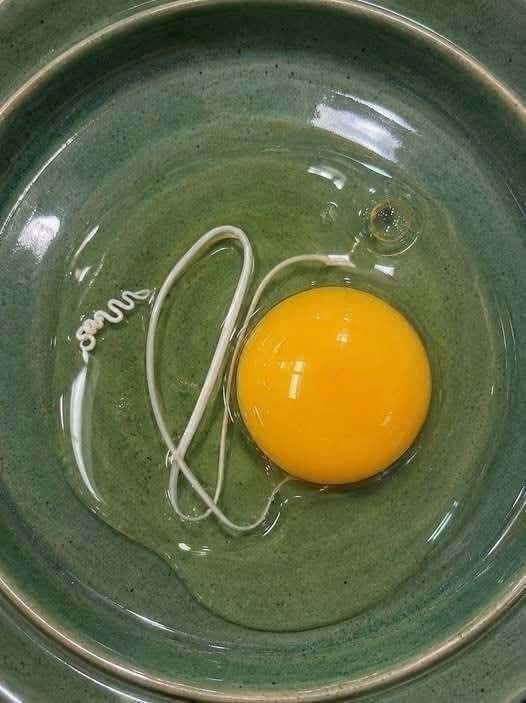
Have you ever cracked open an egg and noticed a strange white, string-like strand attached to the yolk?
At first glance, it can look unusual—even slightly alarming. Some people mistake it for a piece of shell, a blood vessel, or even a developing chick. But that little white strand is actually a completely natural part of the egg called the chalaza.
And there is something particularly interesting about it: a prominent, well-defined chalaza is often associated with a fresher, higher-quality egg. According to the USDA, chalazae are twisted, cord-like strands of egg white that anchor the yolk in the center of the egg. As an egg ages, these structures become less prominent and weaker.
So, the next time you see one, don’t throw the egg away. That strange-looking white strand may actually be telling you something positive about the egg.
🥚 What Exactly Is the Chalaza?
The chalaza (pronounced kuh-LAY-zuh) is a twisted, rope-like structure made from concentrated egg white.
Most eggs have two chalazae, positioned on opposite sides of the yolk. Their primary purpose is to help keep the yolk centered inside the egg.
Think of them as tiny natural suspension cords.
The egg yolk isn’t simply floating randomly inside the egg. The chalazae help anchor it in position while allowing it to remain suspended within the surrounding egg white.
The USDA describes the chalazae as twisted strands of egg white that anchor the yolk in the center of the white.
Why Does an Egg Need a Chalaza?
The yolk is the most delicate major component of the egg, so keeping it properly positioned provides a degree of protection.
The chalazae help prevent the yolk from simply moving freely around the egg whenever it is turned or shaken.
If you carefully examine a freshly cracked egg, you may notice that the yolk seems to remain relatively centered while the thicker egg white surrounds it.
That’s partly thanks to these fascinating little protein structures.
In simple terms:
Chalaza → anchors yolk → helps maintain its position → supports the egg’s internal structure.
Is the Chalaza a Baby Chick?
No.
This is one of the most common misconceptions about the white strand.
The chalaza is not an embryo, not a chick, and not an umbilical cord.
It is simply a natural structural component of the egg.
It can be present in an ordinary unfertilized egg, including the eggs commonly purchased at supermarkets.
So if you crack an egg and see a prominent white strand attached to the yolk, there is no reason to assume that the egg was fertilized.
Why Does a Fresh Egg Have a More Visible Chalaza?
This is where things become especially interesting.
Eggs gradually change internally as they are stored.
Over time, moisture and carbon dioxide escape through the microscopic pores in the shell. The egg white becomes thinner, the yolk becomes flatter and more fragile, and the air cell inside the egg becomes larger. The chalazae also become less prominent and weaker.
This means that a fresh egg will often have:
- A thicker egg white
- A rounder, higher yolk
- A more prominent chalaza
- A yolk that holds its shape better
- Less spreading when cracked onto a plate
As the egg ages, the opposite tends to happen.
The egg white becomes more watery, the yolk becomes flatter, and the chalaza becomes less noticeable.
🔬 What Happens Inside an Egg as It Ages?
An egg may look almost exactly the same from the outside even though its internal quality is gradually changing.
Here’s what happens:
1. Moisture escapes
Eggshells contain microscopic pores. Over time, moisture can escape through these pores.
2. Carbon dioxide escapes
Carbon dioxide naturally present in the egg white gradually leaves the egg.
3. The air cell becomes larger
As the contents contract and gases and moisture are lost, the air cell inside the shell becomes larger.
4. The egg white becomes thinner
The thick albumen gradually loses some of its firmness.
5. The yolk becomes flatter
The yolk absorbs water from the egg white and becomes larger, flatter and easier to break.
6. The chalaza becomes weaker
The distinctive twisted strands become less prominent and less effective at holding the yolk in the center.
This is why that little white strand can actually provide a useful visual clue about egg quality.
Does a Visible Chalaza Guarantee That an Egg Is Fresh?
TO CONTINUE READING THE ARTICLE PLEASE SEE PAGE 2
