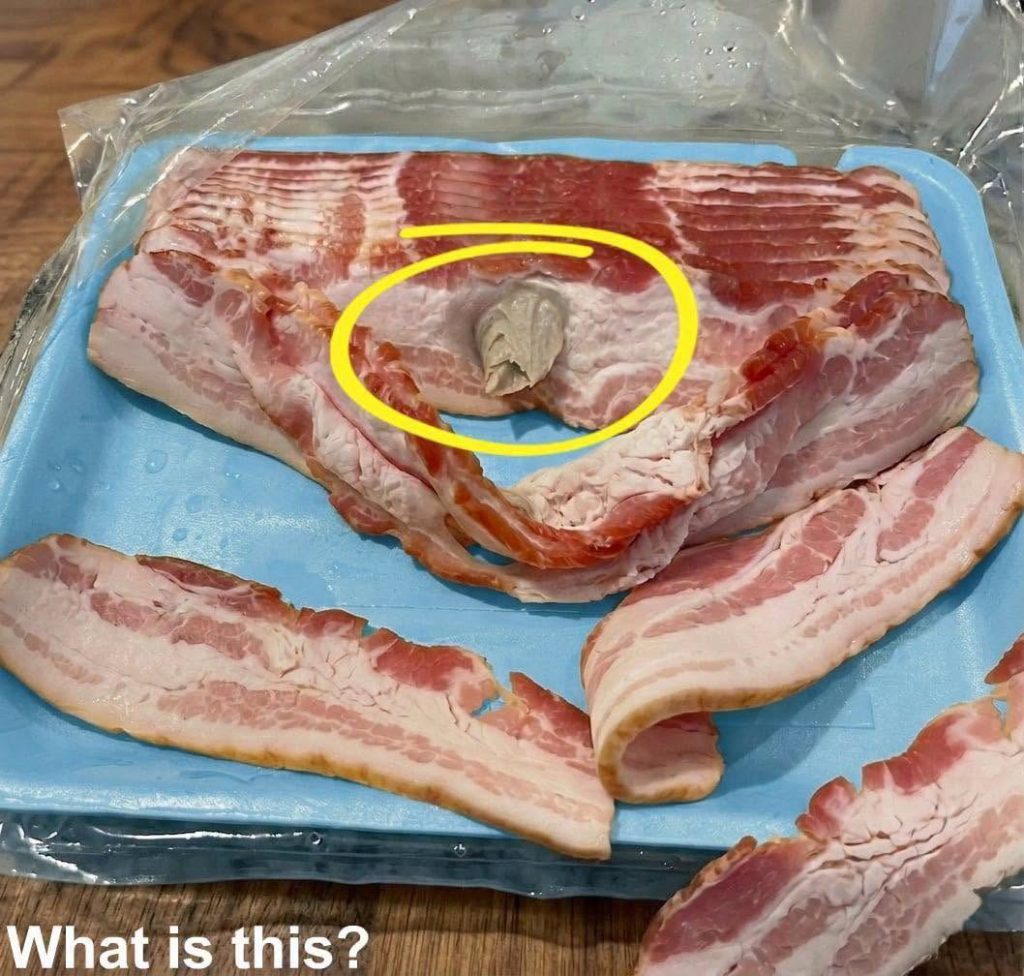
Here’s what the food safety specialist told me that actually made me feel better.
“We’ve trained consumers to expect that meat looks like a plastic-wrapped rectangle of identical pink slices. But meat comes from animals. Animals have body parts. Sometimes those body parts end up in the package. That’s not a safety failure—it’s a reality check.”
She wasn’t being dismissive. She was being honest.
The meat industry does an incredible job of making products look uniform. But no pig is perfectly uniform. No cow is perfectly symmetrical. When you buy bacon, you’re buying slices of an animal’s belly. And bellies have lymph nodes, glands, and connective tissue. Most of these are removed during processing, but occasionally one slips through.
It’s not dangerous. It’s not a sign of poor quality. It’s just… real.
When to Actually Worry (A Practical Food Safety Guide)
Okay, so a random pale chunk isn’t a crisis. But that doesn’t mean you should ignore every oddity in your food. Here’s a quick decision tree for the next time you open a package and something looks off.
Perfectly normal (don’t panic):
Pale, firm, bean-shaped lumps (lymph nodes)
Small, lobed, pale pieces (mammary tissue)
Dense, rubbery white bits (connective tissue)
Dark spots on bone-in meat (blood from processing)
Pay attention (but still probably fine):
Greenish or iridescent sheen on cooked bacon (this is actually light reflecting off fat and nitrates—completely harmless)
White, chalky spots on frozen meat (freezer burn—safe to eat but tastes dry)
Slight discoloration on the edges of packaged meat (oxidation—trim and cook promptly)
Stop and inspect (could be spoilage):
Sticky or slimy texture on fresh meat (bacteria growth)
Strong, sour, or ammonia-like smell (spoilage)
Green or black mold (not the fancy cheese kind)
Bloated, puffy packaging (gas from bacterial growth)
Throw it away immediately (no debate):
Any sign of broken seals or tampering
Meat that’s been left at room temperature for more than 2 hours
Canned goods that are bulging, leaking, or rusted
Healthy Eating Tips for Confident Meal Prep
One of the reasons I panicked over that bacon chunk is that I take food safety seriously. I meal prep. I pack lunches. I feed my family. The idea that something “wrong” could slip into my kitchen felt like a personal failure.
But here’s what I’ve learned: being a smart cook isn’t about never encountering weird things in your food. It’s about knowing how to respond when you do.
Tip #1: Learn what normal looks like.
The more you cook with whole cuts of meat—chicken thighs with skin, pork shoulder, beef brisket—the more familiar you’ll become with the natural variations in animal products. Grocery stores hide this from you by selling only perfect, uniform pieces. But perfect isn’t natural. Natural is messy.
Tip #2: Trust your nose more than your eyes.
Your eyes will lie to you. Discoloration can be oxidation. Iridescence can be light refraction. But your nose? Your nose knows. Spoiled meat has a distinct sour, sickly smell that you will recognize immediately. If it smells fine, it’s almost certainly fine.
Tip #3: When in doubt, cook it thoroughly.
Most foodborne pathogens die at 165°F (74°C). If you’re worried about something you’ve found in your meat, cook it to a safe internal temperature. That weird bacon chunk will crisp right up. That suspicious spot on your chicken breast will be indistinguishable after roasting.
Tip #4: Keep a “food curiosity” journal.
I’m not kidding. When you find something odd in your food, take a picture. Look it up later. Ask your butcher or grocery store meat counter. Over time, you’ll build a mental library of what’s normal and what’s not. Knowledge kills panic.
Smart Meal Prep Awareness: 5 Rules I Live By
After my bacon incident, I got serious about kitchen food safety. Not paranoid—just prepared. Here are the rules I follow now.
Read more on next page 👇
