🖤🧡🤎 Have You Seen Any Woolly Worms Yet? What Are They Telling Us About Winter?
There’s something about spotting a fuzzy little woolly worm crawling across the sidewalk on a crisp autumn day that makes people stop and wonder:
“What kind of winter are we in for?” 👀❄️
For generations, people have looked to the black-and-brown bands of the woolly bear caterpillar for a little hint about the months ahead. According to old weather folklore, these tiny creatures may have their own prediction for whether winter will be mild or brutal.
But is there actually anything to it—or is the woolly worm simply a very cute autumn tradition? 🐛🍂
Let’s take a closer look!
🐛 First Things First: It’s Not Actually a Worm!
Despite the nickname, the woolly worm isn’t a worm at all.
It’s a caterpillar—the larva of the Isabella tiger moth (Pyrrharctia isabella). The familiar caterpillar is usually covered in black and rusty-brown hairs and has distinctive bands along its body. (Almanac.com)
And fall is a particularly good time to spot them.
As the weather changes, mature woolly bears can be seen wandering across roads, sidewalks, yards, and fields while searching for protected places where they can spend the winter. (Extension PSU)
So if you’ve suddenly started noticing fuzzy little caterpillars everywhere, they’re not necessarily appearing because they know a giant snowstorm is coming.
They’re simply doing what woolly bears naturally do this time of year.
🖤🧡 So What Does the Woolly Worm Supposedly Tell Us?
Here’s where the fun begins.
The traditional weather rule goes something like this:
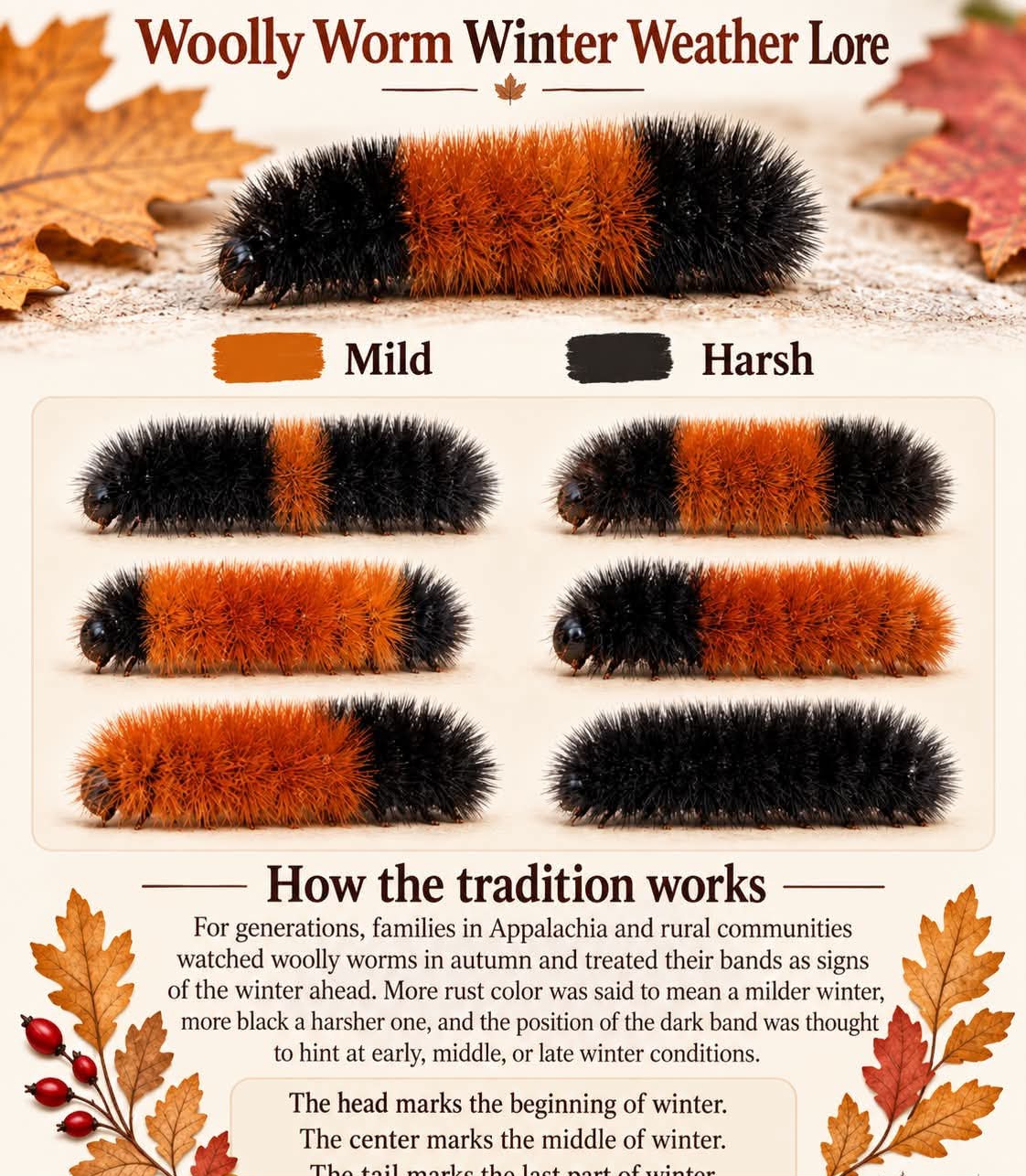
🧡 More brown = milder winter
If the rusty-brown section in the middle is wide, folklore says the upcoming winter should be milder.
🖤 More black = harsher winter
If the caterpillar appears to have more black than brown, the old saying suggests a colder or snowier winter may be ahead.
In other words:
Wide brown stripe: “Relax, winter might be gentle.” 😌🍂
Lots of black: “Better find the blankets.” 🥶🧣
This legend has been passed down for generations and remains one of the most entertaining pieces of autumn weather folklore. (Almanac.com)
👀 But Here’s the Interesting Part…
There actually was an attempt to test the woolly-worm theory.
In 1948, entomologist C. H. Curran of the American Museum of Natural History began collecting woolly bears around New York’s Bear Mountain and recording the amount of brown on their bodies.
He continued the experiment for several years.
The caterpillars he examined generally had substantial brown bands, and the winters during those years were relatively mild. That helped make the woolly-bear prediction even more famous. (Almanac.com)
But there’s an important catch:
The sample was small, and the experiment wasn’t enough to establish that woolly bears can actually forecast winter weather.
Scientists generally regard the prediction as folklore rather than a reliable forecasting method. (Almanac.com)
🔬 What Does the Caterpillar’s Color Really Tell Us?
This is where nature gets even more fascinating.
A woolly bear’s coloration can be influenced by factors including its age and development.
As the caterpillar grows, its appearance can change. Pennsylvania State University Extension notes that the size of the caterpillar is influenced by how favorable its growing season was, while its colors can change as it gets older. (Extension PSU)
So a caterpillar isn’t necessarily growing a giant black stripe because it has secretly checked the long-range forecast. 😂
Its appearance is telling us more about the caterpillar itself and its recent development than providing a dependable forecast for the winter ahead.
That’s one reason scientists are skeptical of using individual woolly bears as miniature meteorologists.
🍂 Why Do We See So Many in Autumn?
This part is completely real.
In autumn, mature woolly bears start wandering around looking for sheltered places to spend the cold months.
You might find one:
- Crossing a driveway
- Crawling across a sidewalk
- Moving through fallen leaves
- Along the edge of a road
- Under logs or bark
- In other protected areas
They’re preparing for winter rather than predicting it.
Woolly bears can survive the cold season in their caterpillar stage, sheltered under natural debris and other protected locations. Eventually, they pupate and emerge as Isabella tiger moths. (Almanac.com)
🐛 And They’re Tougher Than They Look!
That fuzzy appearance isn’t just for decoration.
Woolly bears are remarkably adapted to surviving winter conditions. Their sheltered overwintering strategy allows them to make it through the cold season before continuing their life cycle.
Eventually, the caterpillar forms a cocoon and transforms into the adult Isabella tiger moth, which has yellowish-orange and cream-colored wings marked with black. (Almanac.com)
So the fuzzy caterpillar crawling across your yard today could eventually become a completely different-looking moth.
Nature really does have some impressive transformations. 🐛➡️🦋
❄️ Can We Actually Use Woolly Worms to Predict Winter?
Not reliably.
That’s the big distinction.
The woolly-worm prediction is a wonderful piece of weather folklore, but it shouldn’t replace an actual meteorological forecast.
The caterpillar’s stripes aren’t a dependable measurement of future temperatures, snowfall, or storms. Researchers and entomologists have pointed out that coloration can be related to the caterpillar’s development and environmental conditions rather than acting as a crystal ball for the coming winter. (Almanac.com)
But that doesn’t mean we have to stop having fun with the tradition!
There’s something charming about seeing a woolly bear in October and immediately wondering:
“Okay… what are you trying to tell us?” 😂
🖤🧡 The Woolly Worm Winter Challenge
So here’s a fun experiment you can try this fall.
The next time you see a woolly bear, take a good look at it.
Is it:
🖤 Mostly black?
🧡 Mostly brown?
🖤🧡 A pretty even mixture?
And if you see several of them, compare them.
You’ll probably notice that they don’t all look exactly alike.
That’s actually part of what makes this tradition so much fun. Different caterpillars can have different appearances, and regional variation exists too. (Almanac.com)
Just remember that one caterpillar isn’t going to give you a scientifically reliable forecast for the entire winter.
🍁 Why We Still Love the Woolly Bear Tradition
Maybe the real magic isn’t whether the caterpillar can predict a snowstorm.
Maybe it’s that the woolly bear gives us another reason to pay attention to the changing season.
The leaves are turning.
The evenings are getting darker.
The air feels different.
People are pulling sweaters out of closets.
And suddenly, there’s a tiny black-and-brown caterpillar making its way across the pavement.
It’s one of those little signs that tells us:
Autumn is here. 🍂🖤🧡🤎
Whether its stripes predict anything or not, spotting one has become a beloved part of fall weather folklore in many places. There are even communities that celebrate woolly bears with annual festivals and caterpillar races. (Almanac.com)
🌨️ So… What Is YOUR Woolly Worm Saying?
According to the old tradition:
🧡 Wide brown band = milder winter
🖤 Lots of black = harsher winter
But scientifically, it’s best to treat that as fun folklore rather than a dependable forecast.
Still, I’m curious…
🐛 Have you seen a woolly worm yet this year?
And if you have, was it mostly black, mostly brown, or somewhere in between? 🖤🧡🤎
What is your woolly worm predicting for winter where you live? ❄️👀
