💵 Is It Fair to Pay $120 for a $629 Meal? The Great Restaurant Tipping Debate
A restaurant bill has a way of turning a wonderful evening into a debate.
You enjoy dinner. The food is good, the drinks are flowing, the server is checking on the table, and then the bill arrives.
You look down.
$612.73 subtotal.
Then you see the suggested gratuity:
- 18% — $110.29
- 20% — $122.55
- 22% — $134.80
And suddenly the question becomes:
Is a $120 tip really fair when the bill is already more than $600?
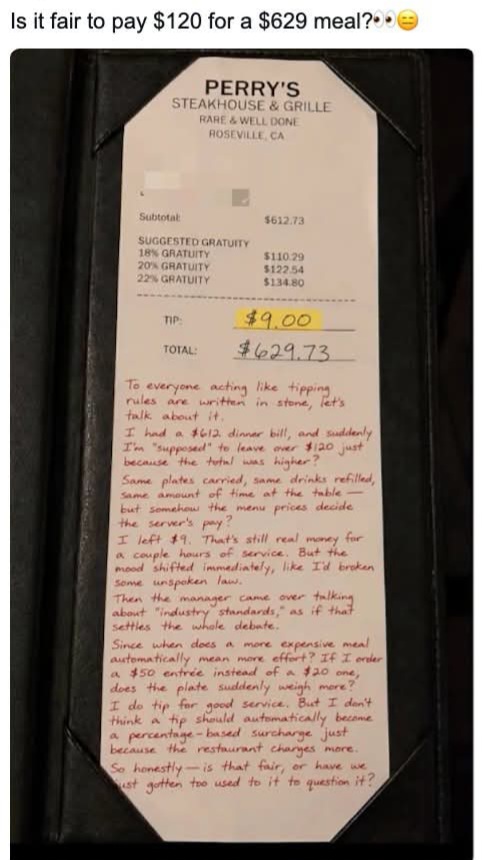
That’s exactly the question this viral-looking picture is trying to start.
🍽️ The Argument Behind the Picture
The handwritten message on the image argues that tipping based on a percentage can feel strange when the price of the meal is very high.
The basic argument is simple:
Did the server do five times as much work because the food cost five times as much?
Imagine two tables.
One table spends $100.
Another spends $600.
If both tables receive essentially the same level of service, a percentage-based tip produces dramatically different tips—even though the server may have performed many of the same tasks.
That’s where the disagreement begins.
💵 $120 Is a Lot of Money
Let’s put the numbers into perspective.
A 20% tip on a $612.73 subtotal is about $122.55.
That’s more than the cost of an entire meal at many restaurants.
Someone looking at that number might reasonably think:
“That’s a lot of money for a tip.”
But someone on the other side of the argument might say:
“If you can afford a $600 dinner, you should be able to afford to properly compensate the person who served you.”
And that is why tipping discussions become so heated.
🤔 Should a Tip Be Based on the Price of the Food?
This is probably the most interesting question in the entire debate.
Consider two hypothetical dinners.
🍔 Restaurant A
Dinner: $100
20% tip: $20
🥩 Restaurant B
Dinner: $600
20% tip: $120
If the server at both restaurants spends roughly the same amount of time taking orders, delivering food, refilling drinks, clearing plates and checking on the table, is the second server really providing six times the service?
That’s the argument made by people who dislike percentage-based tipping.
But there’s another side.
At an expensive steakhouse, service may involve considerably more than simply carrying plates. Fine-dining restaurants can involve detailed menu knowledge, wine service, multiple courses, timing between dishes, tableside preparations and a much longer dining experience.
Perry’s describes its experience as including details such as tableside carving and emphasizes its service professionals as part of the dining experience. (Perry’s Steakhouse & Grille)
So the amount of work isn’t necessarily identical.
🥩 Fine Dining Is Different
A $600 dinner isn’t necessarily comparable to a $600 grocery bill.
You’re paying for more than the food.
You’re paying for:
🍷 Service
🍽️ Hospitality
🥩 Food preparation
🕯️ Atmosphere
👨🍳 Culinary expertise
⏱️ Time
🥂 Attention to detail
🎉 The overall dining experience
Perry’s, for example, describes itself as a fine-dining steakhouse and highlights its “Rare & Well Done” service experience. (Perry’s Steakhouse & Grille)
That’s why many diners believe the percentage model makes sense.
💬 “But the Server Doesn’t Set the Price!”
This is another important point.
A server doesn’t decide whether a steak costs $40 or $100.
They aren’t responsible for the restaurant’s rent, food costs, wine prices, décor or profit margin.
Yet under a percentage-based tipping system, the price of the food directly affects the amount the server receives.
That can feel strange to some customers.
Imagine ordering the exact same service but choosing a more expensive bottle of wine.
Should the server automatically receive a much larger tip simply because the wine cost more?
Some people say yes.
Others say the tip should reflect the quality and amount of service, not simply the price of the items ordered.
❤️ What About the Server?
There’s another side that deserves consideration.
Servers often depend heavily on tips as part of their income.
A table that spends several hours at a restaurant may require considerably more attention than a quick meal.
The server may be:
- Taking multiple orders
- Explaining menu items
- Handling special requests
- Coordinating courses
- Refilling drinks
- Clearing plates
- Checking on guests
- Communicating with the kitchen
- Handling problems
- Processing the final check
So while the food price doesn’t necessarily determine the amount of labor, the overall dining experience can involve significant work.
That’s why many people argue that a large bill should result in a substantial tip.
🧮 Let’s Look at the Numbers
The picture shows a subtotal of $612.73.
Here’s what the suggested percentages would produce:
| Tip | Amount |
|---|---|
| 18% | $110.29 |
| 20% | $122.55 |
| 22% | $134.80 |
So a diner choosing 20% would leave approximately $122.55.
That’s a very substantial tip.
But there’s an important problem with the viral image itself.
The handwritten note shows a $9 tip and a total of $629.73.
Those numbers don’t add up.
$612.73 + $9.00 = $621.73, not $629.73.
And there’s another major red flag: the image identifies the restaurant as Perry’s Steakhouse & Grille in Roseville, California, but Perry’s current official location list does not show a Roseville or other California location. Its listed locations include states such as Texas, Arizona, Colorado, Florida, Illinois, North Carolina, Tennessee and Virginia. (Perry’s Steakhouse & Grille)
So this particular image should not be treated as an authentic restaurant receipt without independent verification.
⚠️ Viral Doesn’t Always Mean Real
That’s an important lesson with social-media posts.
A picture can contain a perfectly understandable argument while the picture itself is fabricated, altered, or incorrectly presented.
In this case, the arithmetic discrepancy alone is enough reason to be skeptical.
And the supposed Roseville, California location doesn’t match Perry’s official current location information. (Perry’s Steakhouse & Grille)
That doesn’t mean the underlying tipping debate isn’t worth discussing.
It absolutely is.
It just means we shouldn’t use an unverified receipt as proof that a particular customer actually had this experience.
💰 So What Is a Fair Tip on a $600 Dinner?
There isn’t one universal answer.
A diner might consider:
⭐ Excellent service
A generous percentage-based tip may feel appropriate.
🙂 Good service
A conventional restaurant tip may feel reasonable.
😐 Average service
Some diners may leave less.
😕 Poor service
A diner may reduce the tip or speak with management about serious problems.
The important thing is to recognize that tipping customs differ by country, restaurant, and situation.
And if a restaurant has an automatic service charge or gratuity, that’s another matter entirely—you should check the bill carefully before adding another tip.
🧾 Always Check the Bill
One of the easiest ways to avoid confusion is simply to look carefully at the check.
Check for:
- Service charges
- Automatic gratuity
- Large-party gratuity
- Taxes
- Fees
- Suggested tip calculations
- Whether the suggested percentages are calculated before or after tax
Don’t assume that a suggested tip is mandatory.
And don’t assume that a large number on the tip line means you’ve been charged that amount.
Read the bill.
🍽️ What Would You Do?
Now let’s get to the question this picture is really asking.
Imagine you’re sitting at a nice restaurant.
Your subtotal is:
$612.73
The service was good.
You enjoyed your meal.
The suggested tip is approximately $123 for 20%.
Would you leave it?
🅰️ Yes — 20% is fair.
🅱️ I’d leave a smaller percentage.
🅲 I’d give a fixed amount based on the service.
🅳 I’d tip generously because it was fine dining.
🅴 I don’t believe tipping should be percentage-based.
💬 THE BIGGER QUESTION
Maybe the real question isn’t:
“Is $120 too much?”
Maybe it’s:
“Should restaurant tips be based on the price of the meal at all?”
That’s a much harder question.
If a server provides excellent service at a $100 restaurant, should they receive $20?
If another server provides the same excellent service at a $600 restaurant, should they receive $120?
Some people say absolutely.
Others say the amount of work should matter more than the price of the food.
And that’s why this debate isn’t going away anytime soon.
🥩 WHAT DO YOU THINK?
If you had a $612.73 restaurant bill and received good service, what would you leave?
💵 $20
💵 $50
💵 $75
💵 $100
💵 $120+
👇 Tell us what you think is fair!
And remember: the picture may not be an authentic receipt, but the tipping question it raises is definitely worth discussing.
