🧈🥛
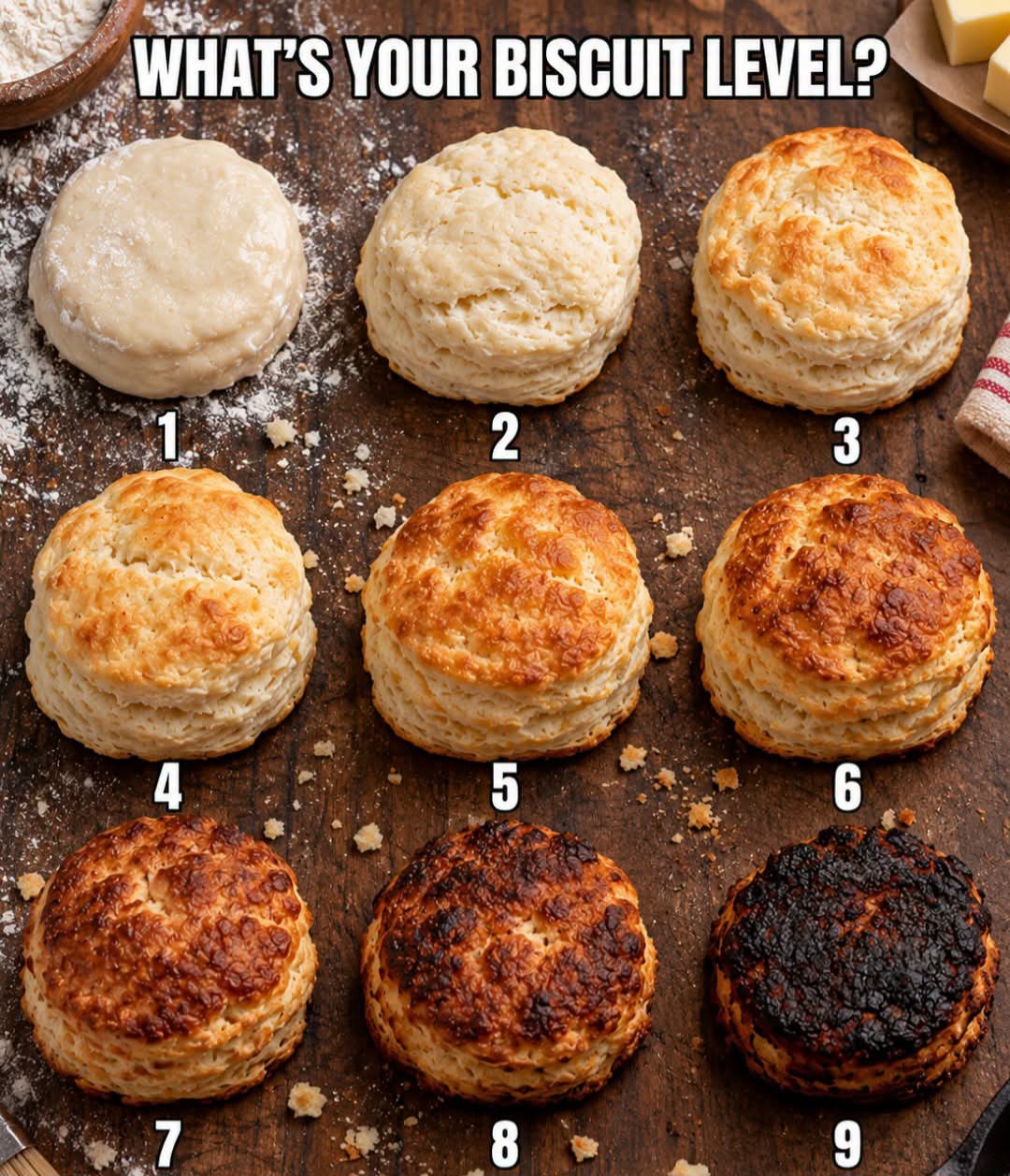
Look at the nine biscuits in the image and you’ll notice something interesting: there isn’t just one way a biscuit can look “right.”
Some are pale and soft. Others are golden and flaky. Some have a deeply browned top, while number 9 has crossed firmly into “Did someone forget the oven?” territory. 😂
But somewhere between raw-looking dough and completely blackened crust is a biscuit that many people would describe as perfect.
So what actually makes a biscuit perfect?
Is it the color?
The height?
The flaky layers?
The buttery flavor?
The soft center?
Or that magical moment when you split one open and steam escapes?
The answer is: all of the above.
🥯 What Does a Perfect Biscuit Look Like?
The ideal biscuit is usually a balance of contrasts.
You want:
- 🟤 A golden-brown exterior
- 🧈 A rich, buttery flavor
- ☁️ A tender interior
- 🪶 Flaky or layered texture
- 📈 Good height
- ✨ A lightly crisp surface
- ❤️ A soft center
The challenge is getting all those qualities at the same time.
A biscuit can be beautifully brown but dry inside.
It can be incredibly soft but pale.
It can have impressive layers but taste bland.
That’s why color alone doesn’t determine whether a biscuit is perfect.
🔢 What Do the Nine Levels Represent?
The image is essentially a biscuit-browning scale.
1️⃣ Level 1 — Too Pale
This biscuit looks more like dough than a finished bake.
It may be cooked through depending on the recipe, but visually it lacks the golden crust most people associate with a properly baked biscuit.
Verdict: Probably needs more oven time.
2️⃣ Level 2 — Lightly Baked
Now we’re getting somewhere.
The biscuit has begun developing color, but the exterior remains very pale.
If you prefer an especially soft biscuit with minimal crust, you might actually like this stage.
3️⃣ Level 3 — Light Golden
This is starting to look like a classic biscuit.
The top has a gentle golden color while the sides remain relatively light.
There’s a good chance this is where people who prefer soft and tender biscuits start getting excited.
4️⃣ Level 4 — Golden
Now we’re talking.
The top has developed a proper golden-brown crust while the interior can still remain tender.
This is a very appealing level for a traditional buttermilk biscuit.
5️⃣ Level 5 — Deep Golden
This might be the sweet spot for many biscuit lovers.
You get:
golden crust + buttery aroma + soft center + visible layers.
The biscuit looks baked without looking overdone.
6️⃣ Level 6 — Richly Browned
Now the crust has more pronounced color and deeper toasted notes.
If you love a little extra crunch on the outside, this is getting interesting.
The important thing is that the interior still needs to remain moist and tender.
7️⃣ Level 7 — Very Brown
We’re entering serious browning territory.
The surface looks intensely toasted, but there can still be plenty of good biscuit underneath.
This can work beautifully if you enjoy a stronger crust.
8️⃣ Level 8 — Heavily Browned
At this point, the crust is approaching the line between deeply browned and overdone.
Some people love that intense roasted flavor.
Others are already reaching for the butter. 😂
9️⃣ Level 9 — Burnt
Let’s be honest.
This is probably beyond the point most people would call perfect.
The dark, nearly black surface suggests excessive browning, and the interior may also be dry or overbaked.
Although a little char can sometimes be intentional, a biscuit generally shouldn’t need to look like it survived a campfire.
🧈 The Secret Is in the Layers
One of the biggest differences between an ordinary biscuit and an impressive flaky biscuit is layer structure.
When cold butter is incorporated into biscuit dough in pieces and the dough is folded, the butter creates separation between layers. During baking, moisture turns to steam and helps lift those layers. King Arthur Baking specifically recommends cold butter and folding techniques for biscuits where the goal is a tall, flaky structure. (King Arthur Baking)
That’s why cutting into a great biscuit can be so satisfying.
You don’t just see bread.
You see layers upon layers of buttery dough.
❄️ Why Cold Butter Matters
Here’s one of the most important biscuit-making rules:
Keep your butter cold.
Warm butter can blend too thoroughly into the flour, reducing the distinct pieces that help create flaky layers.
King Arthur Baking explains that cold butter left in larger pieces can melt and release steam during baking, contributing to a lighter, more layered biscuit. (King Arthur Baking)
So if you’re making biscuits on a warm day:
Cold butter. Cold liquid. Minimal handling.
Your hands are basically the enemy of your butter. 😂
🥛 What Does Buttermilk Do?
Buttermilk is another classic biscuit ingredient.
It contributes moisture and a subtle tang, while helping create the tender texture associated with buttermilk biscuits.
King Arthur Baking’s classic buttermilk biscuit recipe combines flour, baking powder, butter and cold buttermilk or milk, and uses folding to create additional layers. (King Arthur Baking)
And that slight tang is one reason buttermilk biscuits pair so beautifully with:
- Butter
- Honey
- Jam
- Sausage gravy
- Fried chicken
- Bacon
- Eggs
Basically, if something tastes good with butter, there’s a decent chance it belongs on a biscuit. 😋
🥣 Don’t Overwork the Dough
This is where many homemade biscuits go wrong.
You mix the ingredients.
Then you notice the dough looks uneven.
So you knead it.
And knead it.
And knead it some more.
Stop! 😂
Biscuits aren’t bread.
You don’t want to develop lots of gluten.
The goal is to bring the dough together gently and efficiently. King Arthur Baking recommends mixing quickly and gently and avoiding excessive handling. (King Arthur Baking)
Think:
“Bring it together, fold it, cut it, bake it.”
Not:
“Let’s give this dough a full workout.”
🔥 How Brown Should a Biscuit Be?
This is where the image gets interesting.
There’s no universal shade that makes a biscuit perfect.
But for a classic biscuit, you’re generally looking for golden to deep golden brown, depending on the recipe and your preferred texture.
King Arthur Baking’s classic buttermilk biscuits are baked until lightly browned, while its more intensely flaky biscuit recipe calls for well-browned tops and bottoms. (King Arthur Baking)
So even professional recipes don’t treat one exact shade as the universal answer.
The important question is:
Is the biscuit properly baked inside?
A beautifully brown top isn’t much use if the middle is still wet.
🧈 The Butter Test
Here’s a simple test that has nothing to do with science:
Split the biscuit open.
Add butter.
Watch it melt.
If you’re immediately thinking:
“I need another one.”
You’ve probably done something right. 😂
For the ultimate experience, serve biscuits while they’re still warm.
King Arthur Baking notes that biscuits are at their best fresh and warm, particularly for flaky and tender textures. (King Arthur Baking)
🍯 What Goes on the Perfect Biscuit?
This depends entirely on which direction you’re taking.
Sweet biscuit
Try:
🧈 Butter
🍯 Honey
🍓 Strawberry jam
🍑 Peach preserves
🍁 Maple syrup
A warm biscuit with butter and honey is ridiculously simple—and ridiculously good.
Savory biscuit
Try:
🥓 Bacon
🍳 Fried egg
🧀 Cheddar
🌭 Sausage
🥣 Sausage gravy
🍗 Fried chicken
Now we’re talking serious comfort food.
🥪 The Biscuit Sandwich
A perfect biscuit also makes an incredible breakfast sandwich.
Split one open and add:
fried egg + sausage + cheddar + hot sauce.
Or:
crispy bacon + scrambled egg + cheese.
Or go full Southern-inspired:
fried chicken + honey + hot sauce.
At that point, you’re no longer having a simple biscuit.
You’re having an event.
🧪 The Four Ingredients Behind the Magic
At its heart, a biscuit is surprisingly simple.
You generally need:
🌾 Flour
Provides the structure.
🧈 Fat
Adds richness and contributes to tenderness and flakiness.
🥛 Liquid
Brings the dough together and affects texture.
🧂 Leavening + seasoning
Helps the biscuit rise and gives it flavor.
King Arthur Baking describes biscuits as a simple combination of flour, fat, liquid, salt and baking powder, yet small changes in technique can produce dramatically different results. (King Arthur Baking)
That’s what makes biscuits so fascinating.
Simple ingredients. Complicated results.
👨🍳 How to Make Your Own “Perfect” Biscuits
Here’s a straightforward formula for about 8–10 biscuits.
Ingredients
- 2½ cups all-purpose flour
- 1 tbsp baking powder
- 1 tsp salt
- 1 tbsp sugar
- ½ cup cold unsalted butter
- About 1 cup cold buttermilk
Method
1. Heat the oven to 425°F / 220°C.
2. Mix the flour, baking powder, salt and sugar.
3. Cut in the cold butter until you have a mixture with uneven pieces of butter, roughly pea-sized with some larger pieces.
4. Add the cold buttermilk gradually.
Mix just until the dough comes together.
5. Turn it onto a lightly floured surface.
Don’t knead it aggressively.
6. Pat it out and fold it.
Fold the dough over itself several times to create layers. (King Arthur Baking)
7. Cut your biscuits.
Press the cutter straight down rather than twisting it.
8. Bake until golden brown.
Depending on the recipe and biscuit size, this will generally take somewhere around 12–20 minutes.
9. Brush with melted butter.
Immediately after baking.
10. Eat while warm.
This last step is extremely important.
🏆 So… Is There Actually a Perfect Biscuit?
Yes—but it isn’t necessarily one specific biscuit.
The perfect biscuit is the one that gives you the texture and flavor you’re looking for.
Maybe you want:
#3 — pale and tender.
Maybe you’re a #5 person who wants golden perfection.
Maybe you want the darker crust of #7.
And if you’re choosing #9…
I have questions. 😂🔥
The real definition of perfection is:
golden outside + tender inside + buttery flavor + beautiful layers + fresh from the oven.
That’s the biscuit sweet spot.
❤️ Final Thoughts
A biscuit may look simple, but getting it right is all about technique.
Keep the ingredients cold when you’re chasing flakiness. Handle the dough gently. Build layers through folding. Bake until properly browned. And most importantly, serve it warm.
Because whether you’re covering it in sausage gravy, spreading it with butter and honey, or stuffing it with bacon and eggs, a freshly baked biscuit has a way of turning an ordinary breakfast into something special.
So now the important question:
👀 What’s your biscuit level?
1️⃣ Pale
2️⃣ Light
3️⃣ Golden
4️⃣ Nicely browned
5️⃣ Deep golden
6️⃣ Extra crispy
7️⃣ Very brown
8️⃣ Almost charred
9️⃣ “I like my biscuits with a side of smoke” 😂
I’m taking #5. 🧈🥛🔥
