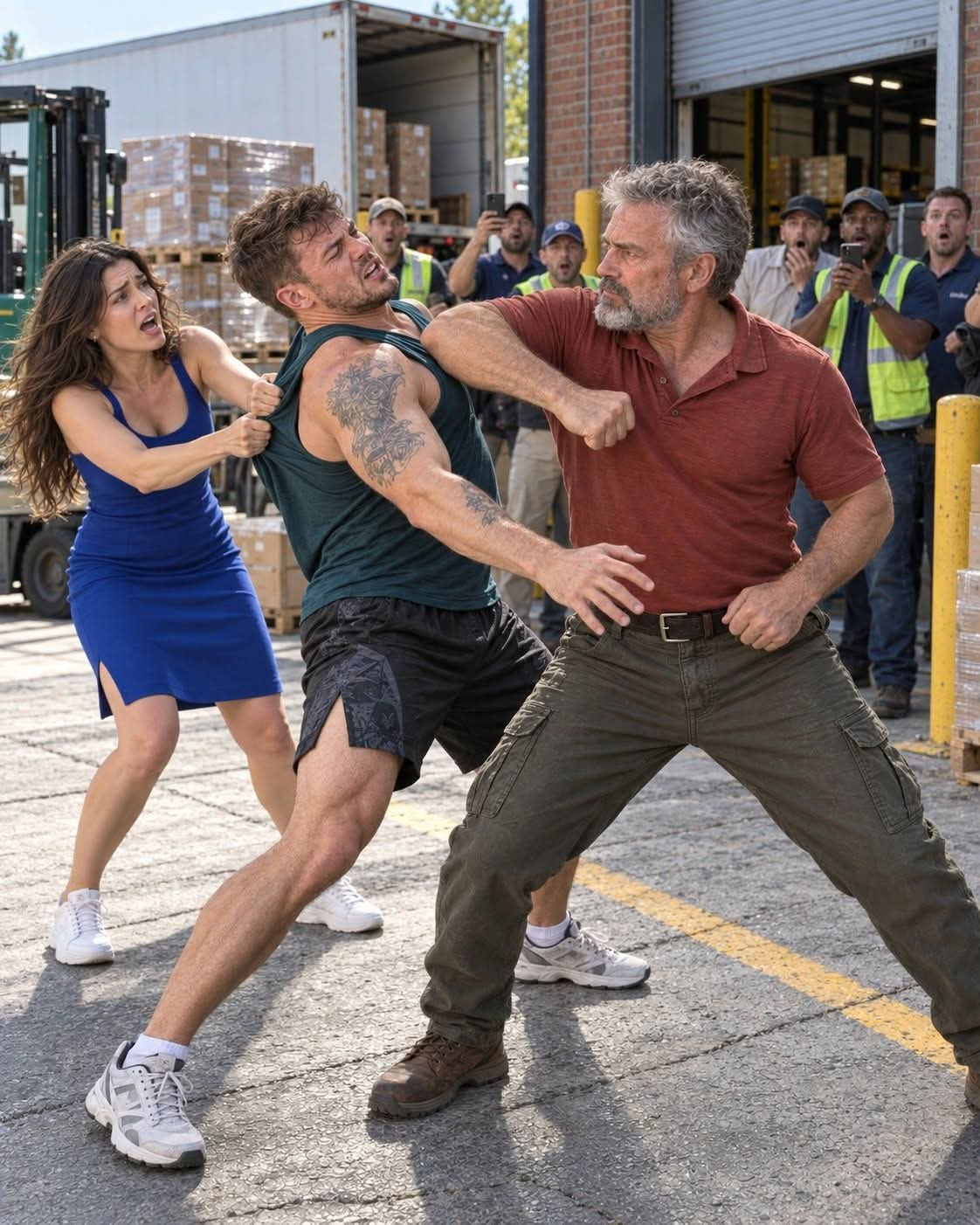
The door of the nearest forklift opened. Mike Larsen came down out of the cab slow, the way a big man does when he doesn’t want to startle anyone. Fifty-one years old, gray beard, forearms like fence posts. He’d been at that yard since before I got back from overseas. He’d hired me over the phone from a hospital parking lot and never once asked what was wrong with my leg.
He walked over and looked down at Julian the way you’d look at a spilled drum of refrigerant.
“Get him off my dock,” Mike said.
Julian got up in pieces. He couldn’t straighten his right arm and he didn’t try. He held it against his ribs and staggered for the gate, and he did not look at me, and he did not look at the dozen men standing between him and his truck.
Sarah hadn’t moved.
She was still by the fence with her iced coffee, and the cup had gone warm in her hand, and she was staring at me with an expression I couldn’t name.
I walked over to her. She took a half step back into the chain link and the fence rattled.
“Your paperwork,” I said, holding it out.
She didn’t take it.
“You could have just signed it,” she said.
Her voice was thin and it cracked on the word *signed*, and something about the way she said it — not *you should have*, not *why didn’t you* — sat wrong in my head and I filed it away without knowing why.
“I’ll have my lawyer send the settlement to yours,” I said. “Fifty-fifty on the equity. That’s the last number I’m saying out loud.”
She took the papers then. She folded them in half without reading them, which was very like her, and she turned and walked out through the gate.
The black SUV pulled away and threw gravel against the fence and was gone.
The yard came back to life around me. A forklift horn. A strap ratchet. Somebody’s radio.
Dave, the kid who drove the box trucks, was still standing there with his mouth open.
“You good?” he asked.
“I’m good,” I said. “Get that flatbed loaded.”
I worked the rest of the shift. My knee swelled up under my jeans and by four o’clock I was walking with my hand on the pallet rack, but I worked the shift.
Nobody said anything. That’s how it works with men who do that kind of work. They don’t ask. They just make sure the heavy side of the pallet goes on the fork side so you don’t have to lift it.
At five I clocked out and drove home.
The house was empty. Sarah hadn’t been back. The kitchen still smelled like the candle she’d burned that morning, vanilla and something sharp underneath.
I made a cup of coffee I didn’t drink and sat at the table with my knee up on the second chair and stared at the wall.
That was the thing I hadn’t expected. Not the shakes — those came later, and they were mine, and I sat through them. It was the quiet. Five years in that kitchen and I had never once been alone in it.
The mail was stacked on the counter where Sarah left it. She always left it, and I always went through it, and that was one of the small, stupid jobs that made me feel like a man who had a household.
I flipped through it. Electric bill. Credit card offer. Something from the county about the fence line.
And then an envelope from a credit union with a branch address two towns over, and it was addressed to both of us, and it had a strip of red text along the bottom left that said **SECOND NOTICE — PAYMENT PAST DUE**.
She pressed the heels of both hands against her eyes.
“I need you to hear the whole thing before you say anything,” she said.
“That’s not usually what people say when the whole thing is going to be good.”
She dropped her hands and her eyes were wet and her voice went flat and hard, and I recognized that tone. I’d heard it at her father’s table for five years. It was the tone she used when she was about to be honest in a way that would cost her something.
“I let him talk me into it,” she said. “He had the build-out for the second location already half done before the lease was even signed. He was going to double his membership, he said. He had a plan, he had a partner, he had a projection sheet with a graph on it.”
“Julian.”
“Yes, Julian.” She said his name like it tasted like a coin. “I co-signed a note with him in March so he could get the cages and the matting and the rest of the equipment. Fifty thousand. It was supposed to be six months of bridge money. He hasn’t made a payment since June, and I’ve been making it out of the joint account, and then out of my own, and now I’m not making it at all.”
The wall clock in the hall clicked over to the half hour.
“And the equity line,” I said.
“I signed your name on the third draw.” She said it fast, one breath, like pulling off a bandage. “Not the first two. You signed those. You signed them because I handed them to you and you didn’t look, and God help me, Marcus, that’s the first time I really understood how far gone we were. You didn’t even ask what they were for.”
And when he had his arm around my neck,” I said, “what were you doing?”
She didn’t answer.
“You were watching to see if it would work.”
“I was watching to see if you’d fight,” she whispered. “I’ve been watching for five years to see if you’d fight. And then you did, and it wasn’t for me, and I stood there with a warm coffee in my hand and I knew exactly what I’d done.”
The refrigerator kicked on. That was the only sound in the room.
I want to be honest about what I felt, because it matters. I did not feel righteous. I felt sick.
I had signed those papers. Not the forged one — the others. I had walked past a stack of documents that could take my house and I had put my name on them without reading, because reading them would have meant having an opinion, and having an opinion would have meant a conversation, and I had spent five years refusing every conversation that might end in a raised voice.
I had called that keeping the peace. It was not keeping the peace. It was leaving the door open and calling it courtesy.
“I’ll tell you what I’m going to do,” I said.
She looked up.
“You’re going to write it down. Every draw, every payment, every date. You’re going to write down the three thousand you took out of the joint account to pay his note, and the fourteen that you signed my name for. You’re going to sign it in front of a notary.”
“Marcus—”
“And then I’m going to bring thirty-two thousand dollars to that branch on Friday and cure the arrears and half the principal, because half that debt is legally mine whether I read the paper or not, and I’m not going to have a lien chase me into the next twenty years of my life.”
I didn’t get the land.
I got a rented trailer down off Route 9 and a shop I could borrow on weekends from a guy Mike knew, and I got to work rebuilding a savings account in my forties, and that is the whole truth of it, and I’m not going to dress it up.
On the last night before the closing, Mike took me out to O’Malley’s and put a bottle in front of me and didn’t ask one question about the money, which is the most generous thing a man like him can do.
Dave came along. He was wearing a shirt with a collar on it, and he spent an hour trying not to ask me about the choke, and then he asked me about the choke.
“What do you do,” he said, “if a guy gets you like that and you can’t get out?”
“You don’t get got,” I said. “That’s the whole trick. You watch his feet before he starts moving.”
He nodded like I’d handed him a set of keys.
I got up to use the phone and stood in the cold by the back door with the noise of the bar coming through the wall.
Davis answered on the second ring, which is what he always does, and there was a different quality to his voice than there’d been all month.
“Where are you,” he said.
“O’Malley’s. Why.”
“The title company ran the final search this afternoon. Standard, forty-five days back, looking for anything that would cloud the deed.”
“And?”
“There’s a second lien on the property. Recorded eleven days ago. Eighteen thousand four hundred dollars.”
I looked out at the parking lot. A truck pulled in and its headlights swept across the dumpster and the chain link and were gone.
“Sarah signed a second one,” I said.
“She’s on the deed,” Davis said. “She can. It’s the timing that’s bothering me, and it’s the witness line. A lien like this requires a witness signature. Do you want to know who signed it?”
The back door of the bar opened behind me and a wall of noise came out and shut off again.
“Tell me,” I said.
Davis told me.
I stood out there in the cold with my phone against my ear until he asked if I was still on the line.
I went back inside, past the pool tables and the men and the television, and set my untouched bottle down on the counter in front of Big Mike.
“I need your truck tomorrow morning,” I said. “You driving or am I?”
