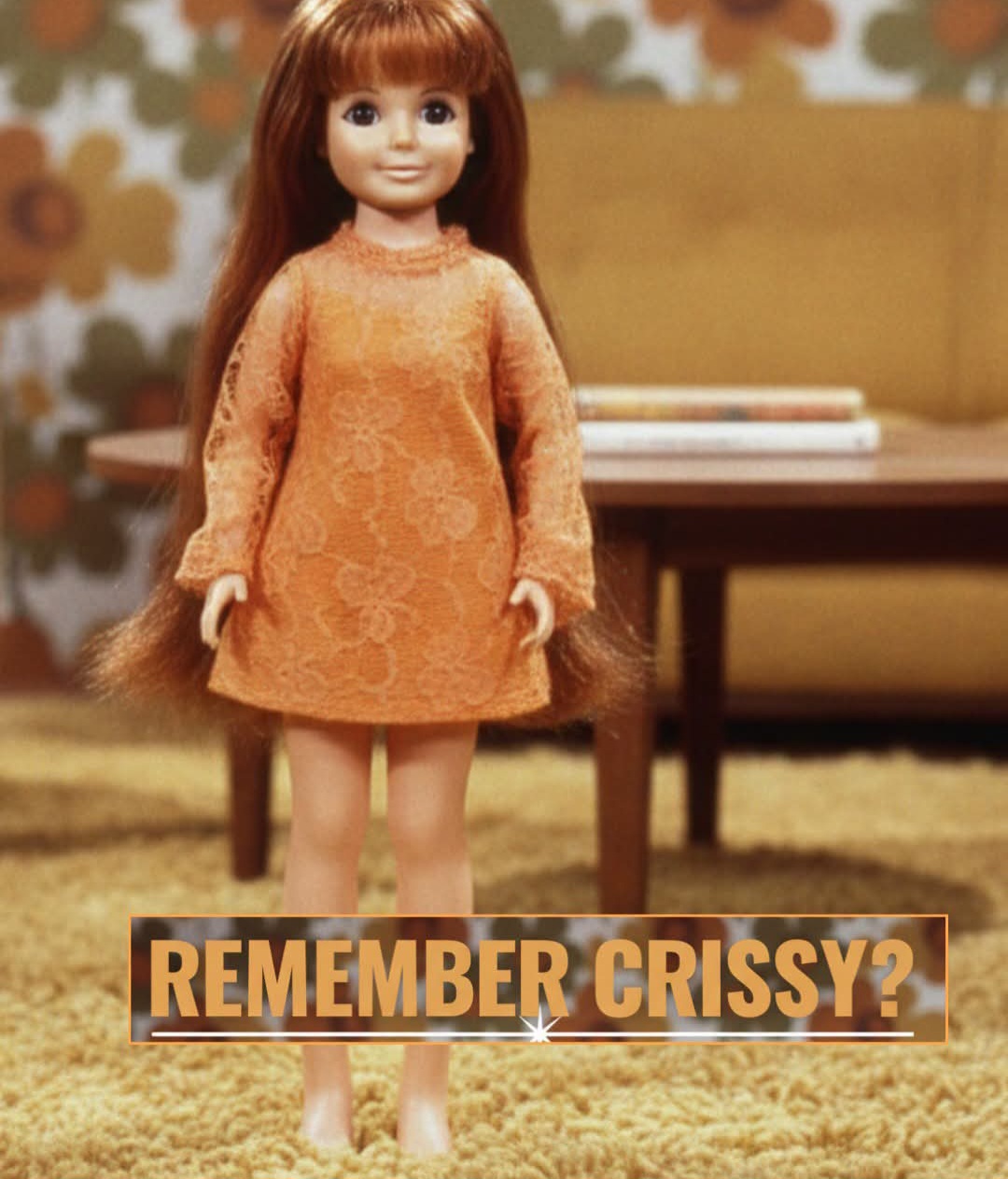
💇♀️ ? The Doll With Hair That Actually “Grew”
If you grew up in the late 1960s or early 1970s, there is a good chance you remember Crissy—the remarkable fashion doll whose hair could actually get longer.
For a generation of children, Crissy wasn’t just another doll. She had a feature that seemed almost magical: you could make her hair grow!
Turn a knob on her back and her long hair would retract. Pull it out again and suddenly Crissy had dramatically longer hair. At a time when toys were becoming more imaginative and interactive, that simple mechanism made her unforgettable.
And while Crissy became famous for the idea, there’s an interesting story behind where the technology came from.
👧 Who Was Crissy?
The Ideal Toy Corporation introduced Beautiful Crissy in 1969. She stood about 18 inches tall, considerably larger than many of the popular fashion dolls of the period.
Her signature feature was her adjustable-length hair. Early versions of Crissy could have hair extending dramatically down toward her feet, while later 1969 versions had a shorter maximum length that became standard for subsequent models. (Wikipédia)
For a child, the concept was wonderfully simple:
Crissy’s hair could grow!
It wasn’t magic, of course. Hidden inside the doll was a mechanical system that allowed the hair to be extended and retracted.
But to a child playing with her?
It certainly felt like magic.
🧡 Crissy Wasn’t Actually the First
Here’s the part many people don’t know.
Tressy came first.
The American Character Doll Company introduced Tressy in 1963 with a similar “growing hair” concept. The doll was designed around an adjustable hair mechanism that allowed children to change the length of her hair. (Wikipédia)
The basic idea had actually been developed before Crissy appeared. When American Character went out of business in the late 1960s, Ideal acquired assets including patents, trademarks and manufacturing materials associated with the company. (Wikipédia)
Ideal then developed its own larger doll around the concept.
That doll was Crissy.
🎠 The 1969 Toy Fair Debut
Crissy entered the toy world in 1969, following her presentation at the New York Toy Fair.
She was marketed as Beautiful Crissy, and her unusual hair feature immediately gave her something that ordinary dolls didn’t have.
Instead of simply brushing and styling the same length of hair over and over, children could change its length.
That meant one doll could have:
- Shorter hair
- Medium-length hair
- Extremely long hair
- Braids
- Ponytails
- Different updos
- Completely new hairstyles
It gave children another dimension of pretend play.
✨ How Did Crissy’s Hair Work?
This is the part that makes vintage toy collectors appreciate Crissy even more.
Her hair wasn’t simply attached to her head in the usual way.
A long section of hair was connected to an internal mechanism. Depending on the particular version, children could use the controls to allow the hair to extend or retract.
Turning the knob on Crissy’s back helped wind the hair back into the doll.
The mechanism effectively stored the excess hair inside her body.
So when you made Crissy’s hair “grow,” you were actually pulling more of that hidden hair out through her head.
Ingenious for a children’s toy from the 1960s!
(Patreon)
💇♀️ Crissy Was More Than Just Her Hair
The growing-hair feature may have been her biggest selling point, but Ideal built an entire world around Crissy.
The Crissy line expanded to include several related dolls and characters.
Among them were:
- Velvet
- Kerry
- Brandi
- Tressy
- Cricket
- Dina
- Mia
- Tara
- Cinnamon
Different dolls came in different sizes, helping create something that felt more like a little doll family rather than a single character. (Doll Reference)
In 1970, Crissy was joined by her shorter cousin Velvet, adding another popular character to the growing line. (Wikipédia)
👗 And Then There Were the Clothes
Of course, no fashion doll is complete without clothes.
Crissy had an extensive wardrobe of dresses, outfits and accessories.
There were also hair-care accessories designed specifically for the dolls.
Vintage catalogs show items such as:
- Brushes
- Combs
- Rollers
- Barrettes
- Hairpins
- Ribbons
- Mirrors
- Hair-setting accessories
- Beauty accessories
Some retailers even offered exclusive Crissy-related sets.
So children weren’t simply playing with a doll—they could pretend they were styling her hair, getting her ready for an event and creating completely different looks. (Crissy and Beth)
🖤 Crissy Also Came in Black Versions
One particularly important part of Crissy’s history is that the line included Black versions of the character.
Collectors document a 1969 Black Crissy, including an early version sold through Sears. (Barbi Girl)
That makes the Crissy collection especially interesting to collectors today because there are numerous variations to discover.
🔍 Why Are the Early Crissy Dolls Special?
If you ever see an original Crissy from 1969, don’t assume every first-year doll is identical.
There were changes during the first year.
Some of the earliest 1969 dolls had hair that could extend all the way down toward the doll’s feet.
Later 1969 versions had a shorter maximum length, around hip/knee level, which became the standard for subsequent Crissy dolls. (Wikipédia)
That means small differences in hair length, clothing, packaging and markings can matter to collectors.
📦 What Came With the Original Doll?
Crissy wasn’t simply placed in a box and sent home.
Original examples could include accessories such as a rat-tail hairbrush, instructions and a hairstyle guide. Some packaging also included information directed toward parents about caring for the doll. (Crissy and Beth)
Those little extras are part of what makes complete vintage examples particularly interesting today.
For collectors, having the original box, clothing, accessories and paperwork can make a big difference.
🕰️ Crissy’s Short but Memorable Run
Crissy’s original production era was relatively brief.
The main Crissy doll was produced from 1969 through 1974. (Wikipédia)
That may seem surprising when you consider how strongly people remember her.
But sometimes a toy doesn’t need to be produced for decades to become part of childhood memories.
Crissy arrived at exactly the right moment.
She had the look of the era, a distinctive personality and—most importantly—a feature children couldn’t easily forget.
❤️ Why People Still Remember Her
Ask someone who owned a Crissy doll what they remember most, and there’s a good chance the answer will involve her hair.
Maybe they remember sitting on the floor brushing it.
Maybe they remember making it as long as possible.
Maybe they remember accidentally getting the hair tangled.
Or perhaps they remember having Crissy alongside other dolls and spending hours changing their clothes and hairstyles.
That’s what makes vintage toys so fascinating.
The plastic, fabric and mechanical parts are only part of the story.
The other part is the memory attached to them.
🧸 Crissy vs. Barbie
Crissy and Barbie were very different dolls.
Barbie was smaller and had become the dominant fashion-doll name of the era.
Crissy was significantly larger and had her own distinctive identity.
Her growing-hair mechanism gave children a completely different type of play experience.
Rather than trying to be another Barbie, Crissy offered something unusual:
A doll whose appearance could physically change.
And that was a pretty clever idea for 1969.
🔎 Why Vintage Crissy Dolls Are Still Collected
Today, collectors look for Crissy dolls for many reasons.
Some want the exact doll they remember from childhood.
Others collect different versions and variations.
Some are interested in the history of the growing-hair mechanism.
And some simply love the fashion and design of late-1960s and early-1970s toys.
The first-year dolls can be particularly interesting because of the changes made during 1969, while complete examples with original clothing and packaging are especially appealing to collectors. (Crissy and Beth)
🌸 A Little Piece of Toy History
Crissy represents an interesting moment in toy history.
Children were beginning to see toys that did more than simply sit on a shelf.
Dolls could talk, walk, change clothes, wear makeup, style their hair and interact with accessories.
Crissy’s growing hair was a wonderfully simple example of that trend.
And the idea had a fascinating history of its own—from the earlier Tressy dolls made by American Character to Ideal’s development of Crissy and the larger Crissy family. (Tressy Doll)
💕 Did You Have a Crissy Doll?
For some people, Crissy was just a vintage doll.
For others, she was the doll they couldn’t forget.
Maybe you had one for Christmas.
Maybe she was a birthday present.
Maybe you inherited one from an older sister.
Or maybe you desperately wanted one but never got her.
And if you did have Crissy, there’s one question I have to ask:
Did you spend more time playing with the doll—or playing with her amazing growing hair? 😂💇♀️
Did you have a Crissy doll? What did you remember most about her? 👇❤️
