? Let’s Settle This With Actual Science
Unlike the “guess the number of eggs” illusions, this one has a real, testable answer — and it’s not what most people assume. Let’s break down the physics.
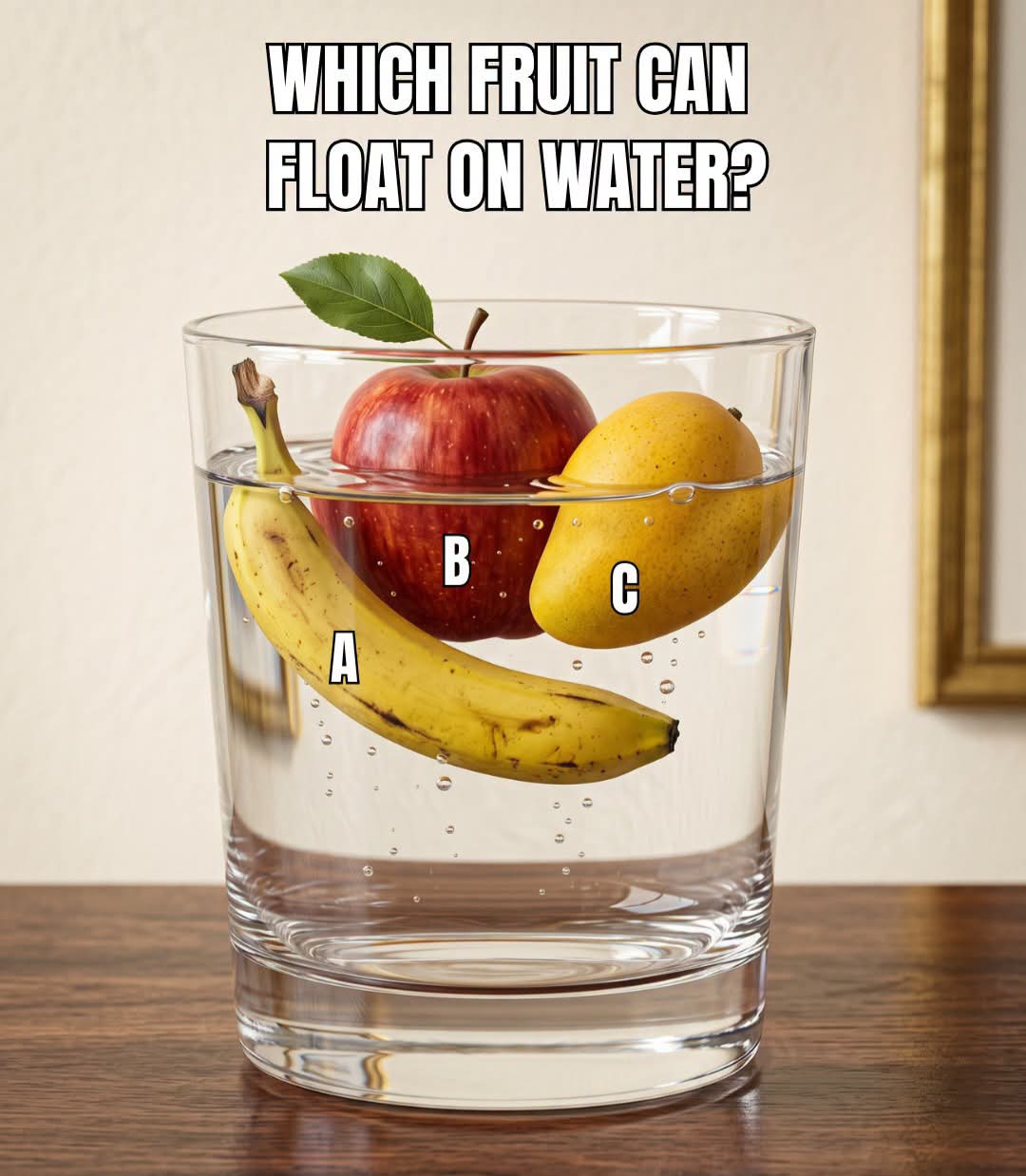
B — The Apple: Floats ✅
Apples are surprisingly buoyant, and it’s not a trick — it’s chemistry. About 25% of an apple’s volume is actually air, trapped in tiny pockets within its flesh. That air makes the apple’s overall density lower than water, so it bobs right at or near the surface. This is a genuinely reliable science-class demonstration, not internet folklore.
A — The Banana: Sinks ❌
Despite looking light and “floaty,” bananas are dense all the way through — no significant air pockets, mostly starch and water. Their density is higher than water’s, so a banana dropped in a glass will sink rather than bob on top, contrary to what a lot of people instinctively guess.
C — The Mango: Sinks ❌
Same story as the banana — mangoes are dense, fibrous, and packed with pulp with minimal internal air. They’ll sink to the bottom too.
So Why Does Everyone Assume Bananas Float?
Probably because bananas float in real life when peeled and thrown in a pool as a joke, or because people confuse “lightweight to hold” with “low density.” But weight alone doesn’t determine floating — it’s weight relative to volume (density) that matters. A banana is light because it’s small, not because it’s airy.
The Actual Rule of Thumb
Fruits and vegetables with high air content (apples, oranges — yes, even with the peel on) tend to float. Dense, fibrous, or water-heavy produce (bananas, mangoes, potatoes, most root vegetables) tends to sink. It’s a fun kitchen-sink experiment you can actually try tonight to verify it yourself. 🍎🍌🥭
