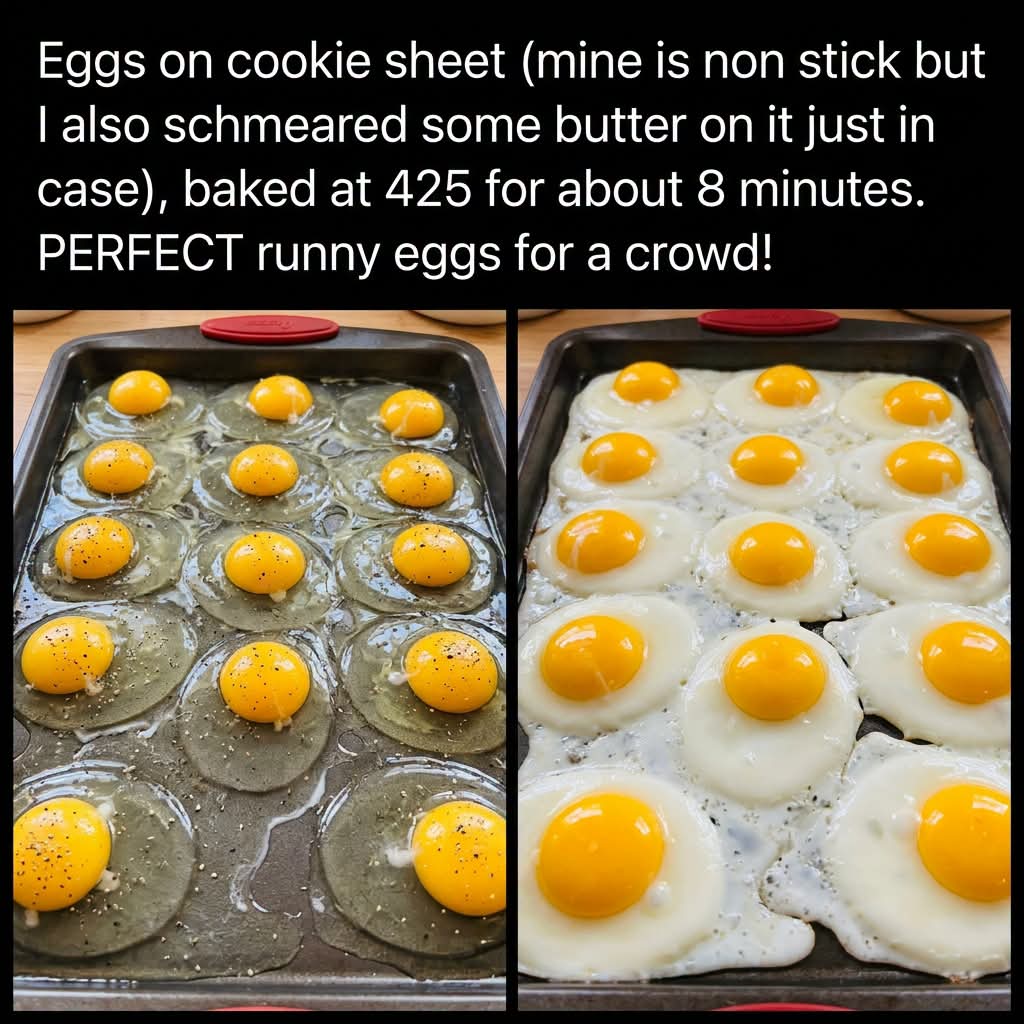
🍳 Sheet-Pan Eggs: The Brilliant Way to Make Runny Eggs for a Crowd
There are some breakfast tricks that make you wonder why you didn’t discover them years ago.
This is one of them.
Instead of standing over a frying pan cooking eggs one or two at a time, imagine cracking an entire dozen eggs onto a baking sheet, sliding the pan into a hot oven, and having breakfast ready for everyone at practically the same time.
That’s the beauty of sheet-pan eggs.
The method shown in the image is wonderfully simple: grease a baking sheet—using butter as an extra precaution if desired—crack the eggs onto it, season them, and bake at around 425°F (220°C) until the whites are set while the yolks remain beautifully runny.
And yes, this is a real technique rather than just a clever internet food idea. Recipes from Food Network and other cooking sources use the same basic approach for preparing multiple eggs at once. (Food Network)
🥚 Why Cook Eggs on a Sheet Pan?
The biggest advantage is obvious:
You can cook a lot of eggs at once.
If you’re making breakfast for two people, frying eggs in a skillet isn’t difficult.
But imagine cooking breakfast for:
- 6 people
- 8 people
- 12 people
- A whole brunch gathering
Suddenly, the frying pan becomes a bottleneck.
You cook two or three eggs.
Take them out.
Cook another batch.
Then another.
By the time everyone sits down, somebody’s eggs are cold.
Sheet-pan eggs solve that problem by turning the oven into one giant frying surface.
Food Network’s version specifically describes the method as a way to get a dozen eggs ready for a group at the same time. (Food Network)
🔥 The Basic Method
The process couldn’t be much easier.
1. Preheat the oven
Set the oven to approximately 425°F / 220°C.
Different ovens behave differently, so the cooking time should be treated as a guide rather than an absolute rule. Several sheet-pan egg recipes recommend checking the eggs early because they can move quickly from runny to firm. (Salty Side Dish)
2. Prepare the baking sheet
Grease the surface generously with butter, oil or nonstick spray.
The butter shown in the original idea is a nice touch because it can help prevent sticking while also adding a little flavor.
Some recipes go a step further and preheat the baking sheet before adding the eggs. Food Network and The Kitchn both use a preheated pan, which helps the eggs begin cooking immediately when they hit the surface. (Food Network)
3. Crack in the eggs
This is the part where you need a little care.
Crack the eggs onto the sheet, trying to distribute them reasonably evenly.
Don’t worry if the whites spread into each other.
That’s completely fine.
The yolks are the important part.
4. Season
A simple sprinkle of salt and freshly ground black pepper is enough.
You can add herbs, chili flakes, paprika or other seasonings if you want something more adventurous.
5. Bake
Place the pan in the oven and keep a close eye on it.
For runny yolks, published recipes commonly fall in the roughly 5–8 minute range at 425°F, depending on the pan, oven and desired doneness. (Salty Side Dish)
The key isn’t simply watching the clock.
Watch the eggs.
You want the whites cooked while the yolks still have that gorgeous wobble.
💛 The Secret Is Knowing When to Pull Them Out
This is probably the most important part of the whole technique.
Eggs continue cooking from residual heat after they come out of the oven.
That means if you wait until the yolks look exactly as cooked as you want them inside the oven, you may end up with firmer yolks than intended.
Some recipes specifically recommend removing the eggs just before they reach the desired doneness because the hot pan continues cooking them. (Blue Meadows)
So for that beautiful runny center, look for:
Firm or nearly firm whites + visibly soft, jiggly yolks.
That’s your moment.
Get them out.
🍞 And Then Comes the Best Part: Toast
A runny egg practically begs for toast.
Imagine putting a warm piece of crusty bread underneath one of these eggs.
Cut through the yolk.
And watch that golden center spread across the toast.
Add a little salt.
Maybe black pepper.
Perhaps some hot sauce.
And you’ve got an incredibly simple breakfast.
Epicurious similarly highlights toast as a natural companion for baked eggs with runny yolks. (Epicurious)
🥓 Build a Full Breakfast Around Them
The eggs don’t have to be served by themselves.
You can turn the sheet-pan method into a complete breakfast spread.
Classic
🍳 Sheet-pan eggs
🥓 Crispy bacon
🍞 Toast
☕ Coffee
Fresh
🍳 Runny eggs
🥑 Avocado
🍅 Tomatoes
🥬 Fresh greens
🍞 Sourdough
Hearty
🍳 Eggs
🥔 Crispy potatoes
🥓 Bacon or sausage
🧀 Cheese
🍞 Toast
Spicy
🍳 Eggs
🌶️ Chili flakes
🥑 Avocado
🍅 Salsa
🍞 Toast
Suddenly, one baking sheet has become the centerpiece of brunch.
🧈 Butter or Oil?
Both can work.
Butter gives the eggs a richer flavor and fits beautifully with a classic breakfast.
Oil is convenient and can help prevent sticking.
Nonstick spray is another practical option.
The important thing is to make sure the cooking surface is properly coated.
A number of sheet-pan egg recipes recommend generously coating the pan before adding the eggs. (Food Network)
And nobody wants to discover that their beautiful breakfast has welded itself permanently to the baking sheet.
👨👩👧👦 Perfect for Family Breakfasts
This is where the method really shines.
Imagine it’s Sunday morning.
Everyone is hungry.
One person wants two eggs.
Someone else wants three.
The kids want breakfast immediately.
Someone is making toast.
Someone is pouring coffee.
Instead of standing over a frying pan for twenty minutes, you can prepare a large batch of eggs together.
Food Network’s recipe makes 12 servings, specifically positioning sheet-pan eggs as a breakfast solution for groups. (Food Network)
That’s the real genius here.
It’s not necessarily about making eggs better.
It’s about making them easier to make for everyone at once.
🍳 The Eggs Don’t Have to Be Runny
Of course, not everybody loves a runny yolk.
That’s perfectly fine.
The same basic technique can be adjusted according to preference.
Runny yolk
Shorter cooking time.
The whites should be set while the yolks remain loose.
Soft or jammy yolk
Give them a little longer.
The center becomes thicker and less liquid.
Firm yolk
Continue cooking until the yolks are completely set.
One sheet-pan egg guide gives approximately 8 minutes for a firmer result, while other recipes suggest checking around 6–10 minutes depending on the desired doneness and oven. (Salty Side Dish)
The important thing is to start checking early.
You can always cook an egg longer.
You can’t uncook it.
⚠️ Why Your First Batch Might Be Different
Don’t be surprised if your cooking time isn’t exactly the same as someone else’s.
Ovens vary.
Pans vary.
Egg sizes vary.
The temperature of the pan matters.
Even the number of eggs you’re cooking can change the result.
For example, one recipe notes that its oven produced runny yolks around eight minutes, while Food Network’s preheated-pan method uses about five minutes for runny yolks. (Salty Side Dish)
That difference is a perfect reminder:
Don’t blindly follow the clock.
Use the clock as a starting point and your eyes as the final judge.
🧂 Keep It Simple
One of the best things about sheet-pan eggs is that they don’t require a complicated recipe.
You need:
- Eggs
- Butter, oil or nonstick spray
- Salt
- Black pepper
That’s basically it.
Everything else is optional.
And sometimes simple is exactly what breakfast needs.
A perfectly cooked egg with a runny yolk, crisp toast and a little salt can be more satisfying than an elaborate breakfast with twenty ingredients.
🌶️ But You Can Get Creative
Once you’ve mastered the basic technique, the possibilities open up.
Try sprinkling the eggs with:
🌶️ Chili flakes
🌿 Fresh herbs
🧄 Garlic powder
🧅 Dried onion
🌶️ Smoked paprika
🧀 Grated Parmesan
🧀 Cheddar
🥓 Cooked bacon pieces
You can also serve them alongside avocado, salsa, roasted vegetables, potatoes or crispy bread.
Some sheet-pan recipes even incorporate vegetables and other breakfast ingredients before the eggs are added. (Isabel Eats)
🧽 And Cleanup Is Surprisingly Easy
There’s another advantage that doesn’t get enough attention:
You’re cooking everything on one pan.
Instead of washing a frying pan after cooking several batches of eggs, you have one baking sheet to clean.
If you’ve properly greased it, cleanup should be considerably easier.
And if you’re feeding a crowd, fewer pans and fewer cooking steps can make the entire morning feel much more relaxed.
❤️ Why This Little Trick Is So Brilliant
There are recipes that require dozens of ingredients and complicated techniques.
Then there are recipes like this.
Crack eggs.
Bake.
Serve.
That’s it.
And yet, sometimes those are the recipes that become part of your regular routine.
Because convenience matters.
Especially in the morning.
When everyone is hungry and nobody wants to wait.
🍳 The Perfect Crowd-Pleasing Breakfast
There’s something wonderfully satisfying about seeing an entire tray of eggs come out of the oven.
One after another.
Golden yolks sitting on top of perfectly cooked whites.
A little black pepper scattered across the surface.
Steam rising from the pan.
Then comes the fun part—cutting individual portions with a spatula and serving them straight away. Sheet-pan egg recipes commonly recommend using a thin spatula to portion and lift the eggs. (Salty Side Dish)
Put them beside toast.
Add bacon.
Pour the coffee.
And suddenly breakfast for a crowd doesn’t feel like a production anymore.
🍳 One Pan. A Dozen Eggs. Breakfast Is Served.
The beauty of this idea isn’t that it replaces the classic fried egg.
It’s that it gives you another option.
When you’re cooking for yourself, grab the skillet.
When you’re cooking for a whole table, grab the baking sheet.
And when someone says:
“Can you make eggs for everyone?”
You no longer have to panic.
Just preheat the oven, grease the pan, crack the eggs, season them and keep an eye on those yolks.
Because when that moment arrives—when the whites are set and the centers are still beautifully golden and runny—you’ve got something pretty special.
A whole tray of sunny-side-up-style eggs, ready at almost the same time. 🍳💛
And honestly, once you’ve tried it, you might never look at a dozen eggs and a baking sheet the same way again.
🍞 Now the only question is…
Are you dipping toast into those runny yolks, putting the eggs on a breakfast sandwich, or eating them straight off the plate? 🤤🍳
