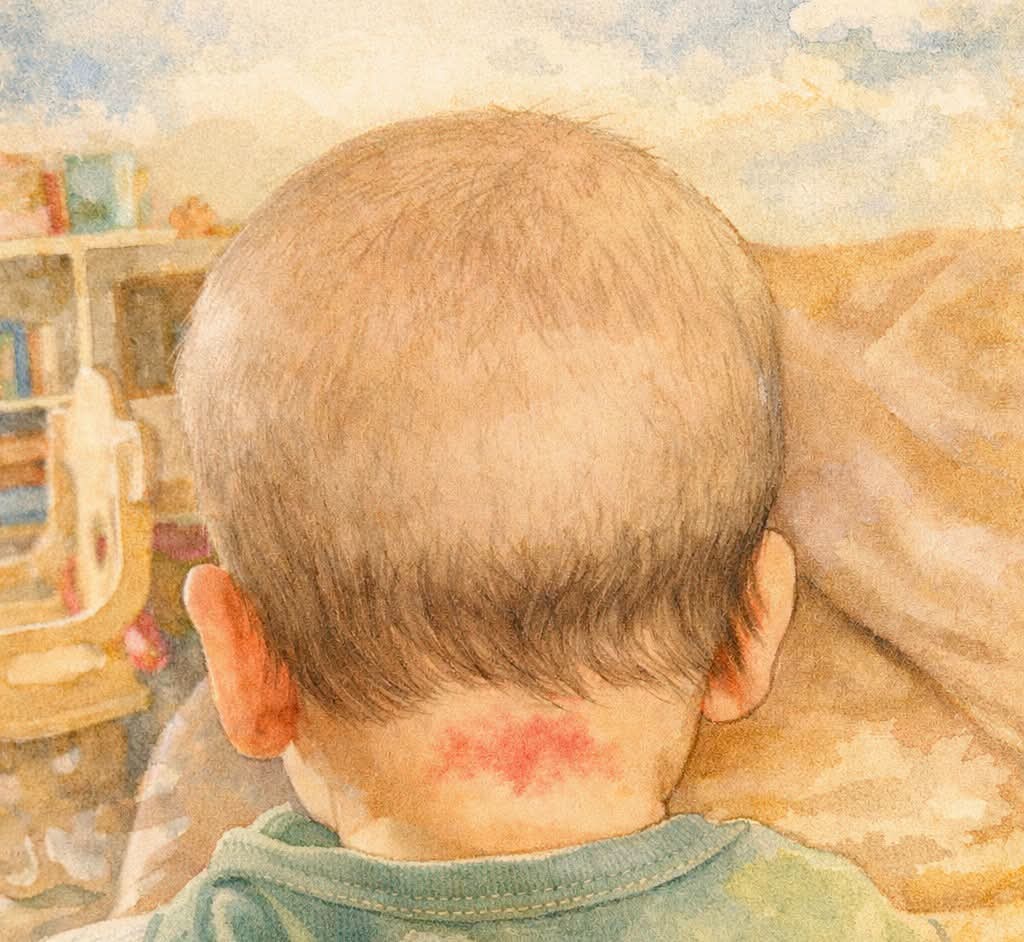
They say those little red marks on the back of your baby’s neck, or sometimes around their eyes, are called “stork bites” or “angel kisses.”
People say storks leave these tiny marks behind when they gently kiss or carry babies on their journey to their families. Some people believe the marks are little reminders that babies were loved and watched over before they ever arrived in their parents’ arms.
I don’t know if it’s true, but I hope it is.
Because I like to think that before they found their way to me, someone was already loving them.
👶❤️ Stork Bites & Angel Kisses: The Little Birthmarks With a Beautiful Story
Have you ever noticed a tiny pink or red mark on a newborn baby’s forehead, eyelids, or the back of their neck?
Maybe someone called it a “stork bite” or an “angel kiss.” 👼🪽
These little marks are incredibly common, and they have inspired some of the sweetest folklore surrounding newborn babies.
There is the beautiful old story that a stork gently carried a baby to their family and left a tiny mark behind. Marks on the face were sometimes imagined as an angel’s kiss, while marks on the back of the neck became known as stork bites.
There isn’t medical evidence that a stork or an angel actually left the mark, of course.
But there’s something lovely about the idea.
Because sometimes a little bit of folklore can give an ordinary moment a beautiful meaning.
🌸 What Are Stork Bites and Angel Kisses?
The medical name for these common marks is nevus simplex. They’re also called salmon patches.
They are flat pink or red areas caused by small blood vessels near the surface of the skin. They can appear on the forehead, eyelids, between the eyebrows, and around the nose, as well as on the back of the neck. (HealthyChildren.org)
When they’re on the back of the neck, they’re commonly called stork bites.
When they’re on the forehead or around the eyes, they’re often called angel kisses.
And they’re much more common than many new parents realize. The American Academy of Pediatrics notes that nevus simplex marks occur in a large proportion of newborns. (HealthyChildren.org)
👼 Why Are They Called “Angel Kisses”?
The name isn’t a medical term. It’s a piece of affectionate folklore.
A pink mark on a baby’s forehead or eyelid can look almost like someone gently touched the skin.
So over generations, people gave these birthmarks a tender explanation: perhaps an angel kissed the baby before they arrived.
It’s not something science can prove.
But that doesn’t mean the story can’t hold sentimental meaning for a family.
A parent looking at a newborn may see much more than a birthmark. They may see a little reminder of just how precious and miraculous that new life feels.
🪽 And What About the Stork?
The stork has been associated with babies in folklore for generations.
The traditional image of a stork carrying a baby in a cloth bundle became a familiar symbol of childbirth and new families.
That symbolism is also reflected in the name “stork bite.” The marks are often found on the back of a baby’s neck, an area associated in folklore with where a stork might have carried the baby. (HealthyChildren.org)
Of course, babies arrive in families through very real journeys—birth, adoption, surrogacy, fostering, and many other paths.
The stork story is simply a bit of imaginative folklore that has endured because it’s so sweet.
❤️ The Science Is Just as Interesting
The real explanation for a nevus simplex is less magical, but still fascinating.
These marks are associated with superficial capillaries—the tiny blood vessels close to the skin’s surface.
Because of that, they can become more noticeable when a baby cries, gets warm, or becomes upset. (HealthyChildren.org)
You may notice that a mark looks faint when your baby is sleeping peacefully and becomes much more noticeable during a big cry.
That’s generally normal for this type of birthmark.
🌿 Do Stork Bites Go Away?
Often, yes.
Many facial nevus simplex marks gradually become less noticeable during infancy and early childhood. The NHS says marks on the forehead and eyelids commonly fade by around age 2, while marks on the back of the head or neck can take longer. (nhs.uk)
The American Academy of Pediatrics similarly notes that most nevus simplex marks fade naturally during the toddler years, although some marks—particularly those on the neck—can persist longer. (HealthyChildren.org)
That means the little mark you notice on your newborn today may eventually become barely visible or disappear completely.
🌸 Do They Need Treatment?
Most typical stork bites and angel kisses don’t require treatment.
They’re generally harmless and simply become less noticeable with time. (HealthyChildren.org)
Parents should still mention unusual, large, changing, or uncertain birthmarks to their baby’s pediatrician. Not every red mark on a newborn is a nevus simplex, and other types of vascular birthmarks can look different and may require medical evaluation. (HealthyChildren.org)
If a mark is raised, rapidly growing, bleeding, or looks substantially different from a typical flat pink birthmark, it’s particularly worth having a healthcare professional take a look.
👶 A Tiny Mark With a Big Meaning
Maybe that’s why these little birthmarks have inspired so many stories.
They’re medically explainable, but they can still feel magical.
A parent might look at that tiny pink patch and think:
“You were kissed before I ever got to hold you.”
And while we know the mark comes from blood vessels beneath the skin rather than an actual angel or stork, the sentiment behind the story can still be beautiful.
Because babies don’t arrive with memories of everything that came before.
They arrive needing warmth, safety, love, and someone to hold them.
And from the moment they’re placed in their family’s arms, they begin creating those memories together. ❤️
🪽 Maybe We Can Keep the Story
Science can explain how a stork bite happens.
It can tell us what the mark is, why it becomes more noticeable when a baby cries, and why many of these marks gradually fade.
But science doesn’t have to take away the sweetness of the story.
You can know the medical explanation and still smile when someone calls it an angel kiss.
Because perhaps the most beautiful part isn’t whether an angel really kissed that baby’s forehead.
It’s what the mark makes us feel when we look at them.
Loved. Cherished. Welcomed.
And maybe that’s a story worth keeping.
❤️ Did your baby have a “stork bite” or “angel kiss”?
Did it fade as they grew, or is that little mark still there today?
Tell us your story below. 👶🪽❤️
