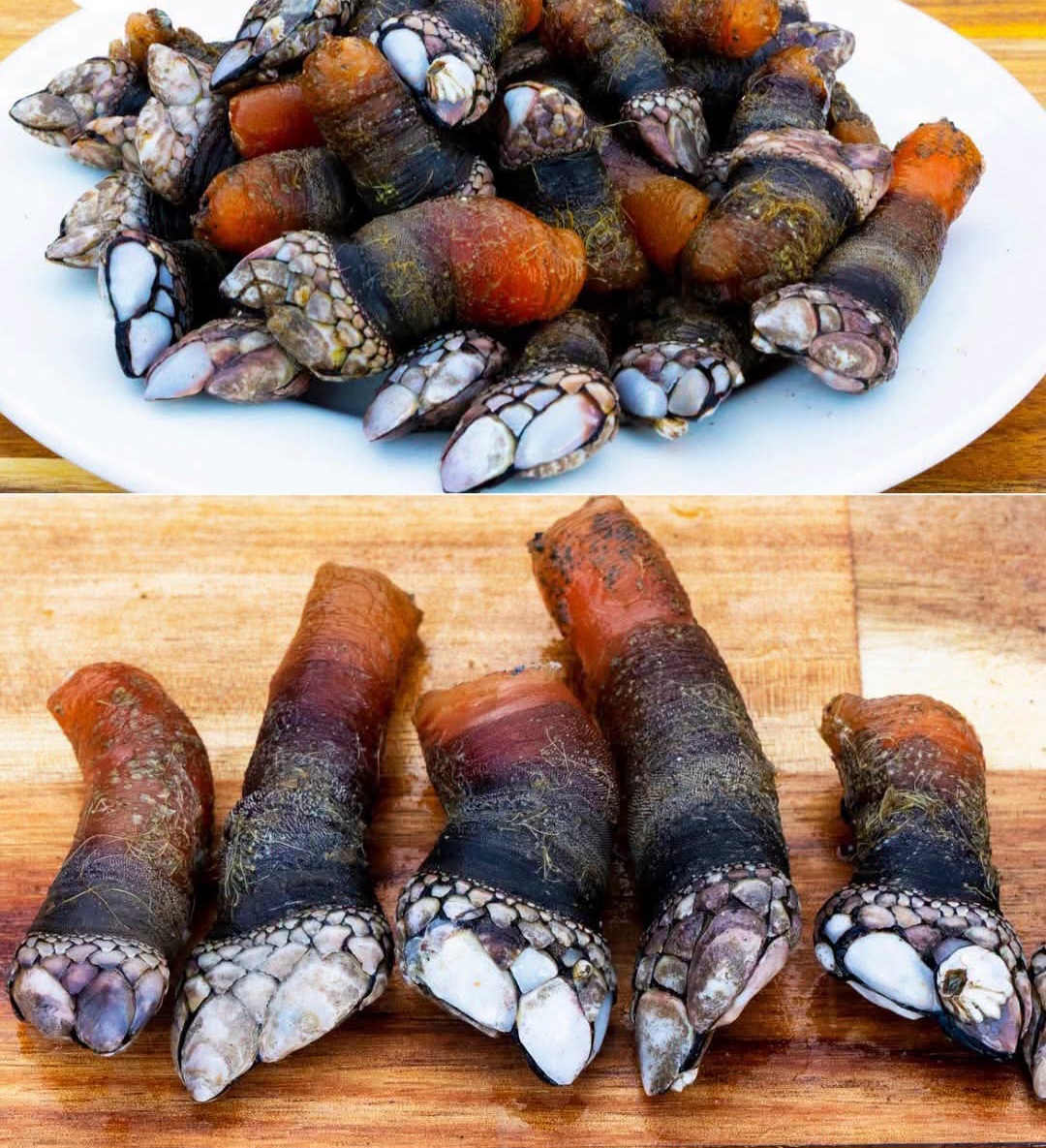
🦀 Ugly, “Dangerous” and Expensive—but Delicious: What Are Percebes?
At first glance, percebes don’t exactly look like something you’d rush to order at a seafood restaurant. 😂
They’re dark, strange-looking, claw-like creatures that look almost prehistoric—and yet they’re considered one of the great seafood delicacies of the Atlantic coast of Spain and Portugal.
Known in English as goose barnacles or gooseneck barnacles, percebes are particularly prized in Galicia, in northwestern Spain, and along parts of the Portuguese coast. (TasteAtlas)
And there’s a very good reason these bizarre little crustaceans can be so expensive:
Getting them off the rocks can be genuinely dangerous.
🦀 What Exactly Are Percebes?
Percebes are a type of stalked barnacle, specifically Pollicipes pollicipes.
Unlike the familiar small barnacles you might see covering rocks or boats, goose barnacles have a long, dark, flexible stalk topped with a shell-like structure made of several plates.
The stalk is the part that is eaten.
They attach themselves firmly to rocky coastal surfaces, especially areas exposed to strong Atlantic waves. The most prized specimens are often the ones growing in places where the sea hits hardest. (Tourisme de Galice)
That harsh environment is actually part of what makes them so valuable.
🌊 They Like the Roughest Parts of the Coast
You might think a delicious shellfish would grow somewhere calm and easy to reach.
Percebes apparently didn’t get that memo.
They thrive on exposed rocky shorelines where powerful waves crash against the rocks.
In Galicia, some of the most famous percebes come from areas along the dramatic Costa da Morte, or “Coast of Death.”
The name sounds dramatic—and the harvesting conditions certainly can be.
Galicia’s tourism authority describes percebeiro harvesting as one of the marine trades requiring the greatest courage, with gatherers timing their work around tides and observing the sea carefully before approaching the rocks. (Tourisme de Galice)
⚠️ Why Are Percebes Dangerous to Harvest?
The danger isn’t the animal itself.
The danger is where it lives.
Professional gatherers, known as percebeiros, have to reach barnacles attached to steep, slippery rocks while powerful waves are moving around them.
They work during low tide and use tools to detach the barnacles from the rock.
Some harvesting areas are so difficult to reach that gatherers may need ropes or other safety arrangements.
A sudden wave can knock someone off balance, slam them against the rocks, or pull them into the sea.
Research on the fishery describes the harvesting technique as simple but very risky because of the difficult terrain and strong local water movement. (ScienceDirect)
So when you see a plate of expensive percebes, you’re not just paying for an unusual seafood delicacy.
You’re also paying for an extremely difficult harvest.
💰 Why Are They So Expensive?
There are several reasons.
🌊 They’re difficult to reach
The best specimens grow in exposed locations that are dangerous to access.
👨🌾 They’re harvested by hand
There isn’t an easy industrial process for collecting them from those wave-battered rocks.
🦀 They’re relatively specialized
Percebes depend on particular rocky coastal environments, which limits where they can be harvested.
🍽️ They’re highly prized
In Galicia and Portugal, they’re considered a luxury seafood delicacy.
Prices can vary dramatically depending on location, season, quality, and availability. Some exceptional catches can command very high prices at auction. (TasteAtlas)
So when someone says, “Why would anyone pay that much for something that looks like that?”
The answer is partly:
Because the seafood is rare—and getting it onto your plate isn’t easy.
🤤 But What Do Percebes Taste Like?
This is where the story gets interesting.
Because once you get past the appearance, people who love percebes describe them as intensely fresh, salty, sweet, and briny.
The flavor is often described as tasting almost like the ocean itself.
They’re delicate but meaty, with a texture that can remind people of other shellfish.
And unlike seafood that gets covered in heavy sauces and seasonings, percebes are generally prepared very simply.
That’s intentional.
The goal is to let the natural flavor shine. (TasteAtlas)
🧂 How Are Percebes Cooked?
One of the most surprising things about percebes is how little preparation they need.
In Galicia, they’re traditionally cooked briefly in boiling seawater or salted water, sometimes with bay leaves.
They’re generally served hot and relatively plain.
That’s it.
No complicated sauce.
No long cooking process.
No elaborate seasoning.
The ingredient itself is the star. (Tourisme de Galice)
There’s even a traditional Galician saying associated with their preparation that essentially means:
When the water boils, put in the percebes.
That’s about as simple as seafood cooking gets! 😂
🖐️ How Do You Eat Them?
This is another part that makes percebes different.
They’re usually served whole.
You hold the hard shell-like end, separate it from the stalk, and pull out the edible portion.
The result is a small piece of tender seafood inside the tough exterior.
And because they’re often served very hot, diners need to be careful while handling them.
The goal is to get to the juicy, flavorful meat inside without making a complete mess of yourself.
🐚 The Best Ones Aren’t Necessarily the Biggest
Interestingly, where the percebes grow can affect their quality.
According to Galicia’s tourism materials, the barnacles growing in the most exposed areas, where the sea hits them with the greatest force, tend to be shorter and thicker, with denser meat.
Those growing in more sheltered areas can be longer and thinner and may contain proportionally more water.
That’s one reason location matters so much when it comes to the quality of percebes. (Tourisme de Galice)
So the wild Atlantic isn’t just making life difficult for the percebeiros.
It’s also helping create the characteristics that make the best percebes so desirable.
🇪🇸 A True Galician Specialty
Percebes are deeply connected to the food culture of Galicia.
They’re celebrated in local festivals, and some coastal communities take enormous pride in the quality of their local harvest.
For example, Galicia’s official tourism site highlights the Festa do Percebe de Aguiño, where the event celebrates both the product and the traditional work of collecting it. The festival specifically notes that the finest examples grow on dangerous, difficult-to-reach rocky shorelines exposed to crashing waves. (Tourisme de Galice)
There’s also a long-standing celebration of the famous percebes from Punta Roncudo near Corme.
So this isn’t simply an expensive food.
It’s part of the cultural identity of coastal communities.
🧑🌾 The People Behind the Delicacy
Perhaps the most important part of the percebes story isn’t the unusual animal at all.
It’s the people who harvest it.
A professional percebeiro needs to understand the coastline, the tides, the rocks, and—perhaps most importantly—the behavior of the sea.
Knowing when not to go can be just as important as knowing where the barnacles are.
Galicia’s tourism authority specifically emphasizes that gatherers check tide conditions and observe the sea before beginning their work. (Tourisme de Galice)
It’s a traditional occupation requiring experience, physical skill, and enormous respect for the ocean.
🌊 Why Can’t We Just Farm Them?
Unlike many other commercially important shellfish, goose barnacles have proven difficult to produce through conventional aquaculture.
Their dependence on highly exposed rocky environments is one of the reasons the fishery remains largely dependent on wild harvesting. (Paradores)
That limited supply, combined with strong demand, helps explain their high value.
In other words:
You can’t simply build a big tank, grow thousands of them, and flood the market.
Nature makes them on her own schedule.
🦆 And What Does “Goose Barnacle” Have to Do With Geese?
Here’s one of the strangest pieces of history surrounding these creatures.
The English name “goose barnacle” comes from an old medieval belief that barnacle geese somehow developed from these organisms.
Before people understood bird migration, some Europeans apparently wondered where certain birds went during parts of the year.
The strange appearance of the barnacles may have contributed to the old myth that they were somehow connected to geese. (Galicia Tips – All about Galicia)
Of course, we now know that goose barnacles and barnacle geese have absolutely nothing to do with one another.
But the bizarre name survived.
🦀 Ugly on the Outside, Gourmet on the Inside
Percebes are a perfect example of how appearance can be misleading.
They’re not beautiful.
They’re not particularly inviting.
They don’t look like the kind of thing you’d expect to see on an expensive seafood platter.
But inside that strange exterior is a delicacy that seafood lovers consider exceptional.
Their flavor is concentrated, briny, and unmistakably marine.
And perhaps that’s exactly why they’re so fascinating.
💰 Is the High Price Worth It?
That depends entirely on the person eating them.
If you don’t particularly enjoy intensely briny seafood, spending a lot of money on percebes probably isn’t going to change your mind.
But if you’re a serious seafood lover, they’re considered a special experience.
You’re tasting something that comes from one of the wildest parts of the Atlantic coastline.
And you’re tasting the result of a traditional fishery that requires extraordinary skill and caution.
❤️ More Than Just an Expensive Seafood
The next time you see a photograph of percebes and think:
“What on earth ARE those things?”
Now you know.
They’re goose barnacles, a highly prized crustacean found on wave-battered Atlantic rocks, particularly in Galicia and Portugal.
They’re strange-looking.
They’re difficult to harvest.
They’re expensive.
And according to people who love them…
they’re absolutely delicious. 🤤🌊
Perhaps that’s the perfect combination for a legendary food:
A little ugly, a little dangerous, a little mysterious—and incredibly good.
🦀 Would You Try Percebes?
If someone put a plate of these in front of you, would you dig in?
YES 🤤 — I want to taste them!
or
NOPE 😂 — I’ll stick with shrimp!
