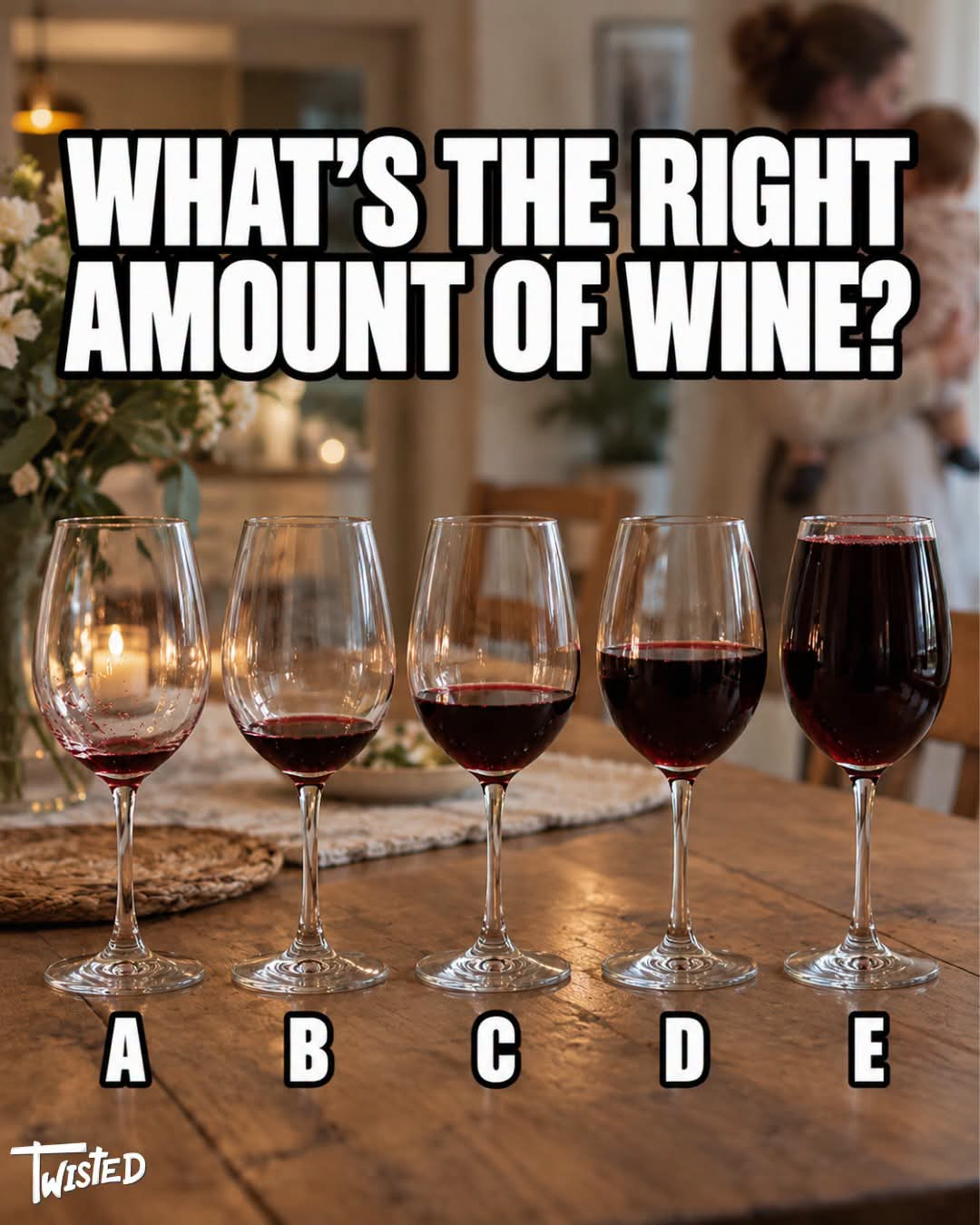
🍷 What’s the Right Amount of Wine? A, B, C, D, or E? 👀
Pouring a glass of wine seems simple enough—but when you look at five glasses filled to different levels, the question becomes surprisingly interesting! Some people prefer just a small pour, others enjoy a moderate serving, and some believe a wineglass looks best when it’s nearly full.
So, which one is actually the right amount?
The answer depends on whether you’re thinking about proper wine serving, enjoying the aroma, or simply how much fits your personal preference. But there’s an important detail many people overlook: a wineglass can hold far more than one standard serving.
Let’s take a closer look at the five options in the picture! 🍷
🍷 Option A: Just a Taste
Option A contains only a small amount of red wine at the bottom of the glass.
This might be suitable for a tasting session, where someone wants to sample several wines without drinking a full serving of each. Small pours can also be useful when comparing different varieties, aromas, or flavors.
However, if you’re sitting down to dinner and want a regular glass of wine, this amount may feel a little too small.
Best suited for: Wine tastings, small samples, or trying a new variety.
🍷 Option B: The Small Pour
Option B offers a little more wine while leaving most of the glass empty.
A small pour can be useful when you want to enjoy the flavor slowly or when you’re sampling wine alongside a meal. It also leaves plenty of room in the glass for swirling and smelling the wine.
Remember, though, that the size of the glass doesn’t determine the serving size. A small amount in a large glass is still a small serving.
Best suited for: People who prefer a modest pour or want to savor a small amount.
🍷 Option C: The Moderate Pour
Option C looks like a modest glass of wine, with enough to enjoy the color and aroma without filling the glass too high.
But here’s the important part: a standard serving of table wine in the United States is about 5 fluid ounces (148 ml) when the wine contains approximately 12% alcohol. The amount of wine shown in a glass doesn’t necessarily tell you how many standard drinks you’re consuming. (Rethinking Drinking)
The best way to know how much you’re pouring is to measure it rather than guess based on the glass.
Best suited for: Someone who wants to keep track of the amount they’re drinking.
🍷 Option D: The Generous Pour
Option D contains considerably more wine than the earlier glasses.
It might look like the perfect pour to someone who enjoys a fuller glass, but a larger serving also means more alcohol. Depending on the wine’s strength and the amount poured, one glass could contain more than one standard drink.
That’s why it’s helpful to pay attention to the actual volume rather than how full the glass looks.
A large wineglass can make a serving look smaller than it really is!
The takeaway: A generous pour isn’t necessarily a standard serving.
🍷 Option E: The Nearly Full Glass
And finally, we have Option E! 🍷
This glass is filled much higher than the others, making it the most dramatic choice in the picture.
Although some people may like the appearance of a full glass, filling a wineglass nearly to the top isn’t necessary to enjoy its aroma or flavor. It can also make it harder to swirl the wine without spilling.
More importantly, the amount shown could represent multiple standard drinks, depending on the glass’s capacity and the wine’s alcohol content.
For perspective, a typical 750 ml bottle of table wine at 12% alcohol contains approximately five U.S. standard drinks. (Rethinking Drinking)
The takeaway: A nearly full glass may look impressive, but it’s not the best guide to a standard serving.
🏆 So, What’s the Right Answer?
If we’re talking about a standard serving of wine, the answer is approximately 5 ounces (148 ml) of table wine at 12% alcohol in the United States. That is a reference serving size, not a recommendation that everyone should drink.
The correct letter in the picture can’t be identified with certainty because the image doesn’t give the capacity of the glasses or the exact volume of each pour.
Here’s what matters:
- The glass size: Large glasses can make pours look smaller.
- The alcohol content: Stronger wines contain more alcohol per ounce.
- The amount poured: A single glass may contain more than one standard drink.
- Your health and circumstances: Alcohol affects people differently, and drinking less reduces alcohol-related risks. There is no guaranteed risk-free level of alcohol consumption. (NIAAA)
If you don’t drink alcohol, there’s no health reason to start. If you do drink, knowing the amount you’re pouring can help you make an informed choice.
🍽️ Does the Type of Wineglass Matter?
Yes, the shape of a wineglass can influence the drinking experience.
Some glasses have a wider bowl that allows room to swirl the wine and release its aromas. Others have a narrower shape.
However, the shape of the glass doesn’t determine how much alcohol you’re consuming. The actual volume and alcohol concentration do.
If you’re hosting a dinner party, you can make serving easier by measuring pours rather than filling glasses to an arbitrary line.
And don’t forget to offer water and appealing nonalcoholic drinks, too!
❤️ Final Thoughts: It’s About More Than the Pour
This picture is a fun way to start a conversation because everyone may have a different idea of what looks like the perfect glass.
Some prefer a small serving, while others are drawn to the nearly full glass. But when it comes to understanding a serving, appearance can be misleading.
The most useful thing to know is how much wine is actually in the glass—not simply which glass looks best.
💬 Let’s Hear Your Answer!
Which glass would you pick: A, B, C, D, or E? 👀🍷
Would you choose a small pour, a moderate serving, or a nearly full glass?
Drop your letter in the comments! And remember, the fullest glass isn’t necessarily the best pou
