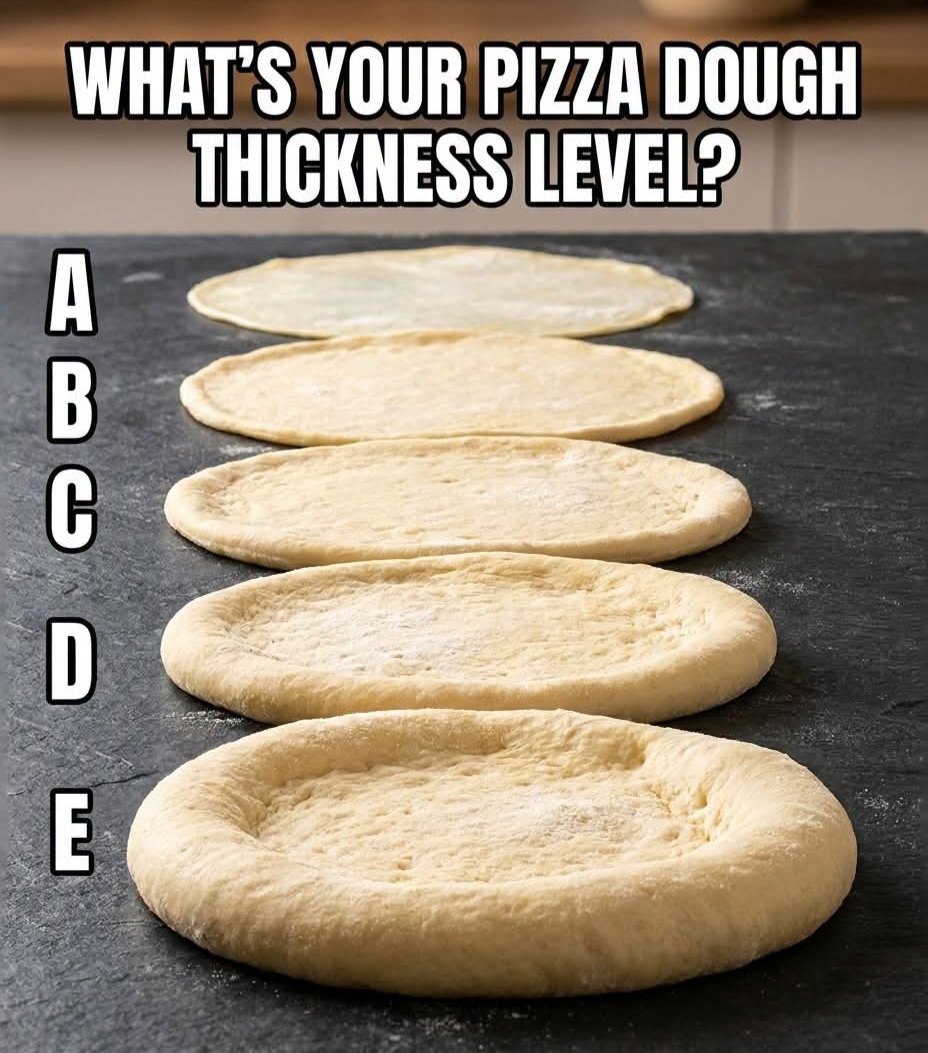
🍕 What’s Your Pizza Dough Thickness Level?
Pizza is one of those foods where everyone has an opinion.
Some people want a crust so thin and crispy that you can hear the crunch with every bite. Others believe pizza isn’t pizza unless the crust is thick, soft, chewy and substantial enough to make you feel like you’ve eaten a proper meal.
And then there are the people somewhere in the middle—the ones who want a crust with a crisp bottom, a chewy center and a beautifully puffed edge.
The image above puts the question rather simply:
A, B, C, D or E?
Which level of pizza dough would you choose? 🍕🤤
The thickness of the dough isn’t just about how much bread you get. It changes the entire eating experience: crispness, chew, how much topping the pizza can support, and how prominent the crust itself becomes. Pizza styles range from extremely thin, cracker-like bases to thick, airy pan pizzas. (King Arthur Baking)
🍕 Level A — Thin, Crisp & Topping-Focused
If you’re choosing A, you’re probably here for the toppings.
The dough is stretched very thin, allowing the sauce, cheese and toppings to take center stage. A properly baked thin crust can develop a crisp bite while remaining flexible enough to pick up.
Thin-crust dough can be rolled or stretched remarkably thin; King Arthur Baking gives about ⅛ inch (3 mm) or less as an example for an ultra-thin homemade crust. (King Arthur Baking)
There’s something incredibly satisfying about that first bite:
CRUNCH.
Then comes the tomato sauce.
Then the cheese.
Then whatever toppings you’ve chosen.
There’s just enough crust to hold everything together without making the pizza feel dominated by bread.
Perfect for:
- Crispy-pizza lovers
- Simple toppings
- People who love lots of cheese and sauce
- Anyone who dislikes a doughy center
- Sharing several different pizzas
Thin crust also tends to work particularly well when you want the toppings to remain the main attraction.
🍕 Level B — Thin but Still Chewy
Level B is where things start getting interesting.
It’s still relatively thin, but there’s a little more substance than A.
Instead of an aggressively crisp base, you might get a combination of crispness underneath and chewiness through the middle.
This is where many people find their ideal balance.
You get the satisfying bite of thin pizza without feeling as though you’re eating a cracker with toppings.
New York-style pizza is a good example of this general territory: King Arthur describes its version as thin and crispy while remaining foldable. (King Arthur Baking)
And that fold matters.
A good slice should be able to bend without completely collapsing.
🍕 Level C — The Middle Ground
Now we’re in classic comfort territory.
C isn’t paper-thin, but it isn’t particularly thick either.
There’s enough dough to give you a satisfying chew, while the toppings remain prominent.
For someone who can’t decide between thin and thick, this might be the compromise.
The beauty of medium crust is versatility.
Pepperoni?
Works.
Mushrooms?
Works.
Chicken?
Works.
Extra cheese?
Absolutely.
And unlike very thin crusts, a slightly thicker base can provide more structural support for heavier toppings. Different pizza guides note that thinner bases generally support fewer or lighter toppings, while thicker doughs provide more structure. (WebstaurantStore)
🍕 Level D — Thick, Soft & Chewy
Now we’re entering serious crust territory.
At D, the crust isn’t merely supporting the pizza.
The crust is part of the main event.
You get more breadiness, more chew and usually a softer interior.
Instead of taking a bite and immediately reaching the toppings, you’re experiencing layers of texture:
crispy outside → chewy crust → melted cheese → sauce → toppings.
And there’s something deeply comforting about a thick, freshly baked pizza base.
It’s warm.
It’s substantial.
It’s filling.
It’s the sort of crust that makes you want to grab the edge with your fingers and give it a little squeeze before taking a bite.
🍕 Level E — Give Me ALL the Dough!
And then there’s E.
The people who choose E aren’t ordering pizza because they’re looking for a little snack.
They’re here for the whole experience.
Thick, fluffy, pillowy dough.
A substantial crust.
A golden exterior.
A soft interior.
And enough structure to support a serious amount of toppings.
Styles such as Sicilian, Detroit-style and pan pizza can occupy the thick-crust end of the spectrum. King Arthur’s current pizza guide describes Sicilian dough as puffy and almost focaccia-like, while its Detroit-style dough produces a thick, pillowy crust with very crisp edges. (King Arthur Baking)
And that’s an important distinction:
Thick doesn’t have to mean dense.
A well-fermented thick crust can be wonderfully airy.
🔥 Thickness Isn’t the Only Thing That Matters
Here’s where pizza gets really fascinating.
Two pieces of dough can look similar before baking and still produce very different pizzas.
That’s because crust texture depends on much more than thickness.
💧 Hydration
The amount of water in the dough affects its texture and structure. Higher hydration can contribute to a lighter, airier interior, while lower hydration tends toward a firmer, crispier result. (Bella Pizza)
⏳ Fermentation
Time matters too.
Fermentation influences both flavor and texture, which is one reason two doughs made with broadly similar ingredients can taste completely different. (Bella Pizza)
🔥 Oven temperature
A very hot oven can rapidly bake the exterior while helping create browning and crispness.
That’s why pizza cooked at extremely high temperatures can have a dramatically different crust from one baked more slowly in a standard home oven.
🍞 How you shape it
Roll it flat and you remove a lot of the air and structure.
Stretch it gently and you can preserve more of the dough’s internal bubbles.
That can give the edge a completely different character.
🍕 Thin vs Thick: What’s Actually Better?
There really isn’t one universal answer.
They’re different experiences.
| Thin Crust | Thick Crust |
|---|---|
| Crisp | Soft & chewy |
| Lighter bite | More substantial |
| Toppings stand out | Crust plays a bigger role |
| Usually cooks quickly | Often needs more baking time |
| Great for simple toppings | Good for heavier toppings |
| Easy to eat by the slice | More filling |
King Arthur Baking’s current collection demonstrates just how broad the spectrum can be, from super-thin crusts through New York and Neapolitan styles to Sicilian and Detroit-style doughs. (King Arthur Baking)
So the real question isn’t “Which crust is best?”
It’s:
“What kind of pizza do I feel like eating?”
🧀 And Then Come the Toppings…
Your preferred crust may also depend on what you’re putting on it.
A delicate thin crust can be fantastic with:
🍅 Tomato sauce
🧀 Mozzarella
🌿 Basil
🫒 Olive oil
🍄 Mushrooms
But pile on enormous amounts of cheese, meat and vegetables and suddenly that thin base has a difficult job.
Thicker dough provides more structural support, which is one reason heavier pizzas often use sturdier crusts. (WebstaurantStore)
Of course, there are no pizza police.
If you want a paper-thin crust covered in an unreasonable amount of cheese, that’s between you and your pizza.
😂
🤤 The Best Part: That First Bite
Regardless of which letter you choose, there’s one moment that never gets old.
The pizza arrives.
It’s hot.
The cheese is bubbling.
You grab a slice.
Maybe there’s a little cheese stretch.
Maybe the crust bends.
You take that first bite.
And suddenly you understand why people can spend so much time arguing about pizza.
Is it the crispness?
The chew?
The sauce?
The cheese?
The toppings?
The crust?
Probably all of it.
Because a great pizza isn’t really about one ingredient.
It’s about how everything works together.
🍕 So, What’s Your Level?
Let’s settle the debate.
A — Give me that thin, crispy crunch.
B — Thin, but I still want some chew.
C — Keep it balanced.
D — Thick, soft and seriously satisfying.
E — The thicker, fluffier and breadier, the better!
And if you’re the kind of person who says “I don’t care how thick it is as long as there’s pizza in front of me”…
Honestly, that’s a perfectly respectable answer too. 😂🍕
So be honest: if you walked into a pizzeria and had to choose one thickness—A, B, C, D or E—which one are you reaching for? 👀🍕🤤
