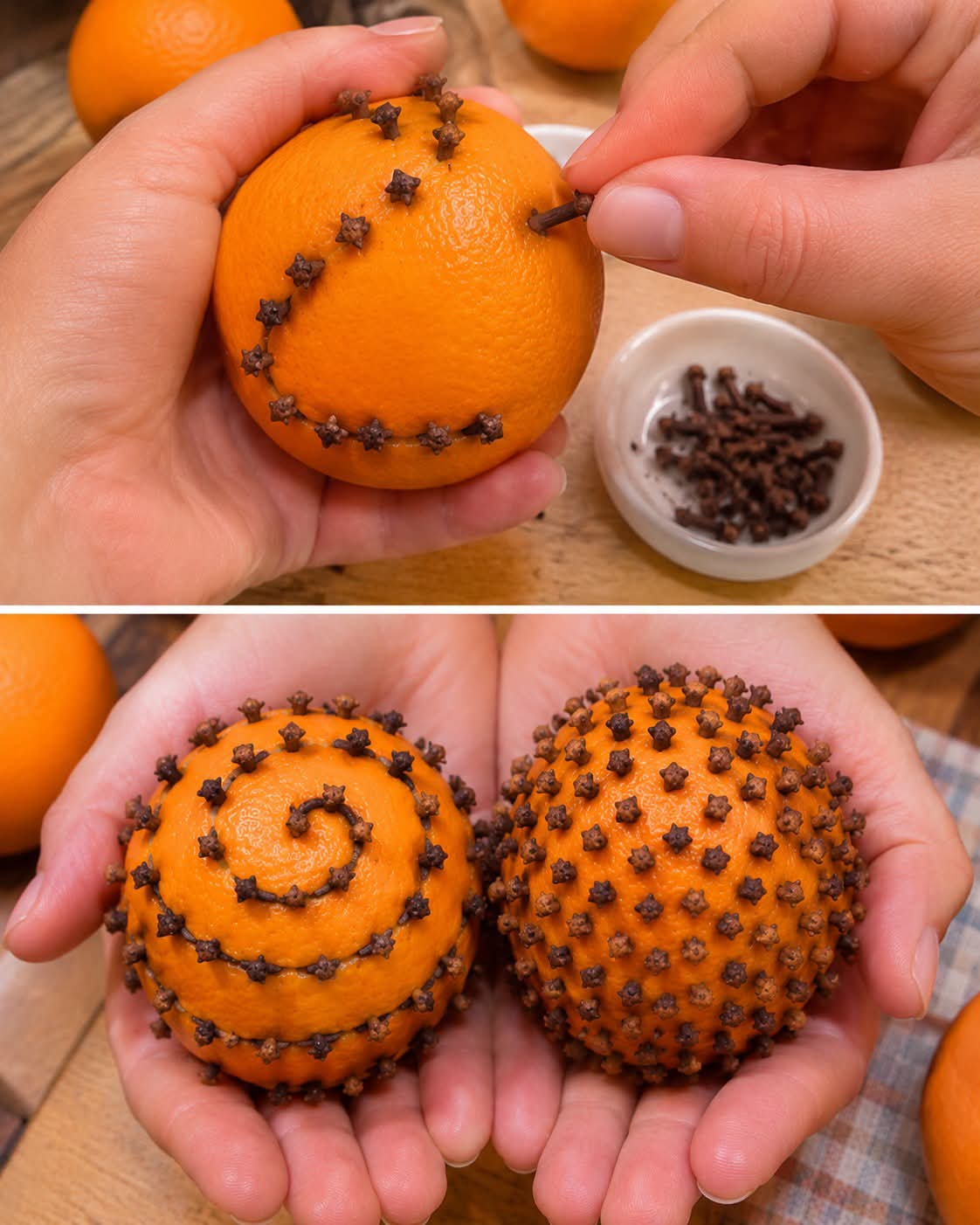
Tip: Select cloves with intact heads. Broken cloves are more difficult to insert and may not look as attractive.
Step 6: Add a Decorative Ribbon
If you plan to hang the pomander, wrap a ribbon or piece of natural twine securely around the orange.
Cross the ribbon at the bottom and tie a bow or hanging loop at the top.
Make sure the ribbon is snug enough to support the fruit.
Fresh oranges can be relatively heavy, so use a strong ribbon and a secure knot.
For long-lasting hanging decorations, drying the pomander first is preferable.
Step 7: Display Your Fresh Pomander
Your orange pomander is now ready to enjoy.
Place it in a decorative bowl or arrange it on a tray with pinecones, cinnamon sticks, and evergreen sprigs.
You can also display it as part of a Christmas centerpiece.
Fresh pomanders release a pleasant citrus-and-clove fragrance, but they are perishable.
Keep them in a cool, dry, well-ventilated place, inspect them daily, and discard them immediately if they become soft or show mold.
Important: A fresh orange pomander should be treated as a short-lived decoration, not something that can safely sit at room temperature for weeks without monitoring.
How to Dry Orange Pomanders So They Last Longer
If you want to preserve your pomanders beyond a few days, drying is the most important step.
Traditional dried pomanders gradually lose moisture until the fruit becomes smaller, lighter, and firmer.
This process can take several weeks.
Method 1: Air-Drying
- Make your pomander, ideally covering much of the orange with cloves.
- Place it on a wire rack in a cool, dry, well-ventilated location.
- Keep it away from direct moisture and humid rooms.
- Turn it regularly so air can circulate around the entire surface.
- Check frequently for soft spots or mold.
- Continue drying until the orange feels noticeably lighter, firm, and shrunken.
Typical drying time: Approximately 3–6 weeks or longer, depending on the fruit’s size, humidity, and airflow.
There is no guaranteed drying time.
In a humid environment, a whole orange may mold before it dries successfully.
Tip: Smaller oranges are generally easier to dry than very large ones.
Method 2: Traditional Spice-Coated Pomanders
Some traditional methods use additional ground spices to create a fragrant coating.
Combine:
- 2 tablespoons ground cinnamon
- 1 tablespoon ground orris root powder (optional)
Lightly roll the freshly clove-studded orange in the mixture, then place it on a drying rack.
The spices add fragrance, while orris root has traditionally been used to help retain scent.
However, neither cinnamon nor orris root guarantees preservation or prevents mold.
The pomander still needs good ventilation and thorough drying.
How Do You Know a Pomander Is Completely Dry?
A properly dried pomander should:
- Feel significantly lighter than when fresh
- Have a firm, shrunken surface
- Show no soft or wet areas
- Have no visible mold
- Smell pleasantly of citrus and cloves rather than fermentation or decay
If you notice fuzzy growth, leaking juice, or an unpleasant odor, discard the fruit.
Never attempt to save a moldy pomander by scraping off the affected area.
5 Beautiful Ways to Use Orange Pomanders at Christmas
1. Make a Rustic Christmas Centerpiece
<escape>Place several clove-studded oranges in a shallow wooden bowl.</escape>
Surround them with pinecones, cinnamon sticks, dried orange slices, and evergreen branches.
The combination of orange, brown, and green creates a timeless holiday look.
2. Hang Them on Your Christmas Tree
Fully dried, lightweight pomanders can become beautiful natural Christmas ornaments.
Tie them with red, cream, or green ribbon and hang them securely from sturdy branches.
Avoid placing fresh, heavy oranges on delicate branches.
3. Create a Holiday Table Decoration
Place one pomander at each table setting, alongside a folded napkin and a small evergreen sprig.
For a festive finishing touch, add a ribbon matching your Christmas table decorations.
4. Make a Natural Fragrant Bowl
Arrange several pomanders in a decorative bowl near your entryway or living room.
The fragrance will be more noticeable when the pomanders are fresh, while fully dried ones may retain a subtler spicy scent.
5. Give Them as Handmade Christmas Gifts
Wrap a fully dried pomander in breathable paper or place it in a small decorative box.
Add a ribbon and a handwritten note.
It’s a thoughtful, inexpensive gift inspired by an old holiday tradition.
How Long Do Orange Pomanders Last?
The lifespan depends on whether the orange is fresh or fully dried.
| Type | Expected lifespan |
|---|---|
| Fresh clove-studded orange | A short-lived decoration; inspect daily |
| Orange undergoing air drying | Several weeks of drying, with mold risk |
| Completely dried pomander | Potentially months or longer when stored properly |
These are general guidelines, not guarantees. Temperature, humidity, fruit condition, and drying success all affect how long a pomander lasts.
How to Store Dried Orange Pomanders
Once your pomander is completely dry:
- Make sure there are no soft or damp areas.
- Place it in a clean, dry container or breathable storage box.
- Store it in a cool, dry location away from direct sunlight.
- Avoid plastic bags that may trap residual moisture.
- Inspect the decoration before reusing it.
Fully dried pomanders may be stored between holiday seasons if they remain dry and mold-free.
Their fragrance may gradually weaken over time.
Common Mistakes to Avoid
1. Using overripe oranges. Soft fruit is more likely to spoil during drying.
2. Inserting cloves without making pilot holes. This can break the cloves and damage the orange unnecessarily.
3. Keeping fresh pomanders in humid rooms. Moisture increases the risk of mold.
4. Assuming cloves completely preserve the orange. Cloves do not eliminate the need for proper drying.
5. Packing pomanders away before they are fully dry. Trapped moisture can lead to spoilage during storage.
6. Placing them near candles or open flames. Dried decorations and ribbons should always be kept away from fire.
Frequently Asked Questions
Can I use mandarins instead of oranges?
Yes! Mandarins and clementines can make lovely miniature pomanders.
Their smaller size is particularly attractive for table decorations, although their delicate skins require careful handling.
Do orange pomanders attract insects?
Fresh fruit may attract fruit flies or other insects as it ages, particularly if it begins to spoil.
Keeping the decorations clean, cool, and dry helps reduce the risk.
Can I use ground cloves instead of whole cloves?
Whole cloves are essential for the traditional studded appearance.
Ground cloves can be included in a spice mixture, but they cannot replace whole cloves for decorating the fruit.
Do pomanders work as natural air fresheners?
They can add a pleasant fragrance to a small area, especially when freshly made.
However, their scent is generally subtler than that of commercial air fresheners and fades over time.
Can children make orange pomanders?
Yes, with adult supervision.
Younger children can help arrange patterns and select ribbons, while adults should handle sharp tools and assist with piercing the orange peel.
Can you eat an orange after decorating it with cloves?
Orange pomanders are intended as decorations.
Once the fruit has been pierced repeatedly, handled, displayed, or left to dry, it should not be treated as food.
Final Thoughts
Sometimes the most beautiful Christmas traditions are also the simplest.
An ordinary orange, a handful of whole cloves, and a little creativity are all you need to make a decoration that fills your home with the familiar fragrance of the holiday season.
Whether you arrange your pomanders in a rustic bowl, hang fully dried ones on your Christmas tree, or make them as handmade gifts, they bring a little old-fashioned charm into the home.
And now you know why people push cloves into oranges every Christmas: it’s a simple way to turn fresh fruit and fragrant spices into a beautiful holiday tradition.
