🥔 Here’s What Those Sprouts Really Mean
Potatoes are one of those kitchen staples that seem to last forever—until you open the pantry and discover a few with tiny eyes, long sprouts, or a slightly wrinkled appearance. 🥔👀
So when should you actually use them, trim them, or throw them away?
The answer isn’t always as simple as seeing a sprout.
🥔 What Do Potato Sprouts Mean?
Those little bumps and shoots are called eyes, and they are the points from which a potato can grow a new plant.
When potatoes are stored for a long time, especially in warm or light conditions, the eyes can begin producing sprouts.
A potato with a couple of small, short sprouts isn’t automatically spoiled.
If the potato is still firm and otherwise looks normal, you can generally cut away the sprouts and the surrounding eyes before cooking.
But there’s an important distinction between a potato that’s simply beginning to sprout and one that’s showing multiple signs of deterioration.
🌱 What About Potatoes With Long Sprouts?
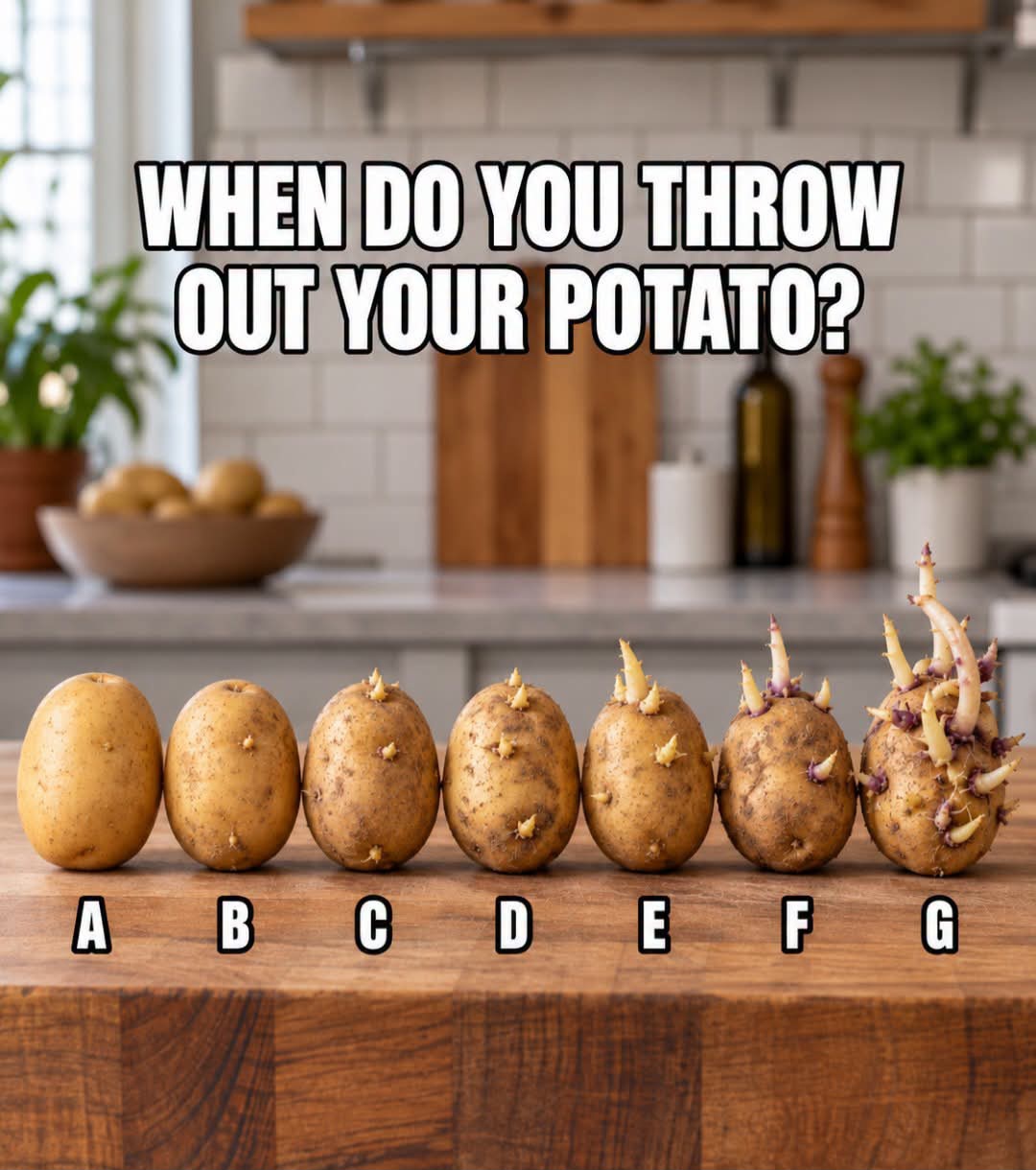
The potatoes in the picture provide a perfect example of how sprouting can progress.
You can see a gradual change from potatoes with barely visible eyes to potatoes covered with increasingly long shoots.
As sprouting progresses, the potato may become:
- Soft or noticeably limp
- Wrinkled
- Shriveled
- Green
- Bitter-tasting
- Covered with extensive sprouts
At that point, it’s better to discard it rather than trying to rescue every last bit.
💚 What If the Potato Is Green?
Green coloration deserves special attention.
Potatoes can develop green areas when exposed to light. The green color comes from chlorophyll, but green potatoes can also have increased levels of glycoalkaloids such as solanine and chaconine.
These compounds can cause illness when consumed in sufficiently high amounts.
A small green area on an otherwise firm potato can sometimes be removed generously, but if a potato is extensively green, very bitter, heavily sprouted, or otherwise deteriorated, discarding it is the safer choice.
And don’t taste a questionable potato to decide whether it’s safe.
👀 What About Those Tiny Eyes?
A few small eyes don’t necessarily mean your potato belongs in the trash.
If the potato is:
✅ Firm
✅ Not green
✅ Free of significant mold or decay
✅ Not leaking
✅ Not unusually soft or shriveled
you can remove the eyes and sprouts generously and prepare the potato normally.
The important thing is to inspect the whole potato, not just the sprout.
🚨 When Should You Definitely Throw It Out?
It’s time to let the potato go when you notice significant deterioration.
Throw it away if it is:
Very soft or mushy
A little loss of firmness can happen during storage, but a potato that feels mushy or badly decomposed shouldn’t be used.
Moldy or rotting
Visible mold, wet decay, leaking, or an unpleasant smell are good reasons to discard it.
Heavily green
Especially when the green coloration is extensive.
Extremely shriveled
A severely dehydrated potato with a poor texture isn’t worth trying to salvage.
Covered in extensive sprouts
A heavily sprouted, deteriorating potato is better discarded.
🧺 How Should You Store Potatoes?
Proper storage can dramatically slow sprouting.
Keep potatoes in a:
- Cool location
- Dark location
- Dry environment
- Well-ventilated container or bag
A paper bag, cardboard box, basket, or breathable storage container can work well.
Avoid storing potatoes where sunlight can reach them, because light encourages greening.
And don’t wash potatoes before storing them. Extra moisture can encourage spoilage.
🧊 Should You Keep Potatoes in the Refrigerator?
For ordinary home storage, potatoes are generally better kept in a cool, dark, dry, well-ventilated place rather than simply putting them in the refrigerator.
If your home is very warm, finding the coolest suitable storage area can help extend their life.
🍎 Keep Potatoes Away From Onions
Potatoes and onions may look like natural pantry companions, but storing them together isn’t ideal.
Both release gases that can contribute to faster deterioration of the other, so keeping them in separate storage areas is a simple way to help them last longer.
🥔 Can Sprouted Potatoes Be Planted?
Here’s the fun part!
A potato that’s no longer appealing for the dinner table may still be useful in the garden if it is healthy enough to plant.
Potatoes with developed eyes and sprouts can sometimes be used as seed potatoes, provided they’re appropriate for planting and free from signs of disease or rot.
You can even cut larger seed potatoes into pieces, making sure each piece has viable eyes, and plant them under suitable conditions.
That means a potato heading toward the end of its kitchen life doesn’t necessarily have to become garbage.
It might become next season’s harvest. 🌱🥔
♻️ Don’t Let Food Waste Make the Decision for You
There’s a temptation to either throw away every potato that develops a tiny sprout or, at the other extreme, keep potatoes far beyond the point where they’re worth eating.
The better approach is to inspect them individually.
A firm potato with a couple of small eyes is very different from a soft, moldy, heavily green potato covered in long sprouts.
Use your eyes, hands, and common sense—and when a potato is clearly deteriorating, don’t take chances.
🥔 So Which Potato in the Picture Would You Throw Out?
Looking at the progression from A through G, the potatoes go from barely sprouted to heavily sprouted.
That’s exactly why this makes such a fun kitchen question:
At what point would YOU stop eating it?
Would you use A, B, C, D, or E?
Would F make you hesitate?
Or would G go straight into the compost or trash? 😂🥔
There isn’t necessarily one visual cutoff that applies perfectly to every potato—the potato’s firmness, color, mold, decay, and overall condition matter too.
👇 Let’s settle the great potato debate!
A — No problem!
B — Still good!
C — I’d trim it!
D — Maybe…
E — Probably not!
F — Too far gone!
G — Absolutely not!
Which letter would make you throw your potato away? 🥔👇
