🥚 Remember When Pantyhose Came in an Egg?
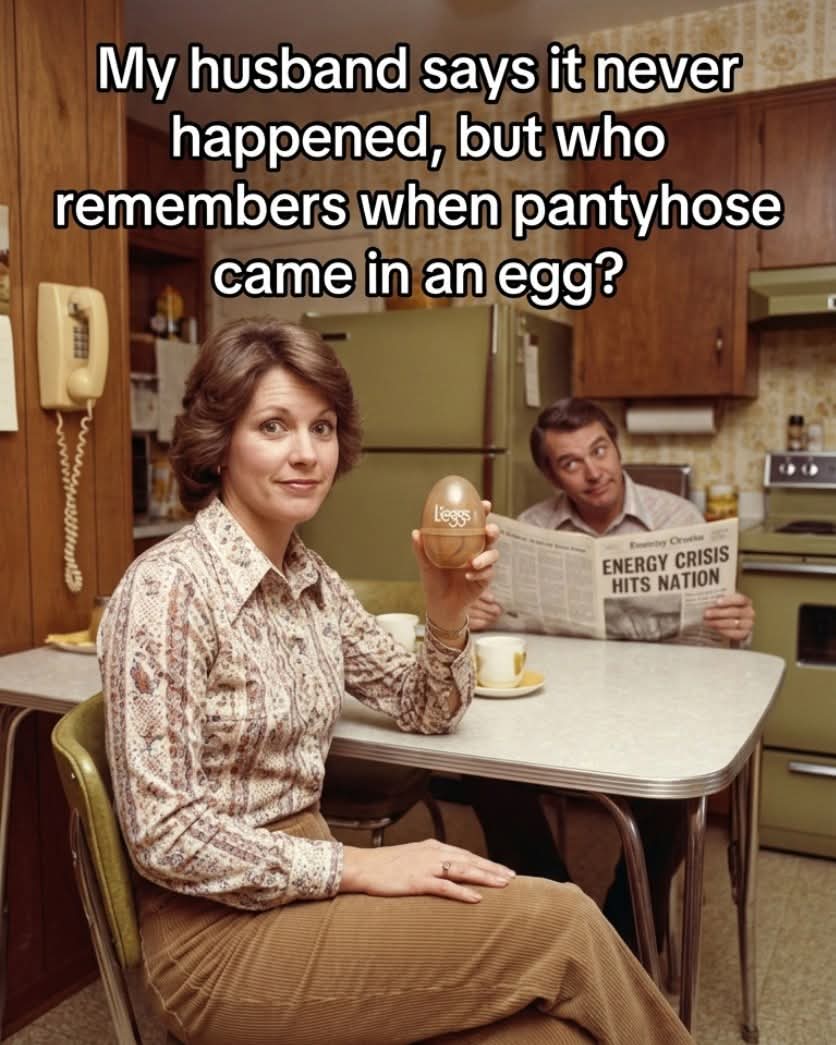
“My husband says it never happened, but who remembers when pantyhose came in an egg?” 😂
If you grew up shopping for clothes and household necessities in the 1970s or 1980s, you may remember walking through a grocery store or drugstore and seeing something that looked completely out of place:
Plastic eggs filled with pantyhose.
And no, you weren’t imagining it.
The famous L’eggs brand really did package pantyhose in distinctive egg-shaped plastic containers. The concept was introduced by Hanes in the late 1960s and became widely available in stores by the early 1970s. (Cooper Hewitt Smithsonian Design Museum)
🥚 What Was Inside the Egg?
Instead of opening a conventional box or package, shoppers would pick up an egg-shaped container and discover a pair of rolled-up pantyhose inside.
The packaging was one of the most recognizable retail designs of its era.
Before L’eggs, pantyhose were commonly packaged in flat boxes or packages with cardboard inserts. L’eggs completely changed the presentation by putting the hosiery inside a plastic egg. (Warc)
The egg wasn’t just a cute gimmick.
It was part of a much bigger idea: make pantyhose easy to find where women were already shopping.
🛒 Why Were Pantyhose Being Sold at the Grocery Store?
Today it might seem perfectly normal to find clothing accessories at a supermarket or drugstore.
But that wasn’t always the case.
Hanes recognized that women were already spending time shopping for groceries and household necessities. Why make them visit a department store just to buy pantyhose?
So L’eggs brought hosiery into supermarkets, drugstores, convenience stores, and other everyday shopping locations. (Warc)
And the unusual egg-shaped package made the product incredibly easy to spot.
💡 How Did Someone Come Up With the Egg?
The story behind the packaging is almost as memorable as the package itself.
Designer Roger Ferriter was working on a new way to package the hosiery. According to accounts of the company’s history, he crumpled up a pair of the unboarded pantyhose in his hand and noticed that the bundle resembled an egg.
That simple observation sparked the idea.
The name L’eggs cleverly played on the words “legs” and “eggs,” while the egg-shaped container completed the concept. (Warc)
It was a remarkably simple idea that became an iconic piece of packaging design.
🥚 The Egg Was Everywhere
For women shopping during the 1970s and 1980s, the L’eggs egg became a familiar sight.
The packages were often displayed on special revolving racks known as L’eggs Boutiques.
Instead of blending into a shelf full of rectangular boxes, the eggs stood out.
The packaging was so distinctive that shoppers could recognize the product from across the store.
The Smithsonian’s Cooper Hewitt collection even includes an original L’eggs package, describing its distinctive plastic dome and cardboard collar. (Smithsonian Institution)
👗 Why Were Pantyhose Such a Big Deal?
It’s difficult to appreciate just how important pantyhose were to everyday fashion several decades ago.
Women frequently wore dresses and skirts to work, church, school events, parties, and other occasions where bare legs weren’t necessarily considered appropriate.
Pantyhose offered a smooth, polished look and became a standard part of many women’s wardrobes.
The rise of the miniskirt and changing fashion trends also helped drive demand for pantyhose during this period. (The Washington Post)
So having an inexpensive pair available during an ordinary shopping trip was genuinely convenient.
😂 And Then There Was the Egg Itself
Here’s the part many people remember most.
You didn’t necessarily throw the egg away.
Once the pantyhose were removed, that little plastic container could become something else entirely.
People reused them for:
- Craft projects
- Small-item storage
- Children’s toys
- Decorations
- Holiday crafts
- Sewing supplies
- Miscellaneous household odds and ends
The unusual container had a life beyond the product inside it.
Even TIME noted in 1991 that the plastic eggs were often reused for arts and crafts. (TIME)
🧵 The Ultimate Childhood Craft Supply
If you grew up during the era, you may remember those plastic eggs appearing in craft boxes long after the pantyhose were gone.
They were the perfect size for little projects.
A few pieces of construction paper, some glue, paint, yarn, and an empty L’eggs egg could become almost anything a creative child could imagine.
And that’s one reason this particular piece of packaging has such strong nostalgic appeal.
It wasn’t simply a container.
It became part of the household.
📦 What Happened to the Plastic Eggs?
Eventually, the famous plastic packaging disappeared.
In 1991, L’eggs announced that it was moving away from the plastic egg and switching to an all-cardboard package. The company cited waste reduction and the greater efficiency of the new packaging. TIME reported that the new package used 38% less material and incorporated recycled paper. (TIME)
Contemporary reporting also noted that the plastic egg was expected to disappear from stores by 1992. (Los Angeles Times)
And just like that, something that had been a familiar sight for more than two decades began disappearing from grocery and drugstore shelves.
🕰️ A Tiny Piece of Retail History
The L’eggs egg is a great example of how packaging can become part of popular culture.
The product itself was useful.
The egg made it memorable.
The distinctive shape helped shoppers find it.
And the fact that it could be reused gave the package a second life.
The design became so recognizable that decades later, people still see an egg-shaped container and immediately think:
“L’eggs!”
❤️ Do You Remember Them?
Now comes the nostalgia question.
Did your mom buy pantyhose in the plastic egg?
Maybe you remember seeing them on those rotating displays.
Maybe you remember choosing the color.
Maybe you remember opening the egg.
Maybe you remember playing with the empty container afterward.
Or maybe you’re like the husband in the picture and your official position is:
“That never happened.” 😂
But history says otherwise.
The L’eggs egg was real, and it really did become a familiar sight in American supermarkets and drugstores during the 1970s and 1980s. (Cooper Hewitt Smithsonian Design Museum)
🥚 Tell Us Your Memory!
Did you remember pantyhose coming in these eggs?
And the more important question:
What did you do with the empty egg afterward? 😂
Did you save them for crafts?
Use them for storage?
Give them to the kids?
Or did your mother have a drawer full of them because “you never know when they’ll come in handy”?
Tell us what you remember! 👇🥚👗
Historical note: L’eggs was introduced by Hanes in 1969, with the distinctive egg packaging reaching national availability around 1971. The plastic egg was later replaced by cardboard packaging in the early 1990s. (Cooper Hewitt Smithsonian Design Museum)
