🥚👀
A, B, or C?
At first glance, this looks like a simple little kitchen quiz. Drop three eggs into water and see where they end up.
But there’s actually some science behind what you’re seeing—and there’s also an important detail that many versions of this viral trick leave out.
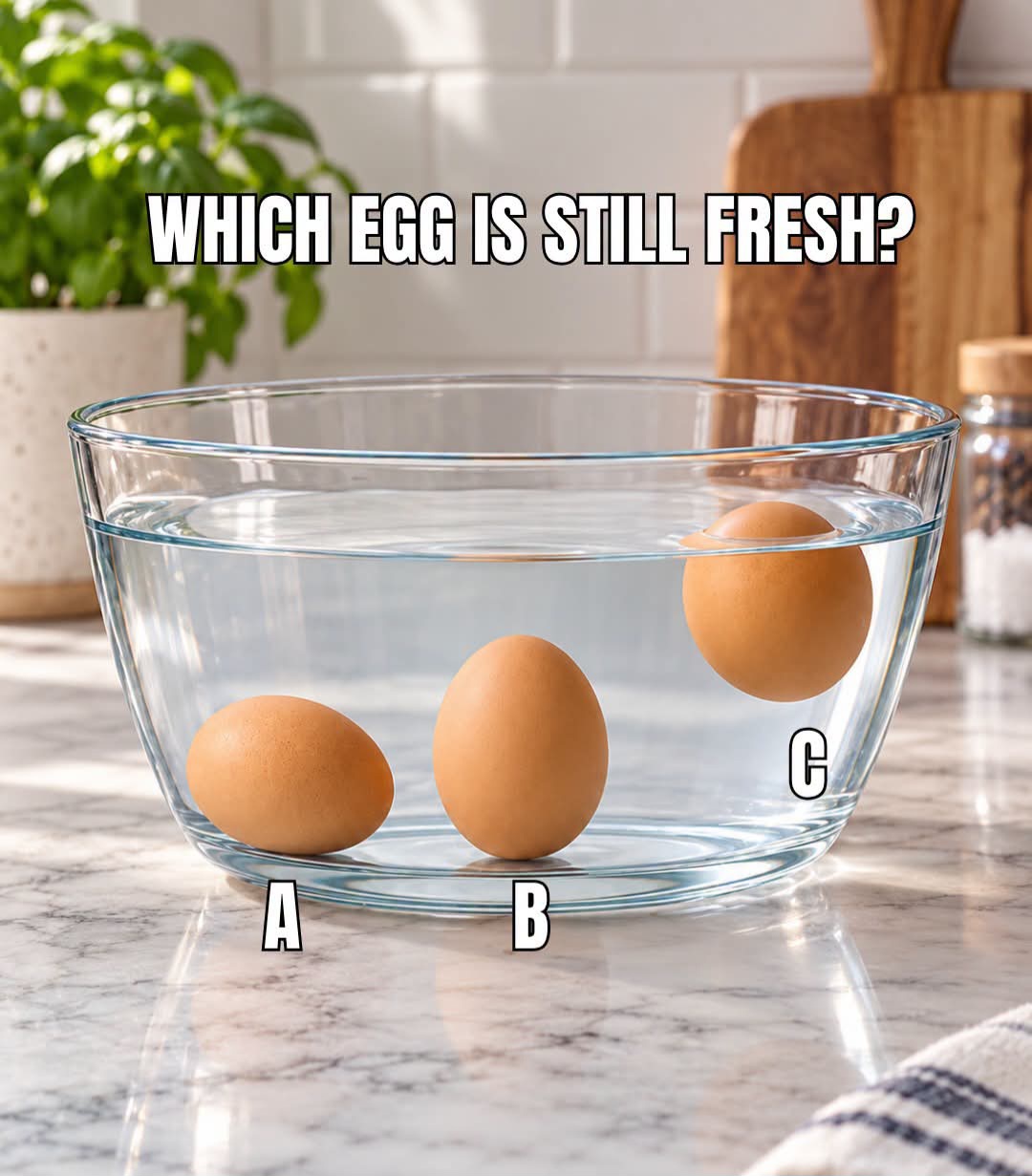
My guess from the picture? 🥚 A!
Egg A is lying flat on the bottom, which traditionally indicates the freshest egg of the three. Egg B is standing more upright, suggesting it’s older, while C is floating near the surface, indicating an even larger air cell and an older egg. (Ask USDA)
But here’s the interesting part:
Older doesn’t automatically mean unsafe.
🥚 Why Do Eggs Float?
The explanation has to do with something inside the shell called the air cell.
When an egg is laid, its air cell is relatively small.
As the egg ages, moisture and gases gradually move through the shell, and the air cell becomes larger.
That larger air space makes the egg increasingly buoyant.
Eventually, the egg can float.
So the classic idea is:
🥚 A — Lays flat
Very fresh
🥚 B — Stands upright
Older
🥚 C — Floats
Older still
The USDA explains that an egg can float because its air cell has enlarged enough to make it buoyant. However, USDA specifically notes that this indicates quality/age rather than automatically proving the egg is spoiled. (Ask USDA)
🥚 A: The Flat Egg
This is the one I’d pick if the question is simply:
“Which egg is the freshest?”
A is sitting flat against the bottom.
That’s the classic sign of a younger egg with a smaller air cell.
And there’s another interesting way to judge freshness once an egg is cracked.
USDA notes that a cloudy egg white is actually a sign of a very fresh egg, while a clearer white indicates that the egg is aging. (Ask USDA)
So don’t automatically assume that a crystal-clear egg white means something is wrong.
Sometimes it simply means the egg isn’t as fresh as it once was.
🥚 B: The Egg Standing Upright
Now we have the middle option.
Egg B is standing on its end at the bottom.
That’s generally associated with an older egg.
As the air cell gets larger, the egg becomes more buoyant and can gradually shift from lying flat to standing upright.
But here’s where things get important:
Older ≠ spoiled.
An egg can be past its peak freshness and still be usable.
That’s why the water test should be treated as a rough age/freshness clue, not a definitive food-safety test.
If you’re unsure about an egg, don’t rely on its position in water alone.
🥚 C: The Floating Egg
And then there’s the dramatic one.
C is floating. 😂
This is the egg that usually makes people say:
“NOPE. THROW IT OUT!”
But that’s not quite what the science says.
According to USDA, an egg floats when its air cell has become large enough to make it buoyant. That means the egg is older and of lower quality, but the floating test by itself does not establish that the egg is unsafe. (Ask USDA)
If you’re evaluating an older egg, crack it into a separate bowl and check for an unusual appearance or unpleasant odor rather than assuming that floating automatically means spoilage.
A spoiled egg can have a very obvious unpleasant smell once cracked.
🚨 The Water Test Has a Big Limitation
This is probably the most important part of the whole article.
The water test tells you something about the age of an egg.
It does not give you a perfect safety test.
Eggs can potentially contain Salmonella, even when they look normal. USDA recommends proper refrigeration, careful handling and thorough cooking rather than relying on appearance alone. (Ask USDA)
So don’t think:
“It sank, therefore it’s guaranteed safe.”
That’s not how food safety works.
🧊 How Should You Store Eggs?
Keeping eggs properly refrigerated is much more important than performing a floating test every time you want breakfast.
USDA recommends buying eggs from a refrigerated case, choosing clean and uncracked shells, and refrigerating them promptly after purchase. It also recommends storing shell eggs in their carton on a refrigerator shelf rather than in the door, where temperatures fluctuate more. (Ask USDA)
That little carton is doing more work than you might think.
It helps protect the eggs and keeps their dates and identification information together.
🍳 And What About Cooking Them?
Whether you’re making:
🍳 Fried eggs
🥚 Scrambled eggs
🥚 Omelets
🥚 Hard-boiled eggs
🥧 Quiche
🍰 Cakes and baked goods
proper handling still matters.
USDA recommends cooking egg dishes to 160°F (71°C) and cooking eggs thoroughly. For dishes containing eggs, a food thermometer is the most reliable way to verify the temperature. (Ask USDA)
So that beautiful runny yolk might be delicious to many people, but if you’re prioritizing food safety, follow the appropriate cooking guidance rather than using the water test to decide whether an egg is safe.
🤯 Here’s the Fun Part
The image makes the answer look incredibly simple:
A = fresh
B = older
C = oldest
And as a traditional freshness demonstration, that’s the basic idea.
But the real lesson is more interesting.
Your egg can change physically as it ages without immediately becoming rotten.
The air cell gets larger.
The egg becomes more buoyant.
The white becomes clearer.
The egg’s internal quality changes.
And eventually, if spoilage occurs, you’ll have additional warning signs.
It’s a great example of how something as ordinary as an egg has a surprisingly interesting little science experiment happening inside it.
🥚 So What’s Your Final Answer?
If the question is:
“Which egg is the freshest?”
👀 My pick is A — the egg lying flat on the bottom.
If the question is:
“Which egg is definitely safe to eat?”
The water test can’t answer that by itself.
That’s where proper storage, handling, dates, inspection and cooking practices come in. (Ask USDA)
So next time someone tells you:
“If it floats, it’s bad!”
you can tell them there’s a little more to the story. 😄
🥚👀 YOUR TURN!
Which one did you choose before reading the explanation?
A, B, or C?
And be honest…
