🧈😳 — What Would You Do?
Some kitchen habits are harmless little quirks.
Others make you stop mid-recipe and think, “Wait… did I just see that?” 👀
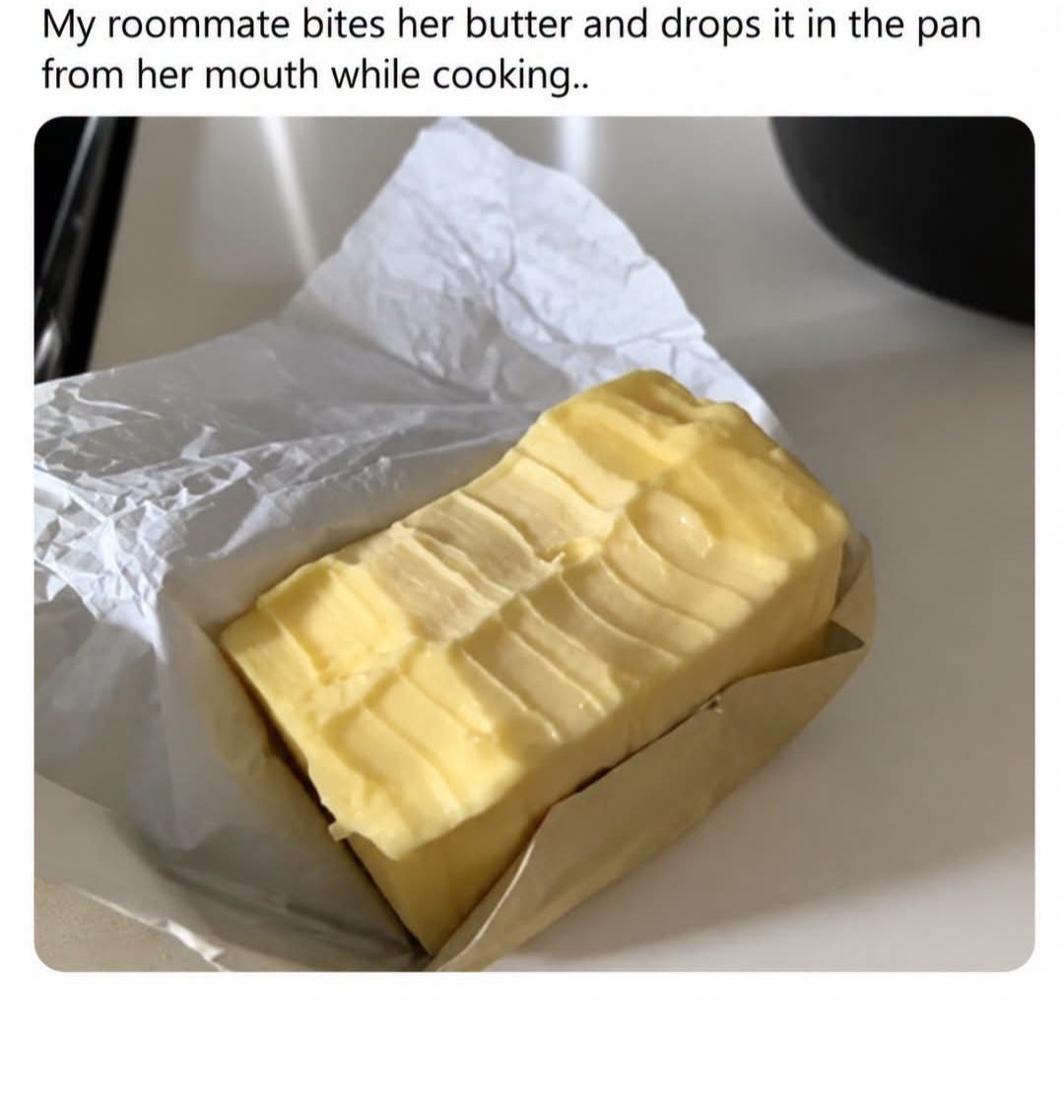
A perfect example is the situation shown here: a roommate takes a piece of butter, bites it directly, and then drops the butter back into the pan while cooking.
For some people, that’s an instant “absolutely not!”
For others, the thought is simply: It’s going into a hot pan anyway, so what’s the big deal?
But when you’re sharing a kitchen, this isn’t really just about butter. It’s about food hygiene, shared ingredients, and respecting other people’s boundaries.
🧈 Would You Eat It?
Imagine you’re making dinner together.
Your roommate unwraps a stick of butter, takes a bite directly from it, and then puts the butter into the skillet.
You watch it happen.
Would you:
A. Say something immediately
B. Quietly throw the butter away
C. Let it go because it’s going into a hot pan
D. Ask them to use a clean utensil next time
E. Suddenly lose your appetite 😂
There isn’t much room for subtlety when someone has literally taken a bite out of a shared ingredient.
🦠 Why Is It a Hygiene Issue?
Our mouths naturally contain bacteria and other microorganisms. When someone bites directly into a food item and returns it to a shared container, microorganisms from their mouth can potentially be transferred to the food.
That doesn’t mean the butter is automatically dangerous after one bite. The actual risk depends on factors such as the person’s health, how the food is handled, storage conditions, and whether the food is subsequently cooked thoroughly.
Still, putting food that has been in someone’s mouth back into a shared ingredient isn’t considered good food-handling practice.
And there’s an important distinction:
What if the butter is going into a very hot pan?
Cooking can destroy many harmful microorganisms, depending on the food, temperature, and amount of time involved.
So if the butter is immediately melted into a thoroughly cooked dish, the situation isn’t necessarily equivalent to eating the contaminated butter cold.
But that doesn’t make the habit hygienic.
And what if the person takes a bite and puts the butter back in the refrigerator?
Now you’ve got a completely different situation.
That butter may later be spread on toast, used in baking, or eaten without cooking.
🧈 There’s Also a Shared-Food Problem
Even if you aren’t particularly worried about germs, there’s another issue: it’s shared food.
If the butter belongs to the household, everyone using it should reasonably expect that it has been handled hygienically.
The same principle applies to:
- Jars of peanut butter
- Jams and preserves
- Cream cheese
- Cheese blocks
- Ice cream
- Sauces
- Dips
- Leftovers
- Shared snacks
Taking a bite and putting the food back isn’t considerate when other people are going to eat it.
🤔 What Would You Say?
If this were your roommate, you don’t necessarily need to turn it into a huge argument.
A simple:
“Hey, could you please use a knife or spoon instead of biting the butter? We’re both using it.”
gets the point across without making the situation unnecessarily dramatic.
If you’re particularly concerned about contamination, you could simply suggest:
“Let’s use a clean piece of butter for the pan and keep the other one separate.”
Sometimes people genuinely don’t realize that a habit that seems normal to them bothers someone else.
🍳 What About Butter Already in the Pan?
If you discover that someone has bitten the butter and immediately put it into a dish that is still being thoroughly cooked, the situation is different from discovering that they bit the butter and returned it to the refrigerator.
If the food is going to be cooked thoroughly, many microorganisms introduced during handling may be reduced or destroyed by the cooking process.
However, you can’t assume that cooking always makes every food-handling mistake completely risk-free.
And if the food is being served to someone particularly vulnerable to foodborne illness—such as a pregnant person, young child, older adult, or someone with a weakened immune system—it’s reasonable to be more cautious.
🧼 A Better Kitchen Rule
A simple household rule can prevent a lot of awkward conversations:
If it touches your mouth, don’t put it back into shared food.
Use a clean knife, spoon, fork, or separate portion instead.
It’s especially important for foods that are going to be eaten without further cooking.
That tiny habit makes a shared kitchen much more hygienic.
🏠 The Roommate Factor
Living with someone means you’ll inevitably discover habits you never knew existed.
Maybe they leave cabinet doors open.
Maybe they put empty containers back in the refrigerator.
Maybe they use the last paper towel and don’t replace the roll.
And apparently, maybe they bite the butter. 😂
Some habits are merely annoying.
Others involve food hygiene and are worth addressing directly.
The key is to focus on the behavior rather than insulting the person.
Instead of:
“That’s disgusting!”
try:
“Could you please not bite food that we’re both going to use? I’d really appreciate it.”
It’s much easier to have a productive conversation that way.
🧈 So… What Would YOU Do?
If you walked into the kitchen and saw your roommate take a bite out of the butter before dropping it into the pan, what would your reaction be?
👀 A. “Absolutely not!”
🧈 B. I’d tell them to use a clean utensil.
🍳 C. If it’s going into a hot pan, I’d let it go.
😳 D. I’d quietly use a different stick of butter.
😂 E. I’d pretend I never saw it.
Be honest—what are you doing in this situation? 👀🧈
