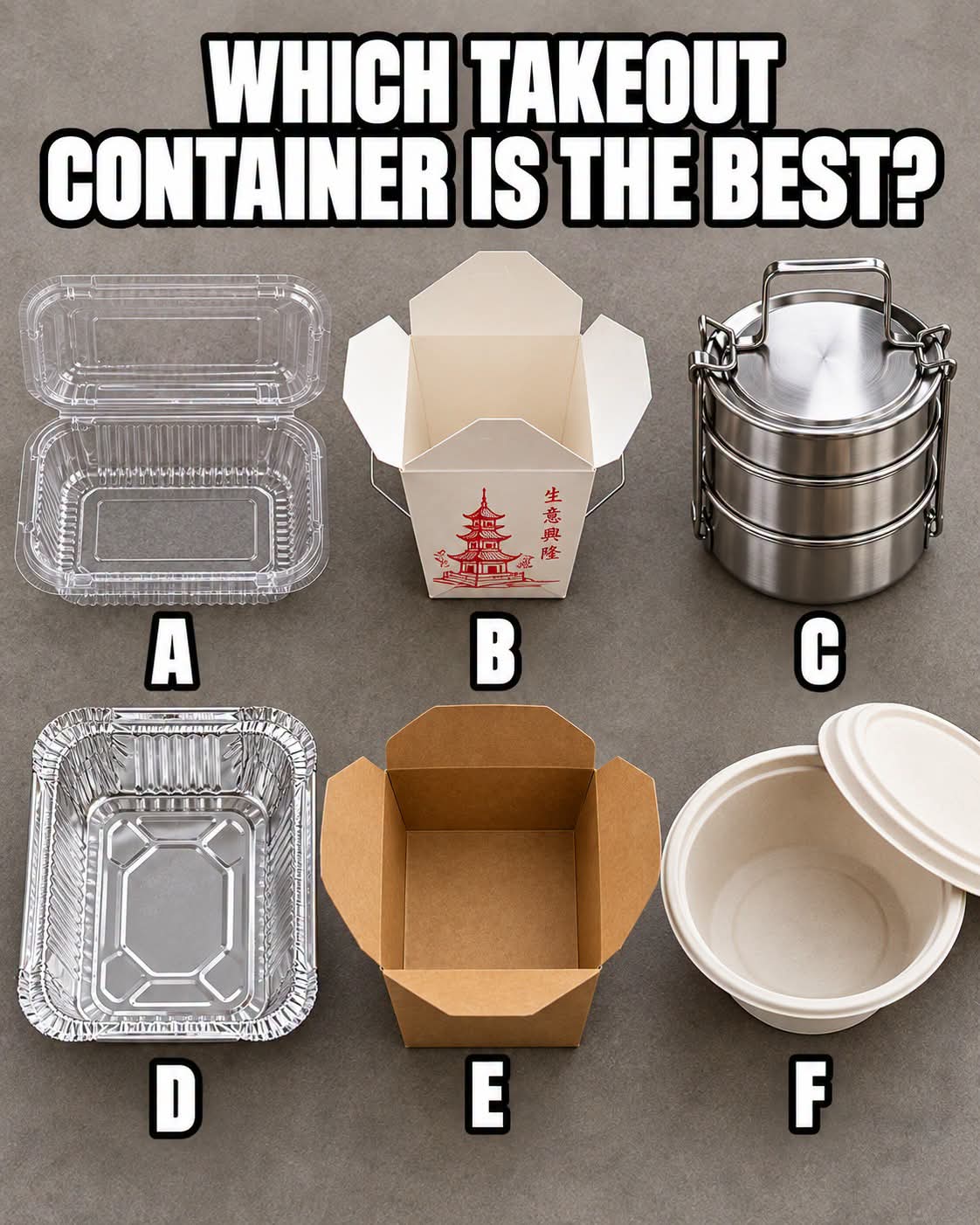
🍱 Which Takeout Container Is the Best? Let’s Settle the Debate!
Takeout food has become part of everyday life. Whether you’re bringing home Chinese food, packing leftovers from a restaurant, grabbing a quick lunch, or saving dinner for tomorrow, the container matters more than we sometimes realize. 😋
And looking at these six options, there’s a surprisingly important question:
Which takeout container would you choose? 👀
You’ve got everything from lightweight plastic to sturdy stainless steel, traditional paper boxes, aluminum trays, and reusable bowls.
But each one has its own strengths—and its own drawbacks.
Let’s break them down!
🅰️ A — The Clear Plastic Container
This is one of the most familiar takeout containers.
It’s lightweight, inexpensive, and you can immediately see what’s inside without opening the lid.
👍 Why people like it
- You can see the food easily
- Lightweight and convenient
- Stackable
- Usually has a secure snap-on lid
- Great for leftovers
- Easy to put in the refrigerator
The transparent design is especially convenient when you’ve forgotten what you put in the fridge three days ago. 😂
Just open the refrigerator, look at the containers, and there it is.
🍜 Best suited for:
Salads, noodles, cold foods, leftovers, fruit, sandwiches, and many other takeout dishes.
For hot foods, however, it’s important to follow the manufacturer’s instructions because not every plastic container is designed for reheating.
🅱️ B — The Classic Chinese Takeout Box
Few containers are as recognizable as this little folded paperboard box. 🥡
It’s compact, lightweight, and has become an iconic part of American takeout culture.
The folding design is clever because the box can be transported without needing a separate plastic container in many cases.
👍 Why people like it
- Lightweight
- Easy to carry
- Disposable
- Convenient for noodles and rice dishes
- Familiar and nostalgic
- Takes up relatively little space
And there’s something satisfying about opening one of these and finding a pile of noodles inside.
🍜 Best suited for:
Noodles, fried rice, stir-fries, and other foods that aren’t excessively wet.
It’s also one of those containers that immediately makes food feel like takeout.
🅲 C — The Stainless-Steel Tiffin
Now we’re getting serious. 😎
The stainless-steel tiered container is designed for repeated use rather than being thrown away after one meal.
Its stacked compartments can be especially useful when you want to keep different foods separate.
👍 Why people like it
- Durable
- Reusable
- Doesn’t absorb food odors as easily as some materials
- Separate compartments can keep foods apart
- Excellent for packed lunches
- Built to be used repeatedly
And let’s be honest—the stacked design looks pretty impressive.
Instead of one container full of everything, you can have rice in one section, vegetables in another, and a main dish somewhere else.
🍛 Best suited for:
Packed lunches, meal prep, rice dishes, curries, vegetables, and anyone trying to reduce their dependence on disposable containers.
The downside?
It’s heavier than plastic or paper, and you’ll have to wash it after every use.
🅳 D — The Aluminum Takeout Tray
The aluminum tray is another classic.
You’ve probably seen these at family gatherings, restaurants, catering events, or when someone sends you home with enough food to feed an entire neighborhood. 😂
👍 Why people like it
- Lightweight
- Rigid enough to hold substantial food
- Excellent for baked dishes
- Convenient for large portions
- Can often go from preparation to serving
They’re particularly useful for foods that need to stay contained during transport.
🍝 Best suited for:
Lasagna, baked pasta, roasted foods, casseroles, grilled meats, and larger portions.
But aluminum containers aren’t automatically suitable for every appliance or food. Always check the manufacturer’s instructions before putting one in an oven, microwave, or other heating appliance.
🅴 E — The Kraft Paper Food Box
The brown kraft-paper container has become increasingly common, especially for modern restaurants and food-delivery businesses.
It has a simple, natural appearance and can feel a little more upscale than a basic plastic container.
👍 Why people like it
- Lightweight
- Easy to transport
- Simple appearance
- Convenient for many dry or moderately moist foods
- Often made from paperboard
It also photographs well.
You know the food is about to look good when it arrives in one of these. 📸😂
🍔 Best suited for:
Fried foods, sandwiches, rice dishes, noodles, snacks, and foods where you want a disposable paperboard container.
Again, not every paper container is designed for every kind of food or heating method, so check the packaging.
🅵 F — The Reusable Bowl
Simple.
Classic.
Practical.
The reusable bowl is especially useful when you’re bringing food home and don’t actually need a traditional “takeout” container.
👍 Why people like it
- Reusable
- Easy to clean
- Good for soups and saucy foods
- Great for leftovers
- Can often be used for serving as well as storage
And unlike a paper box, a proper reusable bowl can become part of your everyday kitchen routine.
🍲 Best suited for:
Soups, stews, curries, pasta, leftovers, oatmeal, salads, and other foods that benefit from a deeper container.
🥡 It’s Not Really About One “Best” Container
Here’s the interesting part.
There isn’t one container that’s perfect for every situation.
The best choice depends on what you’re carrying, how long you’re storing it, whether you’re reheating it, and whether you want something disposable or reusable.
For example:
🍜 Noodles?
A paper takeout box can be incredibly convenient.
🍲 Soup?
A sturdy, leak-resistant reusable bowl makes much more sense.
🍝 Lasagna?
An aluminum tray is extremely practical.
🥗 Salad?
A clear container lets you see exactly what’s inside.
🍛 Packed lunch?
A stainless-steel tiffin can keep different foods separated.
🍔 Fried food?
A ventilated paper container can help prevent some foods from becoming excessively soggy from trapped steam.
♻️ What About Reusability?
This is where the debate gets interesting.
Disposable containers are convenient because you don’t have to wash them.
But reusable containers can be used again and again, potentially reducing the amount of single-use packaging you throw away.
Of course, the environmental impact of a container depends on factors including the material, manufacturing process, transportation, cleaning, and how many times a reusable container is actually reused.
So the simple equation of “reusable always equals better” doesn’t tell the whole story.
What matters in everyday life is choosing a container that fits the job and actually using reusable products repeatedly when you choose them.
🧊 And Then There’s the Leftover Test
This might be the most important test of all.
You’ve finished dinner.
You’re full.
There’s still enough food left for tomorrow.
What do you want?
A container that:
✔️ closes securely
✔️ doesn’t leak
✔️ fits comfortably in the refrigerator
✔️ keeps the food contained
✔️ is easy to clean
Suddenly, container design becomes extremely important. 😂
Nobody wants to open the refrigerator and discover that yesterday’s curry has somehow escaped its container.
🔥 Don’t Forget the Heating Instructions
One of the biggest mistakes people make with takeout containers is assuming that every container can go straight into the microwave or oven.
They can’t.
Plastic, paperboard, aluminum, and reusable containers can have very different heat limitations.
Before reheating food, check the container’s labeling or transfer the food to a dish specifically intended for the appliance you’re using.
And if the restaurant tells you to remove the lid before reheating, remove the lid.
Five seconds of checking can save you a very unpleasant kitchen cleanup. 😅
🏆 The Real Takeout Container Challenge
So, if these six containers were sitting in front of you, what would you choose?
🥡 A — Clear plastic
🍜 B — Classic paper takeout box
🍱 C — Stainless-steel tiffin
🍝 D — Aluminum tray
📦 E — Kraft paper box
🍲 F — Reusable bowl
Each one has a different personality.
The clear container says:
“I need to know exactly what’s in my fridge.” 😂
The paper takeout box says:
“This is officially takeout night.”
The stainless-steel tiffin says:
“I came prepared.”
The aluminum tray says:
“There is enough food here for everyone.”
The kraft box says:
“Let’s make this meal look fancy.”
And the reusable bowl says:
“I’ll be eating these leftovers tomorrow.”
❤️ Final Thought
A takeout container might seem like a tiny part of a meal, but it’s actually doing an important job: protecting the food, making it easier to transport, and sometimes helping preserve its texture and temperature.
The perfect container isn’t necessarily the fanciest one.
It’s the one that works for your food, your situation, and your routine.
So now we need to settle the debate…
👀 Which one are you choosing?
A, B, C, D, E, or F?
And more importantly:
