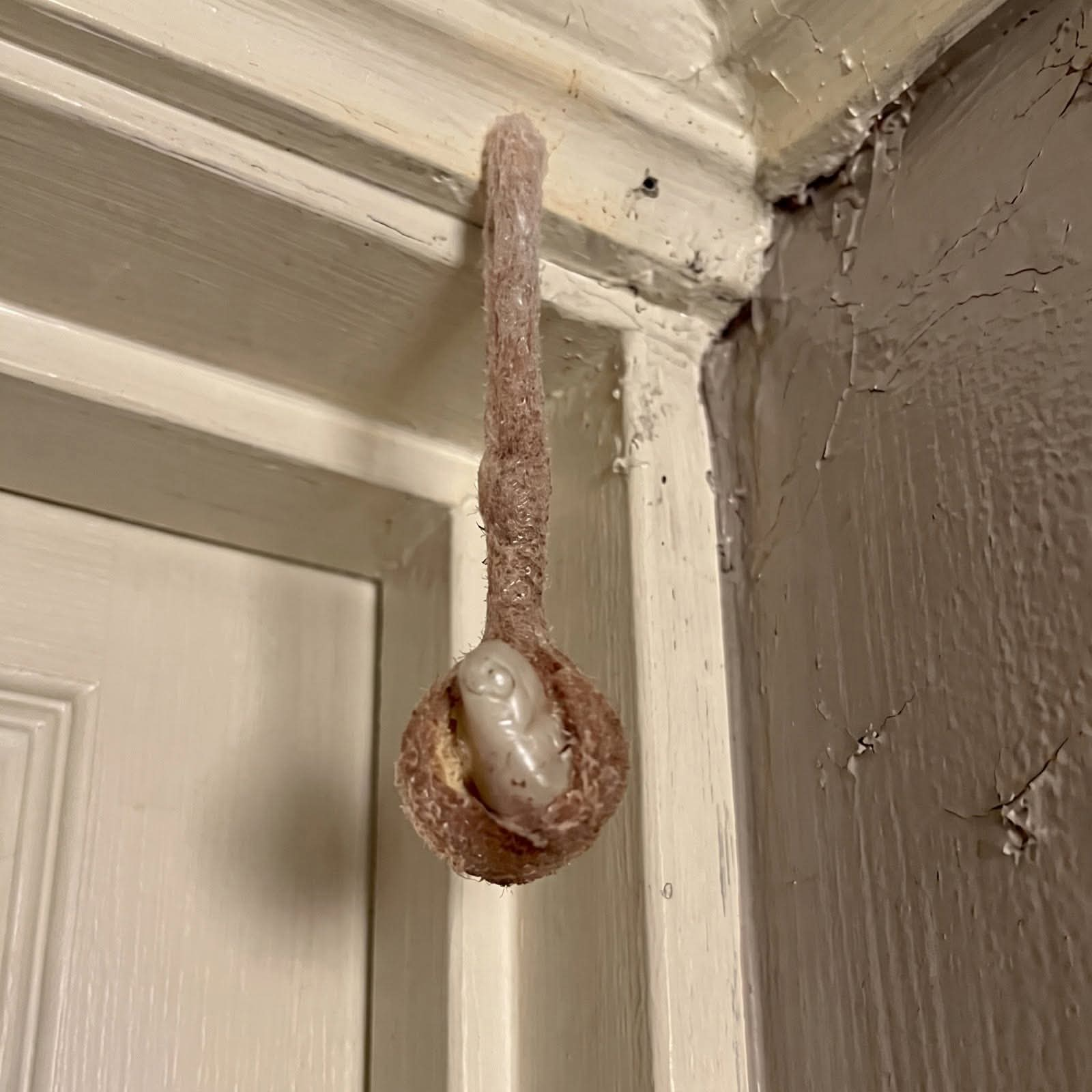
There are some moments when nature finds a way to surprise you in the most unexpected places.
A hotel room isn’t exactly where you’d expect to encounter a tiny piece of wildlife architecture. You’re thinking about unpacking your bag, settling in, finding the nearest coffee shop, or simply relaxing after a long day.
Then you notice it.
A small structure made entirely of mud, tucked quietly into a corner.
At first glance, it might look strange—or even a little unsettling. But look a little closer, and something remarkable becomes clear.
You’ve stumbled upon the work of a mud dauber wasp, one of nature’s surprisingly talented little builders.
Rather than being a reason to panic, a mud dauber nest can be a fascinating reminder that the natural world is constantly working around us, even when we’re not paying attention.
What Is a Mud Dauber Nest?
A mud dauber nest is a structure built by certain solitary wasps using—you guessed it—mud.
Unlike social wasps that build large communal nests, mud daubers generally live solitary lives. The female wasp gathers small amounts of wet mud and carries them back to a sheltered location.
She then carefully shapes the mud into individual chambers.
These chambers serve an important purpose: they’re where she places food and eventually lays her eggs.
The finished nest can look surprisingly intricate.
It’s easy to see why these insects deserve their reputation as natural architects.
A Natural Architect at Work:
A Natural Architect at Work
Think about what goes into building a mud nest.
There are no tools.
No blueprints.
No measuring tape.
No construction crew.
And yet, the wasp gathers material, transports it, places it, and shapes it into a structure designed for the next generation.
The process is small enough that we can easily overlook it.
But once you notice it, it’s difficult not to appreciate the engineering involved.
Every little tube or chamber represents a series of instinctive behaviors that help the wasp reproduce and survive.
It’s nature’s version of a tiny construction project.
Why Would a Mud Dauber Build a Nest in a Hotel Room?
Finding a mud dauber nest indoors might seem unusual, but insects are often excellent opportunists.
A hotel building can provide many of the things a mud dauber looks for in a nesting location:
Shelter from rain and wind
Protected corners and crevices
Relatively undisturbed surfaces
Nearby sources of mud
Warm or sheltered conditions
The wasp isn’t thinking, “This looks like a nice hotel.”
It’s simply responding to its environment and finding a location that seems suitable for building.
That can occasionally mean a porch, shed, garage, building exterior—or, sometimes, an unexpected indoor space.
A Fascinating Process
One of the most interesting things about a mud dauber nest is the process behind it.
The female gathers mud, often working with small amounts at a time.
She transports the mud back to the nesting location and adds it to the developing structure.
Once a chamber is formed, she provisions it with prey appropriate for her species, often paralyzed spiders or other small insects.
An egg is then laid inside, and the chamber is sealed.
The developing young eventually has everything it needs inside that tiny compartment: protection and food.
It’s an astonishingly efficient reproductive strategy.
A Glimpse Into the Natural World
We tend to think of nature as something we need to travel somewhere to see.
A forest.
A national park.
A beach.
See Continuation On Next Page 👇
